
Level:
Correct: 0
Incorrect: 0
Marks: 0/0
Exam Practice
Subject:
Topics:
Edexcel GCSE Maths (Calculator) Smart practice A mixed round aimed at your weak spots
Unit 1
Number
Unit 2
Algebra
Unit 3
Ratio, proportion and rates of change
Unit 4
Geometry and measures
Unit 5
Probability
Unit 6
Statistics
Avg
score:
–
Topics
done:
0/97

Compound units: speed, density and pressure

Practise 38 exam-style questions on Compound units: speed, density and pressure for Edexcel GCSE Maths (Calculator). Write your answer as you would in the exam and get it marked in seconds against the mark scheme, point by point, with an AI tutor on hand if you get stuck.

  • 38 questions
  • 1–5 marks each
  • Instant marking
  • No sign-up needed
20 questions, marked as you go

Sample questions with model answers

Here are 4 of the questions in this topic, each with a model answer, an explanation of why it earns the marks and the mark scheme an examiner would use.

Question 1

2 marks

A train travels 247 km in 2 hours 36 minutes.

Work out the average speed of the train in km/h.

Model answer

36 minutes = 36 ÷ 60 = 0.6 hours, so the time is 2.6 hours.
Average speed = 247 ÷ 2.6 = 95 km/h

Explanation

Average speed = total distance ÷ total time, with the time in hours for km/h. To change minutes into hours divide by 60, so 36 minutes is 0.6 hours. A common mistake is to write 2 hours 36 minutes as 2.36 hours.

Mark scheme
  1. 1 mark

    M1 for converting the time to hours, 2 hours 36 minutes = 2.6 hours, or for 247 ÷ 2.6

    oe, e.g. 247 ÷ 156 × 60

  2. 1 mark

    A1 for 95 km/h

    cao; correct answer with no working scores full marks
Question 2

3 marks

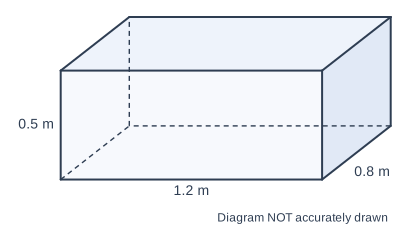
The diagram shows a solid cuboid.
The cuboid rests on a horizontal floor with one of its faces on the floor.
The cuboid exerts a force of 600 newtons on the floor.

Work out the greatest possible pressure the cuboid can exert on the floor.
Give your answer in newtons/m².

A cuboid drawn in 3D with hidden edges shown as dashed lines. The length is labelled 1.2 m (along the front bottom edge). The width (the edge going back) is labelled 0.8 m (along the bottom edge going back on the right). The height is labelled 0.5 m (along the front left vertical edge). The diagram is labelled "Diagram NOT accurately drawn".

Model answer

Pressure = force ÷ area, so the greatest pressure is when the area in contact with the floor is smallest.
Areas of the faces: 1.2 × 0.8 = 0.96 m², 1.2 × 0.5 = 0.6 m², 0.8 × 0.5 = 0.4 m²
Smallest area = 0.4 m²
Greatest pressure = 600 ÷ 0.4 = 1500 N/m²

Explanation

The force stays the same whichever face is on the floor, so the pressure is greatest when the area is smallest - pressure is inversely proportional to area. The smallest face uses the two shortest edges, 0.8 m and 0.5 m. A common mistake is to use the largest face, which gives the least pressure.

Mark scheme
  1. 1 mark

    M1 for the area of the smallest face, 0.8 × 0.5 (= 0.4 m²)

  2. 1 mark

    M1 for 600 ÷ the area of any face, e.g. 600 ÷ 0.96 (= 625), 600 ÷ 0.6 (= 1000) or 600 ÷ 0.4

  3. 1 mark

    A1 for 1500 N/m²

    cao; correct answer with no working scores full marks
Question 3

3 marks

A 750 g jar of coffee costs £4.35 in the UK.
A 1 kg jar of the same coffee costs €5.60 in France.

The exchange rate is £1 = €1.17

In which country is the coffee better value for money?
You must show your working.

Model answer

UK: price per kg = 4.35 ÷ 0.75 = £5.80
France: price per kg = €5.60 = 5.60 ÷ 1.17 = £4.786...
£4.79 per kg is less than £5.80 per kg, so the coffee is better value in France.

Explanation

You must compare the same mass in the same currency, so there are two conversions to make. To change euros into pounds, divide by 1.17 (there are more euros than pounds for the same amount of money). A common mistake is to multiply the euros by 1.17.

Mark scheme
  1. 1 mark

    M1 for a correct method to compare the same mass, e.g. 4.35 ÷ 0.75 (= £5.80 per kg) or 5.60 × 0.75 (= €4.20 for 750 g)

    oe

  2. 1 mark

    M1 for a correct currency conversion, e.g. 5.60 ÷ 1.17 (= £4.786...) or 4.35 × 1.17 (= €5.0895)

    oe

  3. 1 mark

    C1 for France, with correct comparable figures, e.g. £5.80 and £4.79 per kg, or €6.79 and €5.60 per kg, or £4.35 and £3.59 for 750 g

    accept values rounded or truncated

Question 4

5 marks

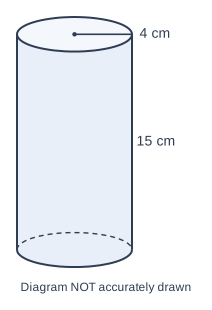
The diagram shows a solid metal cylinder standing on a horizontal table, with one of its circular faces on the table.
The cylinder has radius 4 cm and height 15 cm.
The metal has a density of 7.8 g/cm³.

The force, in newtons, that the cylinder exerts on the table is given by
force = mass in kg × 9.8

Work out the pressure the cylinder exerts on the table, in newtons/m².
Give your answer correct to 3 significant figures.

A cylinder drawn in 3D (hidden edges dashed). The radius is labelled 4 cm (on a line from the centre of the flat top face to its edge). The height is labelled 15 cm (beside the vertical side of the cylinder). The diagram is labelled "Diagram NOT accurately drawn".

Model answer

Volume = π × 4² × 15 = 753.98... cm³
Mass = 7.8 × 753.98... = 5881.06... g = 5.88106... kg
Force = 5.88106... × 9.8 = 57.634... N
Area of base = π × 4² = 50.265... cm² = 0.0050265... m²
Pressure = 57.634... ÷ 0.0050265... = 11 466 N/m²
Pressure = 11 500 N/m² (3 s.f.)

Explanation

Link the two compound units: density gives the mass from the volume, the mass gives the force, and pressure = force ÷ area of the base. The area must be in m² for N/m²: 4 cm = 0.04 m (or divide an area in cm² by 10 000). Interestingly the radius cancels out, so any cylinder of this metal and height gives the same pressure.

Mark scheme
  1. 1 mark

    P1 for the volume, π × 4² × 15 (= 753.9...)

  2. 1 mark

    P1 for the mass, 7.8 × their volume (= 5881.0... g) and converting to kg (= 5.881...)

  3. 1 mark

    P1 for the force, their mass in kg × 9.8 (= 57.6...)

  4. 1 mark

    P1 for the area of the base in m², π × 0.04² (= 0.005026...), or for their force ÷ (π × 4²) (= 1.146... N/cm²)

    oe

  5. 1 mark

    A1 for 11 500 N/m²

    awrt 11 500 (11 466); correct answer with no working scores full marks

Ready to try the rest? Every answer you write is marked against the mark scheme, so you can see exactly where the marks are.

AI Tutor Hints first, answers after you try

Hi! Stuck? Ask me for a hint and I’ll help you work it out. Once you’ve checked your answer I can explain exactly where the marks are.