
Level:
Correct: 0
Incorrect: 0
Marks: 0/0
Exam Practice
Subject:
Topics:
Edexcel GCSE Maths (Calculator) Smart practice A mixed round aimed at your weak spots
Unit 1
Number
Unit 2
Algebra
Unit 3
Ratio, proportion and rates of change
Unit 4
Geometry and measures
Unit 5
Probability
Unit 6
Statistics
Avg
score:
–
Topics
done:
0/97

Recognising and sketching graphs

Practise 28 exam-style questions on Recognising and sketching graphs for Edexcel GCSE Maths (Calculator). Write your answer as you would in the exam and get it marked in seconds against the mark scheme, point by point, with an AI tutor on hand if you get stuck.

  • 28 questions
  • 1–5 marks each
  • Instant marking
  • No sign-up needed
20 questions, marked as you go

Sample questions with model answers

Here are 4 of the questions in this topic, each with a model answer, an explanation of why it earns the marks and the mark scheme an examiner would use.

Question 1

2 marks

The diagram shows a sketch of a curve.
The curve crosses the x-axis at the points (−1, 0) and (3, 0).

Jess says, "The equation of the curve is \(y = x^2 - 2x - 3\)."

Give two reasons why Jess is wrong.
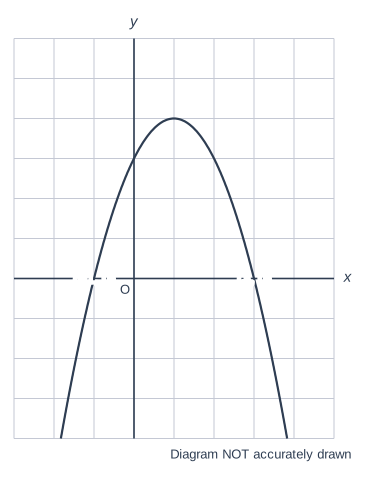
A sketch on a pair of axes (x across, y up) with no scale marked, the axes crossing at the origin O. It is marked "Diagram NOT accurately drawn". The curve is an upside-down U-shaped (∩-shaped) parabola: it meets the x-axis twice; these points cannot be read off, as the sketch has no scale; it crosses the y-axis at a point that cannot be read off, as the sketch has no scale; it has a maximum point, which cannot be read off, as the sketch has no scale. The point (−1, 0) is labelled "(−1, 0)". The point (3, 0) is labelled "(3, 0)".

Model answer

\(y = x^2 - 2x - 3 = (x + 1)(x - 3)\) does cross the x-axis at −1 and 3, but:
1. The coefficient of \(x^2\) is positive, so its graph is U-shaped with a minimum point. The sketch is ∩-shaped with a maximum point.
2. When x = 0, \(y = -3\), so it crosses the y-axis below the origin. The sketch crosses the y-axis above the origin.

Explanation

A quadratic \(y = ax^2 + bx + c\) is U-shaped when a is positive and ∩-shaped when a is negative, and it crosses the y-axis at (0, c). The roots alone do not fix a quadratic: \(y = 3 + 2x - x^2\) has the same roots as Jess's equation but the opposite shape. Always check the shape and the y-intercept as well as the roots.

Mark scheme
  1. 1 mark

    C1 for a reason based on the shape, e.g. the curve is ∩-shaped (has a maximum point) but \(y = x^2 - 2x - 3\) has a positive \(x^2\) term so it would be U-shaped

    oe; correct answer with no working scores full marks

  2. 1 mark

    C1 for a reason based on the y-intercept, e.g. \(y = x^2 - 2x - 3\) crosses the y-axis at (0, −3), below the origin, but the curve in the sketch crosses the y-axis above the origin

    oe; do not accept a reason about the x-intercepts, as \(x^2 - 2x - 3 = (x + 1)(x - 3)\) has the same roots
Question 2

2 marks

Lena is solving cos x = 0.25 for 0 ≤ x ≤ 360.
Here is her working.

\(x = \cos^{-1}(0.25) = 75.5^\circ\)
x = 180 − 75.5 = 104.5°

What mistake has Lena made?
Write down the correct solutions.

Model answer

Lena used 180 − 75.5, which gives the second solution for sine, not cosine. cos 104.5° = −0.25.
The cosine graph is symmetrical about x = 180, so the second solution is 360 − 75.522... = 284.477...
x = 75.5° or x = 284.5°

Explanation

The graph of y = cos x is symmetrical about x = 0 and x = 180, so cos x = cos(360° − x). The rule "180 minus" belongs to sine. Checking each answer by substituting it back into cos x would have shown Lena that 104.5° gives a negative value.

Mark scheme
  1. 1 mark

    C1 for explaining the mistake, e.g. she has used 180 − x, which is the symmetry of the sine graph, instead of 360 − x for the cosine graph

    oe, e.g. cos 104.5° is negative (−0.25), not 0.25

  2. 1 mark

    B1 for 75.5° and 284.5°

    awrt 75.5 and 284.5

Question 3

3 marks

The point (4, 39.0625) lies on the curve \(y = k^x\), where k is a positive constant.

Work out the value of y when x = −2.

Model answer

\(k^4 = 39.0625\)
\(k = \sqrt[4]{39.0625} = 2.5\)
When x = −2: \(y = 2.5^{-2} = \dfrac{1}{2.5^2} = \dfrac{1}{6.25} = 0.16\)

Explanation

Substitute the point into \(y = k^x\) to get an equation for k, then take the fourth root (on a calculator, \(39.0625^{\frac{1}{4}}\) or the \(\sqrt[x]{\ }\) key). A negative index means a reciprocal: \(k^{-2} = \dfrac{1}{k^2}\), so the answer is small but positive. Exponential graphs \(y = k^x\) never go below the x-axis.

Mark scheme
  1. 1 mark

    M1 for \(k^4 = 39.0625\)

    or \(k = \sqrt[4]{39.0625}\); correct answer with no working scores full marks

  2. 1 mark

    A1 for k = 2.5

    cao

  3. 1 mark

    A1 for 0.16

    exact; oe, e.g. \(\dfrac{4}{25}\); ft their k for \(\dfrac{1}{k^2}\)

Question 4

4 marks

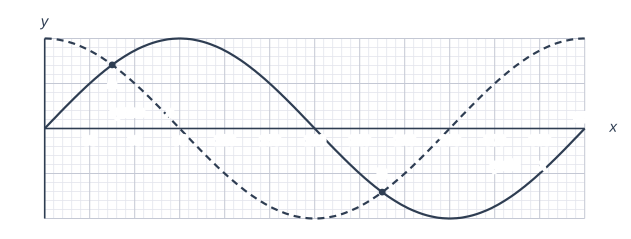
The diagram shows the graphs of y = sin x and y = cos x for 0 ≤ x ≤ 360.
The graphs intersect at the points A and B.

Find the coordinates of A and of B.
Give the y-coordinates correct to 3 significant figures.

A coordinate grid with x from 0 to 360 and y from −1 to 1; the x-axis is marked every 30 and the y-axis every 0.5 (with 5 small squares along each side of a large square), and the axes cross at the origin O. The curve labelled "y = sin x" is a sine curve (a smooth repeating wave): it crosses the x-axis at (0, 0), (180, 0) and (360, 0); it has a maximum point at (90, 1) and a minimum point at (270, −1). The curve labelled "y = cos x" is a cosine curve (a smooth repeating wave): it crosses the x-axis at (90, 0) and (270, 0); it crosses the y-axis at (0, 1); it has a minimum point at (180, −1). The curve labelled "y = sin x" and the curve labelled "y = cos x" cross at 2 points, which can be read from the grid. Point A is marked with a dot; its coordinates can be read from the grid. Point B is marked with a dot; its coordinates can be read from the grid.

Model answer

At an intersection, sin x = cos x. From the graph the first crossing is between 0 and 90, where the rising sine curve meets the falling cosine curve halfway: x = 45.
Check: sin 45° = 0.7071... and cos 45° = 0.7071... ✓
Both graphs repeat with the same pattern shifted 180° and turned upside down, so the next crossing is at 45 + 180 = 225.
sin 225° = cos 225° = −0.7071...
A(45, 0.707) and B(225, −0.707)

Explanation

At a point of intersection both graphs have the same y-value, so sin x = cos x. The cosine graph is the sine graph shifted 90° to the left, so they cross midway between 0° and 90°, at 45°, and again 180° later. Give the y-coordinates by substituting into either function: they have opposite signs.

Mark scheme
  1. 1 mark

    M1 for a correct method to find an x-coordinate, e.g. sin x = cos x so tan x = 1, or using the symmetry of the graphs, or reading x ≈ 45 from the graph and checking sin 45° = cos 45°

    correct answer with no working scores full marks

  2. 1 mark

    A1 for x = 45 at A

  3. 1 mark

    A1 for x = 225 at B

  4. 1 mark

    A1 for A(45, 0.707) and B(225, −0.707)

    awrt 0.707 and −0.707

Ready to try the rest? Every answer you write is marked against the mark scheme, so you can see exactly where the marks are.

AI Tutor Hints first, answers after you try

Hi! Stuck? Ask me for a hint and I’ll help you work it out. Once you’ve checked your answer I can explain exactly where the marks are.