
Level:
Correct: 0
Incorrect: 0
Marks: 0/0
Exam Practice
Subject:
Topics:
Edexcel GCSE Maths (Calculator) Smart practice A mixed round aimed at your weak spots
Unit 1
Number
Unit 2
Algebra
Unit 3
Ratio, proportion and rates of change
Unit 4
Geometry and measures
Unit 5
Probability
Unit 6
Statistics
Avg
score:
–
Topics
done:
0/97

Circles, surface area and volume of solids

Practise 36 exam-style questions on Circles, surface area and volume of solids for Edexcel GCSE Maths (Calculator). Write your answer as you would in the exam and get it marked in seconds against the mark scheme, point by point, with an AI tutor on hand if you get stuck.

  • 36 questions
  • 1–5 marks each
  • Instant marking
  • No sign-up needed
20 questions, marked as you go

Sample questions with model answers

Here are 4 of the questions in this topic, each with a model answer, an explanation of why it earns the marks and the mark scheme an examiner would use.

Question 1

2 marks

The circumference of a circle is 50 cm.

Work out the radius of the circle.
Give your answer correct to 3 significant figures.

Model answer

\(2\pi r = 50\)
\(r = \dfrac{50}{2\pi} = 7.957...\)
7.96 cm (3 s.f.)

Explanation

Write the circumference formula as an equation and rearrange: divide 50 by \(2\pi\). Dividing by π alone gives the diameter, 15.9 cm, so remember to halve it.

Mark scheme
  1. 1 mark

    M1 for \(2\pi r = 50\) or \(r = \dfrac{50}{2\pi}\)

    or d = 50 ÷ π (= 15.9...)

  2. 1 mark

    A1 for 7.96 cm

    awrt 7.96 (7.957...); correct answer with no working scores full marks
Question 2

3 marks

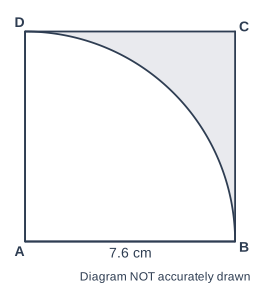
The diagram shows a square ABCD with sides of length 7.6 cm.
A quarter circle with centre A and radius 7.6 cm is drawn inside the square.
The region inside the square but outside the quarter circle is shaded.

Work out the area of the shaded region.
Give your answer correct to 3 significant figures.

Geometry diagram, marked "Diagram NOT accurately drawn". Square ABCD (shaded). A white sector with centre A, bounded by the radii AB and AD and the minor arc from B to D. Side AB is labelled 7.6 cm.

Model answer

Area of square \(= 7.6^2 = 57.76\) cm²
Area of quarter circle \(= \frac{1}{4} \times \pi \times 7.6^2 = 45.364...\) cm²
Shaded area \(= 57.76 - 45.364... = 12.395...\)
12.4 cm² (3 s.f.)

Explanation

The shaded region is what is left of the square when the quarter circle is removed, so subtract. A quarter circle has one quarter of the area of the full circle with the same radius.

Mark scheme
  1. 1 mark

    M1 for the area of the quarter circle, \(\frac{1}{4} \times \pi \times 7.6^2\) (= 45.3...)

  2. 1 mark

    M1 for \(7.6^2 - \frac{1}{4} \times \pi \times 7.6^2\)

  3. 1 mark

    A1 for 12.4 cm²

    awrt 12.4 (12.39...); correct answer with no working scores full marks
Question 3

4 marks

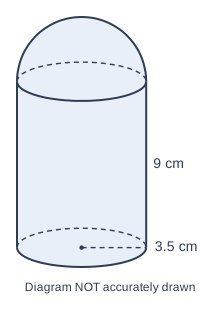
The diagram shows a solid made from a cylinder and a hemisphere.
The cylinder has radius 3.5 cm and height 9 cm.
The hemisphere has radius 3.5 cm.

The solid is made of wood with a density of 0.72 g/cm³.

Volume of a sphere \(= \frac{4}{3}\pi r^3\)

Work out the mass of the solid.
Give your answer correct to 3 significant figures.

A solid made from a cylinder with a hemisphere on top, drawn in 3D (hidden edges dashed). The radius (of the cylinder and the hemisphere) is labelled 3.5 cm (on a dashed line from the centre of the base to its edge). The height of the cylinder is labelled 9 cm (beside the vertical side of the cylinder). The diagram is labelled "Diagram NOT accurately drawn".

Model answer

Cylinder: \(\pi \times 3.5^2 \times 9 = 110.25\pi = 346.36...\) cm³
Hemisphere: \(\frac{1}{2} \times \frac{4}{3} \times \pi \times 3.5^3 = 89.79...\) cm³
Total volume \(= 346.36... + 89.79... = 436.15...\) cm³
Mass \(= 436.15... \times 0.72 = 314.03...\)
314 g (3 s.f.)

Explanation

Find the volume of each part separately and add them. A hemisphere is half a sphere, so halve the sphere formula. Then mass = density × volume; the density is in g/cm³, so the mass is in grams.

Mark scheme
  1. 1 mark

    M1 for the volume of the cylinder, \(\pi \times 3.5^2 \times 9\) (= 346.3...)

  2. 1 mark

    M1 for the volume of the hemisphere, \(\frac{1}{2} \times \frac{4}{3} \times \pi \times 3.5^3\) (= 89.7...)

  3. 1 mark

    M1 for (their 346.3... + their 89.7...) \(\times 0.72\)

    total volume 436.1...

  4. 1 mark

    A1 for 314 g

    awrt 314 (314.0...); correct answer with no working scores full marks
Question 4

5 marks

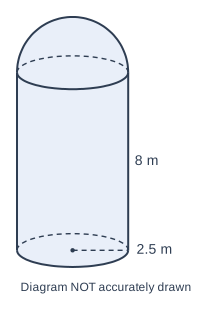
The diagram shows a grain silo.
The silo is a cylinder with a hemisphere on top.
The cylinder has radius 2.5 m and height 8 m. The hemisphere has radius 2.5 m.

The curved surface of the cylinder and the curved surface of the hemisphere are to be painted. The base is not painted.

Surface area of a sphere \(= 4\pi r^2\)

One litre of paint covers 12 m².
Paint is sold in 5-litre tins costing £32.99 each.

Work out the cost of the paint needed.

A solid made from a cylinder with a hemisphere on top, drawn in 3D (hidden edges dashed). The radius (of the cylinder and the hemisphere) is labelled 2.5 m (on a dashed line from the centre of the base to its edge). The height of the cylinder is labelled 8 m (beside the vertical side of the cylinder). The diagram is labelled "Diagram NOT accurately drawn".

Model answer

Curved surface of cylinder \(= 2\pi r h = 2 \times \pi \times 2.5 \times 8 = 40\pi = 125.66...\) m²
Curved surface of hemisphere \(= \frac{1}{2} \times 4 \times \pi \times 2.5^2 = 12.5\pi = 39.26...\) m²
Total \(= 52.5\pi = 164.93...\) m²
Paint needed \(= 164.93... \div 12 = 13.74...\) litres
3 tins give 15 litres (2 tins give only 10 litres), so 3 tins are needed.
Cost \(= 3 \times 32.99 = 98.97\)
£98.97

Explanation

Only the surfaces being painted count: the curved side of the cylinder (the circumference × height) and the curved half of a sphere. Do not include the base, or the circle where the hemisphere joins the cylinder, because neither is on the outside. Round the number of tins up.

Mark scheme
  1. 1 mark

    P1 for the curved surface of the cylinder, \(2 \times \pi \times 2.5 \times 8\) (= 125.6...)

  2. 1 mark

    P1 for the curved surface of the hemisphere, \(\frac{1}{2} \times 4 \times \pi \times 2.5^2\) (= 39.2...)

  3. 1 mark

    P1 for the total area \(\div 12\) (= 13.7... litres)

    total area 164.9... m²

  4. 1 mark

    P1 for 3 tins

  5. 1 mark

    A1 for £98.97

    cao; correct answer with no working scores full marks

Ready to try the rest? Every answer you write is marked against the mark scheme, so you can see exactly where the marks are.

AI Tutor Hints first, answers after you try

Hi! Stuck? Ask me for a hint and I’ll help you work it out. Once you’ve checked your answer I can explain exactly where the marks are.