
Level:
Correct: 0
Incorrect: 0
Marks: 0/0
Exam Practice
Subject:
Topics:
Edexcel GCSE Maths (Calculator) Smart practice A mixed round aimed at your weak spots
Unit 1
Number
Unit 2
Algebra
Unit 3
Ratio, proportion and rates of change
Unit 4
Geometry and measures
Unit 5
Probability
Unit 6
Statistics
Avg
score:
–
Topics
done:
0/97

Properties of quadrilaterals and triangles

Practise 28 exam-style questions on Properties of quadrilaterals and triangles for Edexcel GCSE Maths (Calculator). Write your answer as you would in the exam and get it marked in seconds against the mark scheme, point by point, with an AI tutor on hand if you get stuck.

  • 28 questions
  • 1–5 marks each
  • Instant marking
  • No sign-up needed
20 questions, marked as you go

Sample questions with model answers

Here are 4 of the questions in this topic, each with a model answer, an explanation of why it earns the marks and the mark scheme an examiner would use.

Question 1

2 marks

A triangle has two angles of 34.7° and 110.6°.

Write down the mathematical name for this type of triangle.
Give a reason for your answer.

Model answer

Third angle = 180° − 34.7° − 110.6° = 34.7°
Two angles are equal (34.7° and 34.7°), so the triangle is isosceles.
One angle (110.6°) is obtuse, so it is an obtuse-angled isosceles triangle.

Explanation

Use the angle sum of a triangle (180°) to find the missing angle. A triangle with two equal angles is isosceles (the two sides opposite those angles are equal). The 110.6° angle also makes it obtuse-angled, but "isosceles" is the key name.

Mark scheme
  1. 1 mark

    B1 for finding the third angle: 180 − 34.7 − 110.6 = 34.7°

    cao

  2. 1 mark

    C1 for isosceles (obtuse-angled) triangle, with the reason that two of its angles are equal (34.7° and 34.7°)

    accept isosceles on its own with a correct reason; do not accept "obtuse" alone
Question 2

3 marks

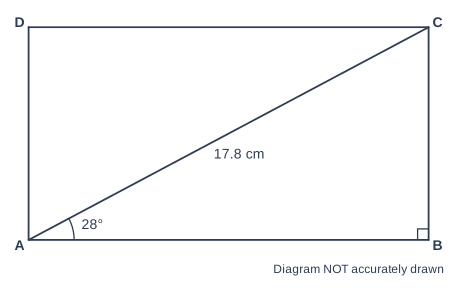
The diagram shows a rectangle ABCD.
The diagonal AC = 17.8 cm and angle CAB = 28°.

Work out the perimeter of the rectangle.
Give your answer correct to 3 significant figures.

Geometry diagram, marked "Diagram NOT accurately drawn". Rectangle ABCD. Line segment AC is drawn. AC is labelled 17.8 cm. Angle CAB is marked 28°. Angle ABC is marked as a right angle (90°).

Model answer

Angle ABC = 90° (rectangle), so triangle ABC is right-angled with hypotenuse AC.
\(AB = 17.8 \cos 28^\circ = 15.716...\) cm
\(BC = 17.8 \sin 28^\circ = 8.3565...\) cm
Perimeter = \(2 \times (15.716... + 8.3565...) = 48.146...\)
Perimeter = 48.1 cm (3 s.f.)

Explanation

Every angle of a rectangle is 90°, so the diagonal splits it into two right-angled triangles and you can use SOHCAHTOA. The perimeter needs each side twice, because opposite sides of a rectangle are equal. A common slip is to add just AB and BC.

Mark scheme
  1. 1 mark

    M1 for \(AB = 17.8 \cos 28^\circ\) (= 15.71...) or \(BC = 17.8 \sin 28^\circ\) (= 8.356...)

    oe, e.g. using tan once one side is known

  2. 1 mark

    M1 for finding both sides and a correct method for the perimeter, e.g. \(2 \times (15.71... + 8.356...)\)

  3. 1 mark

    A1 for 48.1 cm

    awrt 48.1 (48.146...); correct answer with no working scores full marks

Question 3

3 marks

P is the point (−3, 2), Q is the point (2, 4), R is the point (5, −1) and S is the point (0, −3).

What type of quadrilateral is PQRS?
Give reasons for your answer.

Model answer

Gradient PQ = \(\frac{4 - 2}{2 - (-3)} = \frac{2}{5}\), gradient SR = \(\frac{-1 - (-3)}{5 - 0} = \frac{2}{5}\)
Gradient QR = \(\frac{-1 - 4}{5 - 2} = -\frac{5}{3}\), gradient PS = \(\frac{-3 - 2}{0 - (-3)} = -\frac{5}{3}\)
Both pairs of opposite sides are parallel, so PQRS is a parallelogram.
\(\frac{2}{5} \times -\frac{5}{3} = -\frac{2}{3}\) ≠ −1, so there are no right angles: not a rectangle or square.
\(PQ = \sqrt{5^2 + 2^2} = \sqrt{29}\), \(QR = \sqrt{3^2 + 5^2} = \sqrt{34}\), so the sides are not all equal: not a rhombus.
PQRS is a parallelogram.

Explanation

Parallel lines have equal gradients, so equal gradients on opposite sides prove a parallelogram. To decide whether it is a more special shape, test for right angles (gradients multiply to −1) and for equal adjacent sides (Pythagoras).

Mark scheme
  1. 1 mark

    M1 for finding the gradients of opposite sides, e.g. PQ and SR both \(\frac{2}{5}\), QR and PS both \(-\frac{5}{3}\)

    oe, e.g. showing PQ and SR are both the translation \(\begin{pmatrix}5\\2\end{pmatrix}\)

  2. 1 mark

    M1 for a correct check that it is not a rectangle or rhombus, e.g. \(PQ = \sqrt{29}\) and \(QR = \sqrt{34}\), or \(\frac{2}{5} \times -\frac{5}{3} = -\frac{2}{3}\)

  3. 1 mark

    C1 for parallelogram, with reasons: both pairs of opposite sides are parallel, and adjacent sides are neither equal nor perpendicular

    must have both checks for full reasoning

Question 4

4 marks

ABCD is a parallelogram.
A is the point (1, 2), B is the point (7, 4) and D is the point (3, 7).

Work out the area of the parallelogram ABCD.

Model answer

Opposite sides of a parallelogram are equal and parallel, so C = B + (D − A) = (7 + 2, 4 + 5) = (9, 9).
Enclose ABCD in the rectangle from x = 1 to 9 and y = 2 to 9: area = 8 × 7 = 56.
Outside ABCD: two triangles \(\frac{1}{2} \times 6 \times 2 = 6\), two triangles \(\frac{1}{2} \times 2 \times 5 = 5\) and two rectangles 2 × 2 = 4.
Area = 56 − 6 − 6 − 5 − 5 − 4 − 4 = 26 square units.
(Or: AB = \(\sqrt{40}\), AD = \(\sqrt{29}\), angle DAB = 68.198...° − 18.434...° = 49.763...°, area = \(\sqrt{40} \times \sqrt{29} \times \sin 49.763...^\circ = 26\))

Explanation

Use the property that opposite sides are equal and parallel to find C: moving from A to D is the same as moving from B to C. Then either subtract the corner pieces from an enclosing rectangle, or use area = ab sin C with the angle between AB and AD found from the gradients.

Mark scheme
  1. 1 mark

    P1 for a correct start, e.g. C = (9, 9), or \(AB = \sqrt{40}\) and \(AD = \sqrt{29}\), or a correct enclosing rectangle 8 by 7

    correct answer with no working scores full marks

  2. 1 mark

    P1 for a correct next step, e.g. angle DAB = 49.76...° (\(\tan^{-1}\frac{5}{2} - \tan^{-1}\frac{2}{6}\)), or the areas of the parts outside ABCD (triangles 6, 6, 5, 5 and rectangles 4, 4)

  3. 1 mark

    P1 for a complete method, e.g. \(\sqrt{40} \times \sqrt{29} \times \sin 49.76...^\circ\) or 56 − 6 − 6 − 5 − 5 − 4 − 4

  4. 1 mark

    A1 for 26 (square units)

    accept 25.9 to 26.1 from trigonometry

Ready to try the rest? Every answer you write is marked against the mark scheme, so you can see exactly where the marks are.

AI Tutor Hints first, answers after you try

Hi! Stuck? Ask me for a hint and I’ll help you work it out. Once you’ve checked your answer I can explain exactly where the marks are.