
Level:
Correct: 0
Incorrect: 0
Marks: 0/0
Exam Practice
Subject:
Topics:
Edexcel GCSE Maths (Calculator) Smart practice A mixed round aimed at your weak spots
Unit 1
Number
Unit 2
Algebra
Unit 3
Ratio, proportion and rates of change
Unit 4
Geometry and measures
Unit 5
Probability
Unit 6
Statistics
Avg
score:
–
Topics
done:
0/97

Systematic listing and the product rule

Practise 28 exam-style questions on Systematic listing and the product rule for Edexcel GCSE Maths (Calculator). Write your answer as you would in the exam and get it marked in seconds against the mark scheme, point by point, with an AI tutor on hand if you get stuck.

  • 28 questions
  • 1–5 marks each
  • Instant marking
  • No sign-up needed
20 questions, marked as you go

Sample questions with model answers

Here are 4 of the questions in this topic, each with a model answer, an explanation of why it earns the marks and the mark scheme an examiner would use.

Question 1

2 marks

Here are four cards.

2 5 7 8

Kai uses two of the cards to make a two-digit number.

List all the odd numbers that Kai can make.

Model answer

An odd number must end in 5 or 7.
Ending in 5: 25, 75, 85
Ending in 7: 27, 57, 87
The odd numbers are 25, 27, 57, 75, 85, 87

Explanation

List systematically so you do not miss any: fix the last digit (it must be odd, so 5 or 7), then try each of the other cards as the first digit. Each card can only be used once, so 55 and 77 are not possible.

Mark scheme
  1. 2 marks

    B2 for 25, 27, 57, 75, 85, 87 and no others

    B1 for at least four correct numbers with no more than one incorrect number
Question 2

3 marks

There are 3 roads from town A to town B and 4 roads from town B to town C.
There are also 2 roads from town A directly to town C, which do not pass through town B.
There are 5 roads from town C to town D.

Sam drives from town A to town D, passing through town C.
He does not visit any town more than once.

How many different routes can Sam take?

Model answer

A to C through B: \(3 \times 4 = 12\) routes
A to C directly: 2 routes
A to C altogether: \(12 + 2 = 14\) routes
A to D: \(14 \times 5 = 70\) routes

Explanation

Multiply when one choice follows another (A to B, then B to C), and add when there are separate alternatives (through B or direct). Every route from A to C can be followed by any of the 5 roads to D, so multiply the 14 routes by 5.

Mark scheme
  1. 1 mark

    M1 for \(3 \times 4\) (= 12 routes from A to C through B)

    correct answer with no working scores full marks

  2. 1 mark

    M1 for (their 12 + 2) × 5

  3. 1 mark

    A1 for 70

    cao

Question 3

3 marks

Find all the four-digit numbers whose digits add up to 3

You must list the numbers in a systematic way.

Model answer

The first digit cannot be 0, so it is 1, 2 or 3.
First digit 3: 3000
First digit 2 (the other digits add to 1): 2100, 2010, 2001
First digit 1 (the other digits add to 2): 1200, 1020, 1002, 1110, 1101, 1011
That gives 10 numbers: 1002, 1011, 1020, 1101, 1110, 1200, 2001, 2010, 2100, 3000

Explanation

Fix the first digit (it cannot be 0 for a four-digit number), then share out what is left of the total of 3 between the other three digits in an organised order. Working from the largest first digit down makes it easy to see when you have them all.

Mark scheme
  1. 3 marks

    B3 for all ten numbers and no others: 1002, 1011, 1020, 1101, 1110, 1200, 2001, 2010, 2100, 3000

    B2 for at least seven correct with no more than one incorrect; B1 for at least four correct

Question 4

5 marks

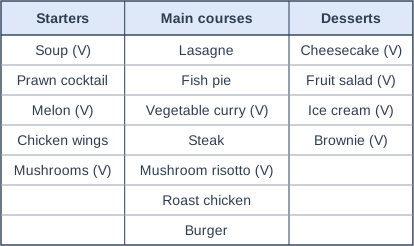
The table shows the menu in a restaurant.
(V) means the dish is vegetarian.

Ella is vegetarian. She chooses a starter, a main course and a dessert that are all vegetarian.
Tom chooses any starter, any main course and any dessert.

The restaurant says,
"Ella and Tom could choose more than 3000 different combinations of meals."

Is the restaurant correct?
You must show how you get your answer.

Table with columns "Starters", "Main courses", "Desserts". Starters: Soup (V); Main courses: Lasagne; Desserts: Cheesecake (V) | Starters: Prawn cocktail; Main courses: Fish pie; Desserts: Fruit salad (V) | Starters: Melon (V); Main courses: Vegetable curry (V); Desserts: Ice cream (V) | Starters: Chicken wings; Main courses: Steak; Desserts: Brownie (V) | Starters: Mushrooms (V); Main courses: Mushroom risotto (V); Desserts:  | Starters: ; Main courses: Roast chicken; Desserts:  | Starters: ; Main courses: Burger; Desserts: .

Model answer

Ella: vegetarian starters 3, vegetarian main courses 2, desserts 4 (all vegetarian)
\(3 \times 2 \times 4 = 24\) meals
Tom: \(5 \times 7 \times 4 = 140\) meals
Combinations for the two of them: \(24 \times 140 = 3360\)
3360 > 3000, so the restaurant is correct.

Explanation

Count each person's meals with the product rule, using only the vegetarian dishes for Ella. Every one of Ella's 24 meals can go with every one of Tom's 140 meals, so multiply again. Adding 24 + 140 is a common mistake.

Mark scheme
  1. 1 mark

    P1 for Ella's number of meals, \(3 \times 2 \times 4\) (= 24)

  2. 1 mark

    P1 for Tom's number of meals, \(5 \times 7 \times 4\) (= 140)

  3. 1 mark

    P1 for multiplying their numbers of meals for Ella and Tom

  4. 1 mark

    A1 for 3360

    cao

  5. 1 mark

    C1 for Yes, with 3360 > 3000

    dependent on P1 P1 P1

Ready to try the rest? Every answer you write is marked against the mark scheme, so you can see exactly where the marks are.

AI Tutor Hints first, answers after you try

Hi! Stuck? Ask me for a hint and I’ll help you work it out. Once you’ve checked your answer I can explain exactly where the marks are.