
Level:
Correct: 0
Incorrect: 0
Marks: 0/0
Exam Practice
Subject:
Topics:
Edexcel GCSE Maths (Calculator) Smart practice A mixed round aimed at your weak spots
Unit 1
Number
Unit 2
Algebra
Unit 3
Ratio, proportion and rates of change
Unit 4
Geometry and measures
Unit 5
Probability
Unit 6
Statistics
Avg
score:
–
Topics
done:
0/97

Similarity: lengths, areas and volumes

Practise 38 exam-style questions on Similarity: lengths, areas and volumes for Edexcel GCSE Maths (Calculator). Write your answer as you would in the exam and get it marked in seconds against the mark scheme, point by point, with an AI tutor on hand if you get stuck.

  • 38 questions
  • 1–5 marks each
  • Instant marking
  • No sign-up needed
20 questions, marked as you go

Sample questions with model answers

Here are 4 of the questions in this topic, each with a model answer, an explanation of why it earns the marks and the mark scheme an examiner would use.

Question 1

2 marks

The diagram shows triangle ABC.
D is the point on AB and E is the point on AC such that DE is parallel to BC.

AD = 5.6 cm, DB = 3.5 cm and DE = 7.2 cm.

Work out the length of BC.
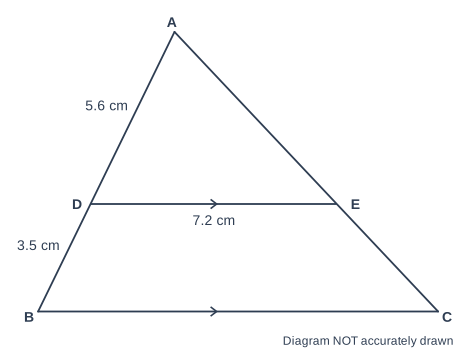
Geometry diagram, marked "Diagram NOT accurately drawn". Triangle ABC. Line segment DE is drawn. D lies on side AB. E lies on side AC. Side AD is labelled 5.6 cm. Side DB is labelled 3.5 cm. DE is labelled 7.2 cm. DE and BC are each marked with an arrowhead (parallel lines).

Model answer

\(AB = 5.6 + 3.5 = 9.1\) cm
Triangles ADE and ABC are similar, with scale factor \(9.1 \div 5.6 = 1.625\)
\(BC = 7.2 \times 1.625 = 11.7\) cm

Explanation

Because DE is parallel to BC, triangle ADE is similar to triangle ABC (corresponding angles are equal and the angle at A is shared). The scale factor compares whole sides: AB with AD, not DB with AD. A common mistake is to use \(3.5 \div 5.6\) or to add 3.5 to DE.

Mark scheme
  1. 1 mark

    M1 for a correct scale factor, e.g. \((5.6 + 3.5) \div 5.6\) (= 1.625), or a correct equation, e.g. \(\dfrac{BC}{7.2} = \dfrac{9.1}{5.6}\)

    oe; \(AB = 9.1\) must be used, not 3.5

  2. 1 mark

    A1 for 11.7 cm

    cao; correct answer with no working scores full marks
Question 2

3 marks

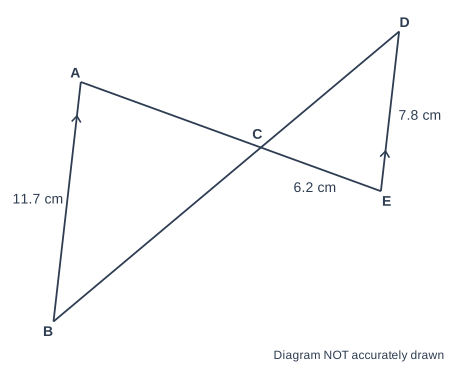
In the diagram, the straight lines AE and BD cross at C.
AB is parallel to DE.

AB = 11.7 cm, DE = 7.8 cm and CE = 6.2 cm.

Work out the length of AE.

Geometry diagram, marked "Diagram NOT accurately drawn". Line segments AB, DE, AE and BD are drawn. C lies on AE and BD. AB is labelled 11.7 cm. DE is labelled 7.8 cm. CE is labelled 6.2 cm. AB and DE are each marked with an arrowhead (parallel lines).

Model answer

Triangles ABC and EDC are similar (alternate angles are equal and the angles at C are vertically opposite).
Scale factor from triangle EDC to triangle ABC \(= 11.7 \div 7.8 = 1.5\)
AC corresponds to EC, so \(AC = 6.2 \times 1.5 = 9.3\) cm
\(AE = AC + CE = 9.3 + 6.2 = 15.5\) cm

Explanation

Parallel lines give equal alternate angles, and the angles at C are vertically opposite, so the two triangles are similar. Match the sides carefully: AC lies opposite B in one triangle, and EC lies opposite D in the other. A common mistake is to stop at AC = 9.3 cm and forget to add CE.

Mark scheme
  1. 1 mark

    M1 for a correct scale factor, e.g. \(11.7 \div 7.8\) (= 1.5) or \(7.8 \div 11.7\) (= \(\frac{2}{3}\))

    oe

  2. 1 mark

    M1 for \(AC = 9.3\) or \(6.2 \times 1.5\)

    oe

  3. 1 mark

    A1 for 15.5 cm

    cao; correct answer with no working scores full marks
Question 3

3 marks

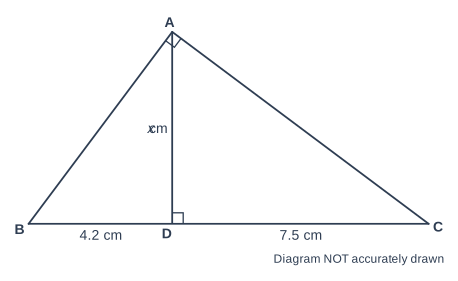
The diagram shows triangle ABC.
Angle BAC = 90°.
D is the point on BC such that AD is perpendicular to BC.

BD = 4.2 cm, DC = 7.5 cm and AD = x cm.

Triangle ABD is similar to triangle CAD.

Work out the value of x.
Give your answer correct to 3 significant figures.

Geometry diagram, marked "Diagram NOT accurately drawn". Triangle ABC. Line segment AD is drawn. D lies on side BC. Angle BAC is marked as a right angle (90°). Angle ADC is marked as a right angle (90°). Side BD is labelled 4.2 cm. Side DC is labelled 7.5 cm. AD is labelled x cm.

Model answer

Triangles ABD and CAD are similar, so corresponding sides are in the same ratio:
\(\dfrac{AD}{BD} = \dfrac{CD}{AD}\)
\(\dfrac{x}{4.2} = \dfrac{7.5}{x}\)
\(x^2 = 4.2 \times 7.5 = 31.5\)
\(x = \sqrt{31.5} = 5.6124...\)
\(x = 5.61\) (3 s.f.)

Explanation

In triangle ABD the side AD is opposite angle B, and BD is next to it; in triangle CAD the side CD is opposite the angle at A that equals angle B, and AD is next to it. Matching these gives \(\frac{x}{4.2} = \frac{7.5}{x}\). A common mistake is to pair the sides the wrong way round, giving \(\frac{x}{4.2} = \frac{x}{7.5}\), which has no solution.

Mark scheme
  1. 1 mark

    M1 for a correct equation from the similar triangles, e.g. \(\dfrac{x}{4.2} = \dfrac{7.5}{x}\)

    oe; or any other complete correct method, e.g. using tan B × tan C = 1

  2. 1 mark

    M1 for \(x^2 = 31.5\)

    oe, e.g. \(x = \sqrt{4.2 \times 7.5}\)

  3. 1 mark

    A1 for 5.61

    awrt 5.61 (5.6124...); correct answer with no working scores full marks

Question 4

4 marks

A container is a hollow cone of height 40 cm.
It is held with its vertex at the bottom and its axis vertical.

Water flows into the empty container at a constant rate.
After 2.5 minutes the depth of the water is 15 cm.

How much longer will it take for the container to be full?
Give your answer in minutes, correct to 1 decimal place.

Model answer

The water forms a cone similar to the container, with length scale factor \(15 \div 40 = 0.375\)
Volume scale factor \(= 0.375^3 = 0.052734...\)
So 2.5 minutes fills 0.052734... of the container.
Time to fill the whole container \(= 2.5 \div 0.052734... = 47.407...\) minutes
Extra time \(= 47.407... - 2.5 = 44.907...\)
Answer: 44.9 minutes (1 d.p.)

Explanation

Because the water flows at a constant rate, time is proportional to volume. The water at depth 15 cm is a cone similar to the full container, so its volume is \(\left(\frac{15}{40}\right)^3\) of the full volume. A common mistake is to assume time is proportional to depth, which gives \(2.5 \times \frac{40}{15} - 2.5 = 4.2\) minutes.

Mark scheme
  1. 1 mark

    P1 for the volume scale factor \(\left(\dfrac{15}{40}\right)^3\) (= 0.0527...) or \(\left(\dfrac{40}{15}\right)^3\) (= 18.96...)

    oe

  2. 1 mark

    P1 for the total time to fill, \(2.5 \div 0.0527...\) or \(2.5 \times 18.96...\) (= 47.4 minutes)

    oe; accept 47.4 to 47.41

  3. 1 mark

    P1 for subtracting the 2.5 minutes already taken

  4. 1 mark

    A1 for 44.9 minutes

    awrt 44.9 (44.907...); correct answer with no working scores full marks

Ready to try the rest? Every answer you write is marked against the mark scheme, so you can see exactly where the marks are.

AI Tutor Hints first, answers after you try

Hi! Stuck? Ask me for a hint and I’ll help you work it out. Once you’ve checked your answer I can explain exactly where the marks are.