
Level:
Correct: 0
Incorrect: 0
Marks: 0/0
Exam Practice
Subject:
Topics:
Edexcel GCSE Maths (Calculator) Smart practice A mixed round aimed at your weak spots
Unit 1
Number
Unit 2
Algebra
Unit 3
Ratio, proportion and rates of change
Unit 4
Geometry and measures
Unit 5
Probability
Unit 6
Statistics
Avg
score:
–
Topics
done:
0/97

Scale factors, scale drawings and maps

Practise 30 exam-style questions on Scale factors, scale drawings and maps for Edexcel GCSE Maths (Calculator). Write your answer as you would in the exam and get it marked in seconds against the mark scheme, point by point, with an AI tutor on hand if you get stuck.

  • 30 questions
  • 1–5 marks each
  • Instant marking
  • No sign-up needed
20 questions, marked as you go

Sample questions with model answers

Here are 4 of the questions in this topic, each with a model answer, an explanation of why it earns the marks and the mark scheme an examiner would use.

Question 1

2 marks

The scale of a map is 1 : 50 000.
On the map, the distance between two villages is 7.4 cm.

Work out the real distance between the two villages.
Give your answer in kilometres.

Model answer

Real distance = \(7.4 \times 50\,000 = 370\,000\) cm
\(370\,000 \div 100 = 3700\) m
\(3700 \div 1000 = 3.7\) km

Explanation

With a scale of 1 : 50 000, 1 cm on the map is 50 000 cm in real life. Multiply, then convert centimetres to kilometres by dividing by 100 000 (100 cm in a metre, 1000 m in a kilometre).

Mark scheme
  1. 1 mark

    M1 for \(7.4 \times 50\,000\) (= 370 000 cm)

  2. 1 mark

    A1 for 3.7 km

    cao; correct answer with no working scores full marks
Question 2

3 marks

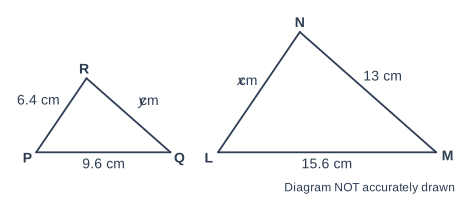
The diagram shows two triangles, PQR and LMN.
Triangle LMN is an enlargement of triangle PQR.

Work out the value of \(x\) and the value of \(y\).

Geometry diagram, marked "Diagram NOT accurately drawn". Triangle PQR. Triangle LMN. Side PQ is labelled 9.6 cm. Side PR is labelled 6.4 cm. Side QR is labelled y cm. Side LM is labelled 15.6 cm. Side LN is labelled x cm. Side MN is labelled 13 cm.

Model answer

PQ corresponds to LM, so scale factor = \(15.6 \div 9.6 = 1.625\)
\(x = 6.4 \times 1.625 = 10.4\)
\(y = 13 \div 1.625 = 8\)

Explanation

Use a pair of corresponding sides whose lengths are both known (PQ and LM) to find the scale factor. Multiply lengths in the small triangle to get lengths in the large one, and divide to go back. A common mistake is to add 6 (the difference between 15.6 and 9.6) instead of multiplying.

Mark scheme
  1. 1 mark

    M1 for the scale factor \(15.6 \div 9.6\) (= 1.625), or \(9.6 \div 15.6\)

    correct answer with no working scores full marks

  2. 1 mark

    A1 for \(x = 10.4\)

    cao

  3. 1 mark

    A1 for \(y = 8\)

    cao

Question 3

3 marks

Map P has a scale of 1 : 20 000.
Map Q has a scale of 1 : 50 000.
Both maps show the same park.

On map Q, the area of the park is 12.5 cm².

Work out the area of the park on map P.
Give your answer correct to 3 significant figures.

Model answer

Lengths on map P are \(50\,000 \div 20\,000 = 2.5\) times as long as on map Q.
Area scale factor = \(2.5^2 = 6.25\)
Area on map P = \(12.5 \times 6.25 = 78.125\) cm²
Area = 78.1 cm² (3 s.f.)

Explanation

Map P has the larger scale (1 cm represents less ground), so the park looks bigger on it. Each length is 2.5 times as long, so each area is \(2.5^2 = 6.25\) times as big. Multiplying by 2.5 only (31.25 cm²) is the common mistake.

Mark scheme
  1. 1 mark

    M1 for the length scale factor between the maps, \(50\,000 \div 20\,000\) (= 2.5)

    or for the real area, 12.5 × 50 000² = 3.125 × 10¹⁰ cm²; correct answer with no working scores full marks

  2. 1 mark

    M1 for \(12.5 \times 2.5^2\) or the real area \(\div 20\,000^2\)

  3. 1 mark

    A1 for 78.1 cm²

    awrt 78.1 (78.125)

Question 4

4 marks

A map has a scale of 1 : 10 000.
On the map, a field is a rectangle 6.5 cm long and 4.2 cm wide.

The field is for sale at £8500 per hectare.
1 hectare = 10 000 m²

Work out the price of the field.

Model answer

Real length = \(6.5 \times 10\,000 = 65\,000\) cm = 650 m
Real width = \(4.2 \times 10\,000 = 42\,000\) cm = 420 m
Area = \(650 \times 420 = 273\,000\) m²
In hectares: \(273\,000 \div 10\,000 = 27.3\)
Price = \(27.3 \times 8500 = 232\,050\)
Price = £232 050

Explanation

Convert the map lengths into real lengths in metres, then multiply to find the area. A hectare is 10 000 m² (a square 100 m by 100 m), so divide by 10 000 before multiplying by the price per hectare.

Mark scheme
  1. 1 mark

    P1 for real lengths, \(6.5 \times 10\,000 = 65\,000\) cm (650 m) and \(4.2 \times 10\,000 = 42\,000\) cm (420 m)

    correct answer with no working scores full marks

  2. 1 mark

    P1 for the real area, \(650 \times 420\) (= 273 000 m²)

  3. 1 mark

    P1 for converting to hectares (27.3) and multiplying by 8500

  4. 1 mark

    A1 for £232 050

    cao

Ready to try the rest? Every answer you write is marked against the mark scheme, so you can see exactly where the marks are.

AI Tutor Hints first, answers after you try

Hi! Stuck? Ask me for a hint and I’ll help you work it out. Once you’ve checked your answer I can explain exactly where the marks are.