Practise 28 exam-style questions on Geometry problems on coordinate axes for Edexcel GCSE Maths (Calculator). Write your answer as you would in the exam and get it marked in seconds against the mark scheme, point by point, with an AI tutor on hand if you get stuck.
28 questions
1–5 marks each
Instant marking
No sign-up needed
20 questions, marked as you go
Sample questions with model answers
Here are 4 of the questions in this topic, each with a model answer, an explanation of why it earns the marks and the mark scheme an examiner would use.
Question 1
2 marks
M is the midpoint of the line segment AB. A is the point (−4, 3) and M is the point (2.5, −1.25).
Work out the coordinates of B.
Model answer
From A to M: x increases by 2.5 − (−4) = 6.5 and y changes by −1.25 − 3 = −4.25. From M to B is the same step: x-coordinate of B = 2.5 + 6.5 = 9 y-coordinate of B = −1.25 + (−4.25) = −5.5 B is (9, −5.5).
Explanation
M is halfway between A and B, so the step from A to M is the same as the step from M to B. Add that step to M. A common mistake is to find the midpoint of A and M, which gives a point between them instead of beyond M.
Mark scheme
1 mark
M1 for a correct method for one coordinate, e.g. \(2 \times 2.5 - (-4)\) or \(2 \times (-1.25) - 3\)
or for one correct coordinate
1 mark
A1 for (9, −5.5)
cao; correct answer with no working scores full marks
Question 2
3 marks
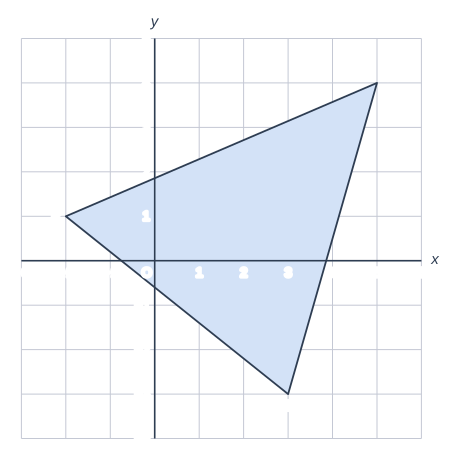
The diagram shows triangle PQR on a coordinate grid.
Work out the perimeter of triangle PQR. Give your answer correct to 3 significant figures.
None of the sides is horizontal or vertical, so find each length with Pythagoras using the changes in x and y, then add. Read the coordinates carefully from the grid, and keep at least 4 significant figures for each side before adding.
Mark scheme
1 mark
M1 for a correct method for the length of one side, e.g. \(PQ = \sqrt{7^2 + 3^2}\)
PQ = 7.61..., QR = 7.28..., PR = 6.40...
1 mark
M1 for a correct method for all three sides
1 mark
A1 for 21.3
awrt 21.3 (21.29...); correct answer with no working scores full marks
Question 3
3 marks
A is the point (1, 2) and B is the point (9, 8). AB is a diameter of a circle. C is the point (8, 1).
Show that C lies on the circle.
Model answer
Centre = midpoint of AB = \(\left(\dfrac{1 + 9}{2}, \dfrac{2 + 8}{2}\right) = (5, 5)\) \(AB = \sqrt{8^2 + 6^2} = 10\), so the radius is 5. Distance from (5, 5) to C(8, 1) \(= \sqrt{3^2 + (-4)^2} = \sqrt{25} = 5\) This equals the radius, so C lies on the circle.
Explanation
A point is on a circle exactly when its distance from the centre equals the radius. The centre is the midpoint of the diameter. Another way: show that AC and BC are perpendicular (gradients multiply to −1); then angle ACB = 90°, so C is on the circle with diameter AB.
Mark scheme
1 mark
M1 for the centre (5, 5) and the radius 5 (from AB = 10)
or gradients of AC \(= -\dfrac{1}{7}\) and BC = 7
1 mark
M1 for the distance from (5, 5) to C \(= \sqrt{3^2 + 4^2} = 5\)
or product of gradients = −1
1 mark
C1 for a conclusion: the distance from the centre to C equals the radius, so C is on the circle
or angle ACB = 90°, so C lies on the circle with diameter AB (converse of the angle in a semicircle)
Question 4
4 marks
A is the point (1, 2) and B is the point (9, 6).
Show that there is no point C on the y-axis for which angle ACB = 90°.
Model answer
If angle ACB = 90°, then C lies on the circle with diameter AB (converse of the angle in a semicircle). Centre = midpoint of AB = (5, 4) \(AB = \sqrt{8^2 + 4^2} = \sqrt{80}\), so the radius is \(\dfrac{\sqrt{80}}{2} = \sqrt{20} = 4.472...\) The distance from the centre (5, 4) to the y-axis is 5. 5 > 4.472..., so the circle does not meet the y-axis. So there is no point C on the y-axis with angle ACB = 90°.
Explanation
Every point C with angle ACB = 90° lies on the circle with diameter AB. This circle is too small to reach the y-axis. You can also let C = (0, c) and set the product of the gradients of AC and BC equal to −1: this gives \(c^2 - 8c + 21 = 0\), which has a negative discriminant and so no solutions.
Mark scheme
1 mark
P1 for a correct strategy, e.g. C must lie on the circle with diameter AB, or C = (0, c) with AC perpendicular to BC
or \(AC^2 + BC^2 = AB^2\)
1 mark
P1 for the centre (5, 4) and radius \(\sqrt{20}\) (= 4.47...), or for \((2 - c) \times \dfrac{6 - c}{9} = -1\)
or \(1 + (c - 2)^2 + 81 + (c - 6)^2 = 80\)
1 mark
P1 for the distance from the centre to the y-axis = 5, or for \(c^2 - 8c + 21 = 0\)
1 mark
C1 for a complete argument, e.g. 5 > 4.47 so the circle does not reach the y-axis, or the discriminant \(64 - 84 = -20 < 0\) so there are no solutions
Ready to try the rest? Every answer you write is marked against the mark scheme, so you can see exactly where the marks are.
Ctrl + Enter to check
AI TutorHints first, answers after you try
Hi! Stuck? Ask me for a hint and I’ll help you work it out. Once you’ve checked your answer I can explain exactly where the marks are.