Practise 28 exam-style questions on Angles, parallel lines and polygons for Edexcel GCSE Maths (Calculator). Write your answer as you would in the exam and get it marked in seconds against the mark scheme, point by point, with an AI tutor on hand if you get stuck.
28 questions
1–5 marks each
Instant marking
No sign-up needed
20 questions, marked as you go
Sample questions with model answers
Here are 4 of the questions in this topic, each with a model answer, an explanation of why it earns the marks and the mark scheme an examiner would use.
Question 1
2 marks
Work out the size of each interior angle of a regular polygon with 14 sides. Give your answer correct to 1 decimal place.
Find the exterior angle first (360° ÷ number of sides), then use interior + exterior = 180°. Alternatively divide the angle sum, \(12 \times 180^\circ = 2160^\circ\), by 14. Keep the full value until the end.
Mark scheme
1 mark
M1 for \(360 \div 14\) (= 25.71...) or \((14 - 2) \times 180 \div 14\)
1 mark
A1 for 154.3°
awrt 154.3 (154.28...); correct answer with no working scores full marks
Question 2
3 marks
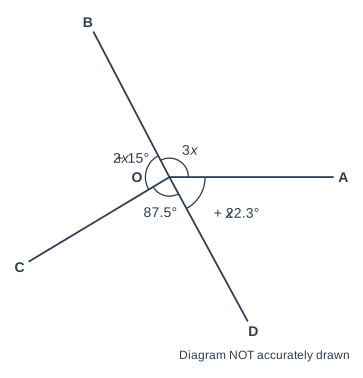
The diagram shows four angles around a point.
Work out the value of \(x\).
Model answer
Angles at a point add up to 360°. \(3x + (2x + 15) + 87.5 + (x + 22.3) = 360\) \(6x + 124.8 = 360\) \(6x = 235.2\) \(x = 39.2\)
Explanation
The angles around a point make a full turn, 360°. Collect the \(x\) terms and the number terms, then solve the equation. Check: 117.6 + 93.4 + 87.5 + 61.5 = 360.
Mark scheme
1 mark
M1 for \(3x + 2x + 15 + 87.5 + x + 22.3 = 360\) oe
angles at a point add up to 360°; correct answer with no working scores full marks
1 mark
M1 for \(6x = 235.2\) oe
1 mark
A1 for \(x = 39.2\)
cao
Question 3
3 marks
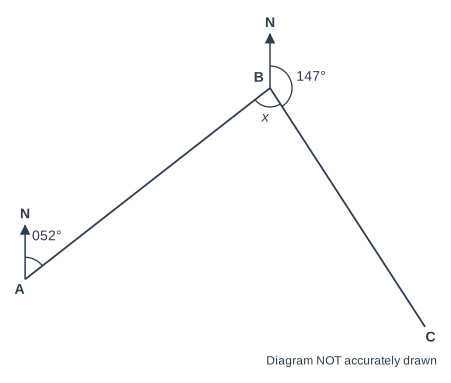
The diagram shows the positions of three towns, A, B and C. The bearing of B from A is 052°. The bearing of C from B is 147°.
Work out the size of angle ABC, marked \(x\).
Model answer
The north lines at A and B are parallel. The bearing of A from B = 052° + 180° = 232°. Angle ABC = 232° − 147° = 85°
Explanation
Use the fact that north lines are parallel. The back bearing from B to A is 232°, and angle ABC is the difference between the bearing of A from B and the bearing of C from B. Equivalently, the co-interior angle at B is 128°, and the angles round B add up to 360°: 360 − 128 − 147 = 85.
Mark scheme
1 mark
M1 for using the parallel north lines, e.g. the angle between north at B and BA is 180° − 52° = 128° (co-interior), or the bearing of A from B is 232°
correct answer with no working scores full marks
1 mark
M1 for a complete method, e.g. 232 − 147 or 360 − 128 − 147
1 mark
A1 for \(x = 85^\circ\)
cao
Question 4
4 marks
Regular polygon A has twice as many sides as regular polygon B. Each interior angle of polygon A is 15° more than each interior angle of polygon B.
Work out the number of sides of each polygon.
Model answer
Let polygon B have \(n\) sides, so polygon A has \(2n\) sides. Exterior angle of B \(= \dfrac{360}{n}\); exterior angle of A \(= \dfrac{360}{2n} = \dfrac{180}{n}\) A's interior angle is 15° bigger, so its exterior angle is 15° smaller: \(\dfrac{360}{n} - \dfrac{180}{n} = 15\) \(\dfrac{180}{n} = 15\) \(n = 12\) Polygon B has 12 sides and polygon A has 24 sides. Check: interior angles 150° and 165°, a difference of 15°.
Explanation
Write the angles in terms of the number of sides. Because interior + exterior = 180°, a 15° larger interior angle means a 15° smaller exterior angle, which gives a simple equation. Always check your answer by working out both interior angles.
Mark scheme
1 mark
P1 for exterior angles in terms of \(n\): \(\dfrac{360}{n}\) for B and \(\dfrac{360}{2n}\) for A
or interior angles \(180 - \frac{360}{n}\) and \(180 - \frac{360}{2n}\); correct answer with no working scores full marks
1 mark
P1 for \(\dfrac{360}{n} - \dfrac{360}{2n} = 15\) oe
1 mark
P1 for \(\dfrac{180}{n} = 15\)
or a correct trial of n = 12
1 mark
A1 for B has 12 sides and A has 24 sides
cao
Ready to try the rest? Every answer you write is marked against the mark scheme, so you can see exactly where the marks are.
Ctrl + Enter to check
AI TutorHints first, answers after you try
Hi! Stuck? Ask me for a hint and I’ll help you work it out. Once you’ve checked your answer I can explain exactly where the marks are.