Practise 28 exam-style questions on Transformations of graphs for Edexcel GCSE Maths (Calculator). Write your answer as you would in the exam and get it marked in seconds against the mark scheme, point by point, with an AI tutor on hand if you get stuck.
28 questions
1–5 marks each
Instant marking
No sign-up needed
20 questions, marked as you go
Sample questions with model answers
Here are 4 of the questions in this topic, each with a model answer, an explanation of why it earns the marks and the mark scheme an examiner would use.
Question 1
2 marks
The point P(4, −2.5) lies on the curve y = f(x).
Write down the coordinates of the point to which P is mapped on the curve y = −f(x) and on the curve y = f(−x).
Model answer
y = −f(x) is a reflection in the x-axis: (x, y) → (x, −y), so P(4, −2.5) → (4, 2.5) y = f(−x) is a reflection in the y-axis: (x, y) → (−x, y), so P(4, −2.5) → (−4, −2.5)
Explanation
A minus sign outside the function, −f(x), changes the sign of every y-value: a reflection in the x-axis. A minus sign inside, f(−x), changes the sign of x: a reflection in the y-axis. Students often mix these two up, so test with a point.
Mark scheme
1 mark
B1 for (4, 2.5) on y = −f(x)
cao; correct answer with no working scores full marks
1 mark
B1 for (−4, −2.5) on y = f(−x)
cao
Question 2
2 marks
The graph of \(y = 3^x\) is translated by the vector \(\begin{pmatrix}0\\-4\end{pmatrix}\).
Write down the equation of the asymptote of the translated graph and the coordinates of the point where the translated graph crosses the y-axis.
Model answer
The translated graph is \(y = 3^x - 4\). \(y = 3^x\) has asymptote y = 0, so the translated graph has asymptote y = −4. When x = 0: \(y = 3^0 - 4 = 1 - 4 = -3\), so it crosses the y-axis at (0, −3).
Explanation
A translation of 4 units down moves every point, and the asymptote, down by 4. \(y = 3^x\) gets closer and closer to y = 0 and crosses the y-axis at (0, 1), so the translated graph approaches y = −4 and crosses the y-axis at (0, −3). A common mistake is to say the asymptote is still the x-axis.
Mark scheme
1 mark
B1 for y = −4
cao; correct answer with no working scores full marks
1 mark
B1 for (0, −3)
cao
Question 3
3 marks
The graph of \(y = 1.8^x\) is reflected in the y-axis to give the graph of y = g(x).
Work out the value of g(2.5). Give your answer correct to 3 significant figures.
A reflection in the y-axis replaces x by −x, so g(2.5) is the value of the original function at −2.5. A negative power means the reciprocal, so the answer is less than 1. A common mistake is to reflect in the x-axis instead, giving \(-1.8^{2.5}\).
Mark scheme
1 mark
M1 for \(g(x) = 1.8^{-x}\)
oe, e.g. \(g(x) = \left(\dfrac{1}{1.8}\right)^x\) or \(\left(\dfrac{5}{9}\right)^x\)
1 mark
M1 for \(1.8^{-2.5}\)
oe, e.g. \(\dfrac{1}{1.8^{2.5}}\) or \(1.8^{2.5} = 4.346...\)
1 mark
A1 for 0.230
awrt 0.230 (0.23004...); accept 0.23; correct answer with no working scores full marks
Question 4
4 marks
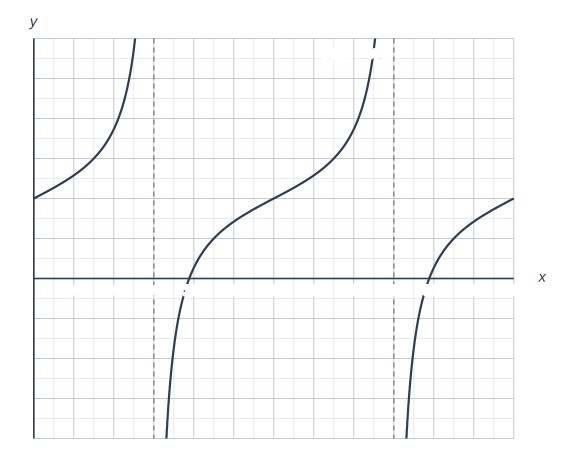
The graph of y = tan x is translated by the vector \(\begin{pmatrix}0\\2\end{pmatrix}\). The diagram shows the translated graph for 0 ≤ x ≤ 360.
Find the x-coordinates of the points where the translated graph crosses the x-axis. Give your answers correct to 1 decimal place.
Model answer
The translated graph is y = tan x + 2. It crosses the x-axis when tan x + 2 = 0, so tan x = −2. \(\tan^{-1}(-2) = -63.434...\) (not in the range) tan x repeats every 180°: −63.434... + 180 = 116.565... and −63.434... + 360 = 296.565... x = 116.6 and x = 296.6
Explanation
Moving the graph up 2 means the new graph meets the x-axis where tan x = −2 on the old graph. The calculator gives a negative angle, so add the period of tan, 180°, until you are in the range. The graph shows one crossing on each branch between the asymptotes.
Mark scheme
1 mark
B1 for y = tan x + 2, or tan x + 2 = 0
correct answer with no working scores full marks
1 mark
M1 for tan x = −2 and \(\tan^{-1}(-2) = -63.43...\)
1 mark
M1 for adding 180 (or 360) to their angle
1 mark
A1 for 116.6 and 296.6
awrt 116.6 and 296.6; no extra values in the range
Ready to try the rest? Every answer you write is marked against the mark scheme, so you can see exactly where the marks are.
Ctrl + Enter to check
AI TutorHints first, answers after you try
Hi! Stuck? Ask me for a hint and I’ll help you work it out. Once you’ve checked your answer I can explain exactly where the marks are.