Practise 19 exam-style questions on Constructions and loci for Edexcel GCSE Maths (Calculator). Write your answer as you would in the exam and get it marked in seconds against the mark scheme, point by point, with an AI tutor on hand if you get stuck.
19 questions
1–5 marks each
Instant marking
No sign-up needed
19 questions, marked as you go
Sample questions with model answers
Here are 4 of the questions in this topic, each with a model answer, an explanation of why it earns the marks and the mark scheme an examiner would use.
Question 1
2 marks
Two straight parallel lines are 6.4 cm apart.
Describe fully the locus of all the points that are the same distance from both lines.
Model answer
A straight line parallel to the two lines and midway between them, 3.2 cm from each line.
Explanation
The distance from a point to a line is measured along the perpendicular. Points the same distance from both parallel lines must be halfway across the 6.4 cm gap, so they lie on the parallel line 3.2 cm from each. Points outside the two lines are always nearer one line than the other.
Mark scheme
1 mark
B1 for a straight line parallel to the two lines
1 mark
B1 for midway between them, 3.2 cm from each line
Question 2
3 marks
A lawn is a rectangle 12 m long and 8 m wide. A sprinkler is placed at the centre of the lawn. It waters all the lawn that is within 3.5 m of the sprinkler.
Work out the percentage of the lawn that is not watered. Give your answer correct to 1 decimal place.
Model answer
Area of lawn = 12 × 8 = 96 m² The sprinkler waters a circle of radius 3.5 m (it fits inside the lawn because 3.5 < 4). Watered area \(= \pi \times 3.5^2 = 38.484...\) m² Area not watered \(= 96 - 38.484... = 57.515...\) m² Percentage \(= \dfrac{57.515...}{96} \times 100 = 59.91...\%\) = 59.9% (1 d.p.)
Explanation
The points within 3.5 m of the sprinkler form a circle of radius 3.5 m. It is completely inside the lawn because the centre is 4 m from the nearest edge. Find the area that is not watered, then write it as a percentage of the whole lawn.
Mark scheme
1 mark
P1 for the watered area \(\pi \times 3.5^2\) (= 38.48...)
correct answer with no working scores full marks
1 mark
P1 for \(\dfrac{96 - 38.48...}{96} \times 100\) oe
1 mark
A1 for 59.9%
awrt 59.9 (59.91...)
Question 3
3 marks
A rectangular pond is 6 m long and 4 m wide. A path is made around the outside of the pond. The path covers all the points outside the pond that are within 1.5 m of the edge of the pond.
Work out the length of the outer edge of the path. Give your answer correct to 3 significant figures.
Model answer
Along each side, the edge of the path is a straight line 1.5 m from the pond, the same length as that side. At each corner, the points 1.5 m from the corner form a quarter circle of radius 1.5 m. Straight parts: 6 + 4 + 6 + 4 = 20 m Four quarter circles make one full circle: \(2 \times \pi \times 1.5 = 9.424...\) m Length \(= 20 + 9.424... = 29.424...\) = 29.4 m (3 s.f.)
Explanation
The locus of points a fixed distance from a rectangle has straight sides parallel to the rectangle and rounded corners, because near a corner the nearest point of the pond is the corner itself. The four quarter circles join up to make a whole circle of radius 1.5 m. A common mistake is to draw square corners, giving 32 m.
Mark scheme
1 mark
P1 for recognising the outer edge is made of 4 straight sides (6, 4, 6, 4) and 4 quarter circles of radius 1.5 m at the corners
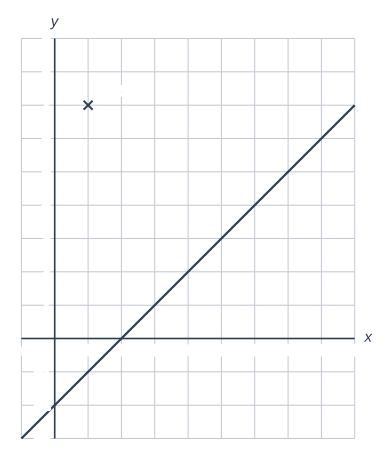
The diagram shows the line L with equation \(y = x - 2\) and the point P(1, 7).
Work out the shortest distance from P to the line L. Give your answer correct to 3 significant figures.
Model answer
The shortest distance is along the perpendicular from P to L. L has gradient 1, so the perpendicular has gradient −1. Through P(1, 7): \(y - 7 = -(x - 1)\), so \(y = -x + 8\) Meets L where \(x - 2 = -x + 8\), so \(x = 5\), \(y = 3\): the foot is (5, 3). Distance \(= \sqrt{(5 - 1)^2 + (3 - 7)^2} = \sqrt{32} = 5.656...\) = 5.66 (3 s.f.)
Explanation
The perpendicular distance from a point to a line is the shortest distance. Find the equation of the perpendicular through P (negative reciprocal gradient), find where it meets L, and then use Pythagoras' theorem. Measuring straight down to L (from (1, 7) to (1, −1), 8 units) gives a longer distance, not the shortest.
Mark scheme
1 mark
P1 for the line through P perpendicular to L: gradient −1, \(y = -x + 8\)
correct answer with no working scores full marks
1 mark
P1 for solving \(x - 2 = -x + 8\) to find the foot of the perpendicular (5, 3)