Level:
Correct: 0
Incorrect: 0
Marks: 0/0
Exam Practice
Subject:
Topics:
Edexcel GCSE Maths (Calculator) Smart practice A mixed round aimed at your weak spots
Unit 1
Number
Unit 2
Algebra
Unit 3
Ratio, proportion and rates of change
Unit 4
Geometry and measures
Unit 5
Probability
Unit 6
Statistics
Avg
score:
–
Topics
done:
0/97

Sine rule and cosine rule

Practise 36 exam-style questions on Sine rule and cosine rule for Edexcel GCSE Maths (Calculator). Write your answer as you would in the exam and get it marked in seconds against the mark scheme, point by point, with an AI tutor on hand if you get stuck.

  • 36 questions
  • 1–5 marks each
  • Instant marking
  • No sign-up needed
20 questions, marked as you go

Sample questions with model answers

Here are 4 of the questions in this topic, each with a model answer, an explanation of why it earns the marks and the mark scheme an examiner would use.

Question 1

2 marks

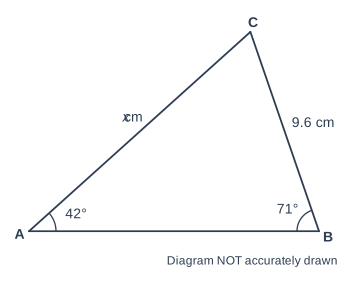
The diagram shows triangle ABC.
BC = 9.6 cm, angle BAC = 42° and angle ABC = 71°.

Work out the value of x.
Give your answer correct to 3 significant figures.

Geometry diagram, marked "Diagram NOT accurately drawn". Triangle ABC. Angle BAC is marked 42°. Angle ABC is marked 71°. Side BC is labelled 9.6 cm. Side AC is labelled x cm.

Model answer

\(\dfrac{x}{\sin 71^\circ} = \dfrac{9.6}{\sin 42^\circ}\)
\(x = \dfrac{9.6 \times \sin 71^\circ}{\sin 42^\circ} = 13.565...\)
\(x = 13.6\) (3 s.f.)

Explanation

Each side pairs with the angle opposite it: BC = 9.6 cm is opposite the 42° angle, and x (AC) is opposite the 71° angle. With two angles and a side, use the sine rule. A common mistake is to pair 9.6 cm with 71°.

Mark scheme
  1. 1 mark

    M1 for \(\dfrac{x}{\sin 71^\circ} = \dfrac{9.6}{\sin 42^\circ}\)

    oe, e.g. \(x = \dfrac{9.6 \sin 71^\circ}{\sin 42^\circ}\)

  2. 1 mark

    A1 for 13.6

    awrt 13.6 (13.565...); correct answer with no working scores full marks

Question 2

3 marks

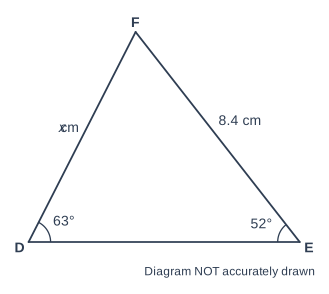
The diagram shows triangle DEF.
EF = 8.4 cm, angle EDF = 63° and angle DEF = 52°.
DF = x cm.

Show that x = 7.4 correct to 1 decimal place.

Geometry diagram, marked "Diagram NOT accurately drawn". Triangle DEF. Angle EDF is marked 63°. Angle DEF is marked 52°. Side EF is labelled 8.4 cm. Side DF is labelled x cm.

Model answer

DF is opposite angle E (52°) and EF is opposite angle D (63°).
\(\dfrac{x}{\sin 52^\circ} = \dfrac{8.4}{\sin 63^\circ}\)
\(x = \dfrac{8.4 \times \sin 52^\circ}{\sin 63^\circ} = 7.4290...\)
7.4290... = 7.4 correct to 1 decimal place.

Explanation

Match each side with its opposite angle: x (DF) is opposite the 52° angle at E, and 8.4 cm (EF) is opposite the 63° angle at D. In a "show that" question you must write a more accurate value (7.429...) before rounding to 7.4.

Mark scheme
  1. 1 mark

    M1 for \(\dfrac{x}{\sin 52^\circ} = \dfrac{8.4}{\sin 63^\circ}\)

    oe

  2. 1 mark

    M1 for \(x = \dfrac{8.4 \times \sin 52^\circ}{\sin 63^\circ}\)

    oe

  3. 1 mark

    A1 for 7.429... (a value to more than 1 decimal place) which rounds to 7.4

    accept 7.42 to 7.43; answer only, or 7.4 with no more accurate value, scores at most M1 M1

Question 3

4 marks

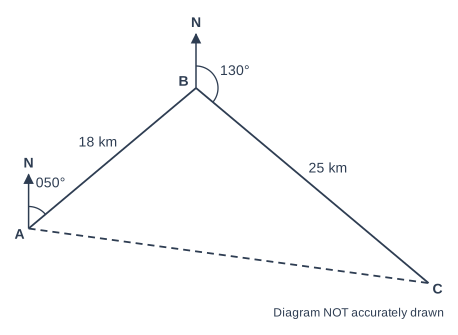
A boat sails 18 km from a port A on a bearing of 050° to a buoy B.
It then sails 25 km on a bearing of 130° to a lighthouse C.

The diagram shows the journey.

Work out the distance from A to C.
Give your answer correct to 3 significant figures.

Geometry diagram, marked "Diagram NOT accurately drawn". Line segments AB and BC are drawn. Dashed line segment AC is drawn. A north line (an arrow pointing straight up, labelled N) is drawn at A. At A, the angle measured clockwise from north round to AB is marked 050° (the bearing of B from A). A north line (an arrow pointing straight up, labelled N) is drawn at B. At B, the angle measured clockwise from north round to BC is marked 130° (the bearing of C from B). AB is labelled 18 km. BC is labelled 25 km.

Model answer

At B, the bearing back to A is 050° + 180° = 230°.
Angle ABC \(= 230 - 130 = 100^\circ\)
\(AC^2 = 18^2 + 25^2 - 2 \times 18 \times 25 \times \cos 100^\circ\)
\(AC^2 = 324 + 625 + 156.28... = 1105.28...\)
\(AC = 33.245...\)
AC = 33.2 km (3 s.f.)

Explanation

First find the angle inside the triangle at B, using the north lines: the angle between BA and due south at B is 50° (alternate angles with the 050° bearing at A), and the angle between due south and BC is 180° − 130° = 50°, so angle ABC = 100°. Then use the cosine rule. Because cos 100° is negative, the last term is added. A common mistake is to use 80° (130 − 50) for the angle at B.

Mark scheme
  1. 1 mark

    P1 for angle ABC = 100°

    e.g. 230 − 130, or 50° (alternate angles) + 50° (180 − 130); may be seen on a diagram; correct answer with no working scores full marks

  2. 1 mark

    M1 for \(AC^2 = 18^2 + 25^2 - 2 \times 18 \times 25 \times \cos 100^\circ\)

    oe, ft their angle ABC if obtained by a correct method

  3. 1 mark

    M1 for \(AC^2 = 1105.28...\) or the square root of their correct expression

    accept 1105 to 1105.3

  4. 1 mark

    A1 for 33.2 km

    awrt 33.2 (33.245...)

Question 4

5 marks

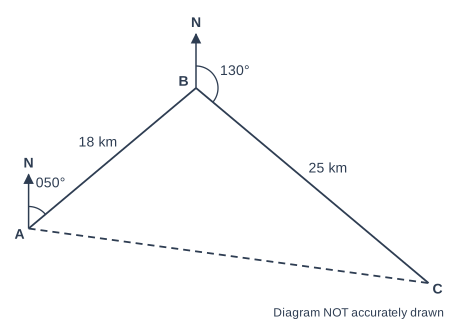
A boat sails 18 km from a port A on a bearing of 050° to a buoy B.
It then sails 25 km on a bearing of 130° to a lighthouse C.

The diagram shows the journey.

Work out the bearing of C from A.
Give your answer correct to the nearest degree.

Geometry diagram, marked "Diagram NOT accurately drawn". Line segments AB and BC are drawn. Dashed line segment AC is drawn. A north line (an arrow pointing straight up, labelled N) is drawn at A. At A, the angle measured clockwise from north round to AB is marked 050° (the bearing of B from A). A north line (an arrow pointing straight up, labelled N) is drawn at B. At B, the angle measured clockwise from north round to BC is marked 130° (the bearing of C from B). AB is labelled 18 km. BC is labelled 25 km.

Model answer

Angle ABC \(= (50 + 180) - 130 = 100^\circ\)
\(AC^2 = 18^2 + 25^2 - 2 \times 18 \times 25 \times \cos 100^\circ = 1105.28...\), so \(AC = 33.245...\) km
\(\dfrac{\sin(\text{angle } BAC)}{25} = \dfrac{\sin 100^\circ}{33.245...}\)
\(\sin(\text{angle } BAC) = \dfrac{25 \times \sin 100^\circ}{33.245...} = 0.7405...\)
Angle BAC \(= 47.77...^\circ\)
Bearing of C from A \(= 50 + 47.77... = 97.77...^\circ\)
Bearing = 098°

Explanation

Find the angle at B from the north lines (100°), use the cosine rule for AC, then the sine rule for angle BAC. The bearing of C from A is measured clockwise from north at A, so add angle BAC to the bearing of B (050°). Keep the unrounded AC in your calculator. A common mistake is to give angle BAC (48°) as the bearing.

Mark scheme
  1. 1 mark

    P1 for angle ABC = 100°

    may be seen on a diagram; correct answer with no working scores full marks

  2. 1 mark

    P1 for \(AC^2 = 18^2 + 25^2 - 2 \times 18 \times 25 \times \cos 100^\circ\)

    oe

  3. 1 mark

    A1 for AC = 33.2...

    accept 33.2 to 33.25

  4. 1 mark

    P1 for \(\dfrac{\sin(\text{angle } BAC)}{25} = \dfrac{\sin 100^\circ}{33.2...}\) (angle BAC = 47.7...°)

    oe, e.g. cosine rule for angle BAC; accept angle BAC from 47.7 to 47.8

  5. 1 mark

    A1 for 098°

    accept 97.7 to 97.8 or 98

Ready to try the rest? Every answer you write is marked against the mark scheme, so you can see exactly where the marks are.

AI Tutor Hints first, answers after you try

Hi! Stuck? Ask me for a hint and I’ll help you work it out. Once you’ve checked your answer I can explain exactly where the marks are.