
Level:
Correct: 0
Incorrect: 0
Marks: 0/0
Exam Practice
Subject:
Topics:
Edexcel GCSE Maths (Calculator) Smart practice A mixed round aimed at your weak spots
Unit 1
Number
Unit 2
Algebra
Unit 3
Ratio, proportion and rates of change
Unit 4
Geometry and measures
Unit 5
Probability
Unit 6
Statistics
Avg
score:
–
Topics
done:
0/97

Combined events and tree diagrams

Practise 38 exam-style questions on Combined events and tree diagrams for Edexcel GCSE Maths (Calculator). Write your answer as you would in the exam and get it marked in seconds against the mark scheme, point by point, with an AI tutor on hand if you get stuck.

  • 38 questions
  • 1–5 marks each
  • Instant marking
  • No sign-up needed
20 questions, marked as you go

Sample questions with model answers

Here are 4 of the questions in this topic, each with a model answer, an explanation of why it earns the marks and the mark scheme an examiner would use.

Question 1

2 marks

A spinner is biased.
The probability that the spinner lands on red is 0.28.

Shreya spins the spinner two times.

Work out the probability that the spinner does not land on red either time.

Model answer

P(not red) = 1 − 0.28 = 0.72
P(not red and not red) = 0.72 × 0.72 = 0.5184

Explanation

First find the probability of "not red" using 1 − 0.28. The two spins are independent, so multiply: \(0.72^2\). A common mistake is to work out \(1 - 0.28^2\), which is the probability of not getting red on both spins (it includes getting red once).

Mark scheme
  1. 1 mark

    M1 for 1 − 0.28 (= 0.72) used in a product, e.g. 0.72 × 0.72

  2. 1 mark

    A1 for 0.5184 oe

    accept 0.518; correct answer with no working scores full marks
Question 2

3 marks

A dice is biased.
The probability that the dice lands on six is 0.3.

Carl rolls the dice two times.
He says,
"The probability of getting at least one six is 0.3 + 0.3 = 0.6."

Carl is wrong.
Explain why, and work out the correct probability of getting at least one six.

Model answer

Carl has added the probabilities, but the two events can both happen (six on both rolls), so adding counts (six, six) twice.
P(no six) = 0.7 × 0.7 = 0.49
P(at least one six) = 1 − 0.49 = 0.51

Explanation

You can only add probabilities of events that cannot happen together. "Six on roll 1" and "six on roll 2" can both happen, so use 1 − P(no sixes) instead. Carl's answer is too big by exactly 0.3 × 0.3 = 0.09, the probability of two sixes.

Mark scheme
  1. 1 mark

    C1 for a correct explanation, e.g. adding counts the outcome (six, six) twice, or getting a six on the first roll and on the second roll are not mutually exclusive

    accept e.g. "with 4 rolls his method would give 1.2, which is impossible"

  2. 1 mark

    M1 for 1 − 0.7 × 0.7 oe

    or 0.3 × 0.7 + 0.7 × 0.3 + 0.3 × 0.3

  3. 1 mark

    A1 for 0.51 oe

    cao

Question 3

3 marks

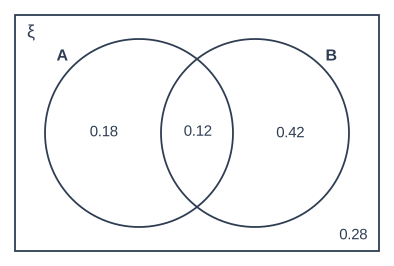
The Venn diagram shows the probabilities of two events, A and B.

Are events A and B independent?
You must show how you get your answer.

A Venn diagram: a rectangle labelled ξ (the universal set) containing two overlapping circles labelled A and B. The numbers written in each region are: A ∩ B′ (in A only): 0.18; A ∩ B (in both A and B): 0.12; A′ ∩ B (in B only): 0.42; A′ ∩ B′ (outside both circles): 0.28.

Model answer

P(A) = 0.18 + 0.12 = 0.3
P(B) = 0.12 + 0.42 = 0.54
P(A) × P(B) = 0.3 × 0.54 = 0.162
P(A ∩ B) = 0.12
0.162 ≠ 0.12, so A and B are not independent.

Explanation

Events A and B are independent exactly when P(A ∩ B) = P(A) × P(B). Remember that P(A) includes the overlap: add both regions inside circle A. A common mistake is to use 0.18 and 0.42 as P(A) and P(B), which are the probabilities of "A only" and "B only".

Mark scheme
  1. 1 mark

    M1 for P(A) = 0.3 and P(B) = 0.54

    0.18 + 0.12 and 0.12 + 0.42

  2. 1 mark

    M1 for P(A) × P(B) = 0.3 × 0.54 (= 0.162)

  3. 1 mark

    C1 for No, since 0.162 ≠ 0.12 = P(A ∩ B)

    must compare P(A) × P(B) with P(A ∩ B) = 0.12

Question 4

5 marks

At a school fair it costs £1.50 to play a game.
Each player spins spinner A once and spinner B once.
The probability that spinner A lands on a star is 0.2.
The probability that spinner B lands on a star is 0.15.
The spinners are independent.

A player who gets a star on both spinners wins £5.
A player who gets a star on exactly one spinner wins £1.
Players do not get their £1.50 back.

400 people play the game.
Work out an estimate for the profit the school makes.

Model answer

P(star on both) = 0.2 × 0.15 = 0.03
P(star on exactly one) = 0.2 × 0.85 + 0.8 × 0.15 = 0.17 + 0.12 = 0.29
Expected number winning £5 = 400 × 0.03 = 12, prize money 12 × £5 = £60
Expected number winning £1 = 400 × 0.29 = 116, prize money 116 × £1 = £116
Money taken = 400 × £1.50 = £600
Profit = 600 − 60 − 116 = £424

Explanation

Work out the probability of each prize, multiply by the number of players to estimate how many win each prize, and then find the total prize money. Profit is money taken minus money paid out. A common mistake is to find "exactly one star" with only one of its two paths (0.17 or 0.12).

Mark scheme
  1. 1 mark

    P1 for P(two stars) = 0.2 × 0.15 (= 0.03)

    correct answer with no working scores full marks

  2. 1 mark

    P1 for P(exactly one star) = 0.2 × 0.85 + 0.8 × 0.15 (= 0.29)

  3. 1 mark

    P1 for the expected prize money, e.g. 400 × 0.03 × 5 (= 60) and 400 × 0.29 × 1 (= 116)

    ft their probabilities

  4. 1 mark

    P1 for the money taken, 400 × 1.50 (= 600), and a subtraction of their total prize money

  5. 1 mark

    A1 for £424

    cao

Ready to try the rest? Every answer you write is marked against the mark scheme, so you can see exactly where the marks are.

AI Tutor Hints first, answers after you try

Hi! Stuck? Ask me for a hint and I’ll help you work it out. Once you’ve checked your answer I can explain exactly where the marks are.