Level:
Correct: 0
Incorrect: 0
Marks: 0/0
Exam Practice
Subject:
Topics:
Edexcel GCSE Maths (Calculator) Smart practice A mixed round aimed at your weak spots
Unit 1
Number
Unit 2
Algebra
Unit 3
Ratio, proportion and rates of change
Unit 4
Geometry and measures
Unit 5
Probability
Unit 6
Statistics
Avg
score:
–
Topics
done:
0/97

Plans and elevations

Practise 18 exam-style questions on Plans and elevations for Edexcel GCSE Maths (Calculator). Write your answer as you would in the exam and get it marked in seconds against the mark scheme, point by point, with an AI tutor on hand if you get stuck.

  • 18 questions
  • 1–5 marks each
  • Instant marking
  • No sign-up needed
18 questions, marked as you go

Sample questions with model answers

Here are 4 of the questions in this topic, each with a model answer, an explanation of why it earns the marks and the mark scheme an examiner would use.

Question 1

2 marks

The plan of a solid is a square of side 5 cm.
The front elevation of the same solid is also a square of side 5 cm.

Owen says, "The solid must be a cube."

Is Owen correct?
Give a reason for your answer.

Model answer

No, Owen is not correct.
For example, a cylinder with diameter 5 cm and length 5 cm, lying on its curved surface with its length going from left to right, has a square plan (5 cm by 5 cm) and a square front elevation (5 cm by 5 cm), but its side elevation is a circle.
So the solid does not have to be a cube; you need the side elevation as well.

Explanation

Two views do not always fix a solid. Think of other solids that look like a 5 cm square from the front and from above. A cylinder lying on its side or a triangular prism can both do this, which is why plans and elevations are usually given as a set of three views.

Mark scheme
  1. 1 mark

    C1 for No (not necessarily)

    must be supported by a reason to score

  2. 1 mark

    C1 for a correct counter-example, e.g. a cylinder of diameter 5 cm and length 5 cm lying on its curved surface with its axis from left to right (its side elevation is a circle), or a triangular prism 5 cm long whose side elevation is a triangle of base 5 cm and height 5 cm

    any valid solid that is not a cube
Question 2

3 marks

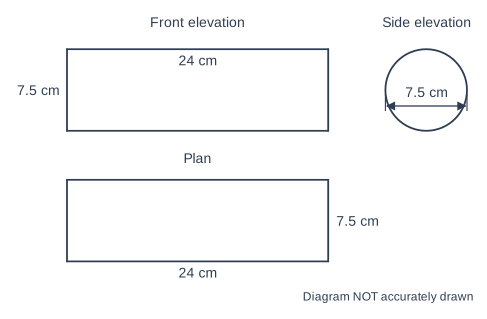
Here are the front elevation, the side elevation and the plan of a solid.
The front elevation and the plan are both rectangles 24 cm by 7.5 cm.
The side elevation is a circle of diameter 7.5 cm.

Work out the volume of the solid.
Give your answer correct to 3 significant figures.

Geometry diagram, marked "Diagram NOT accurately drawn". A circle. A rectangle with vertices 4 unlabelled points in order. A rectangle with vertices 4 unlabelled points in order. Side an unlabelled line going to the right is labelled 24 cm. Side an unlabelled line going upwards is labelled 7.5 cm. Side an unlabelled line going to the right is labelled 24 cm. Side an unlabelled line going upwards is labelled 7.5 cm. A double-headed dimension arrow alongside an unlabelled line going to the right (the distance from an unlabelled point to an unlabelled point) is labelled 7.5 cm. The text "Front elevation" is written. The text "Side elevation" is written. The text "Plan" is written.

Model answer

The side elevation is a circle and the other views are rectangles, so the solid is a cylinder lying on its curved surface.
Radius = 7.5 ÷ 2 = 3.75 cm, length = 24 cm
Volume \(= \pi \times 3.75^2 \times 24 = 1060.28...\)
Volume = 1060 cm³ (3 s.f.)

Explanation

Interpret the views first: a circle from the side and rectangles from the front and above mean a cylinder lying down, with the circle as its cross-section. A common mistake is to use 7.5 cm as the radius instead of the diameter.

Mark scheme
  1. 1 mark

    B1 for identifying a cylinder of radius 3.75 cm and length 24 cm

    exact values; may be implied by working

  2. 1 mark

    M1 for \(\pi \times 3.75^2 \times 24\)

    oe

  3. 1 mark

    A1 for 1060 cm³

    awrt 1060 (1060.28...); correct answer with no working scores full marks

Question 3

4 marks

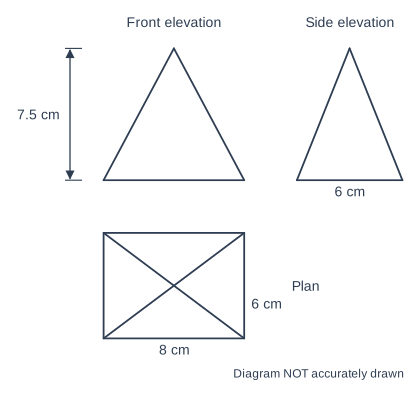
Here are the plan, the front elevation and the side elevation of a pyramid.
The plan is a rectangle 8 cm by 6 cm with both diagonals drawn.
The front elevation is an isosceles triangle with base 8 cm and height 7.5 cm.
The side elevation is an isosceles triangle with base 6 cm and height 7.5 cm.

Work out the length of one of the sloping edges of the pyramid.
Give your answer correct to 3 significant figures.

Geometry diagram, marked "Diagram NOT accurately drawn". A rectangle with vertices 4 unlabelled points in order. A sloping line with no labelled ends is drawn. A sloping line with no labelled ends is drawn. A isosceles triangle with vertices 3 unlabelled points in order. A isosceles triangle with vertices 3 unlabelled points in order. Side an unlabelled line going to the right is labelled 8 cm. Side an unlabelled line going upwards is labelled 6 cm. A double-headed dimension arrow alongside an unlabelled line going upwards (the distance from an unlabelled point to an unlabelled point) is labelled 7.5 cm. Side an unlabelled line going to the right is labelled 6 cm. The text "Front elevation" is written. The text "Side elevation" is written. The text "Plan" is written.

Model answer

The plan shows a rectangular base with the apex above the point where the diagonals cross (the centre), and the elevations show the height is 7.5 cm.
Distance from a corner of the base to the centre \(= \dfrac{1}{2}\sqrt{8^2 + 6^2} = \dfrac{1}{2} \times 10 = 5\) cm
Sloping edge \(= \sqrt{7.5^2 + 5^2} = \sqrt{81.25} = 9.0138...\)
Sloping edge = 9.01 cm (3 s.f.)

Explanation

Each sloping edge is the hypotenuse of a right-angled triangle made by the vertical height and the line from the centre of the base to a corner (half a diagonal). The sloping sides of the front elevation (8.5 cm) are not true lengths of the edges, because the edges also slope towards or away from you.

Mark scheme
  1. 1 mark

    P1 for recognising the apex is 7.5 cm vertically above the centre of the 8 cm by 6 cm rectangular base

    may be implied by working

  2. 1 mark

    P1 for the distance from a corner of the base to its centre \(= \dfrac{1}{2}\sqrt{8^2 + 6^2}\) (= 5)

    or \(\sqrt{4^2 + 3^2}\)

  3. 1 mark

    P1 for \(\sqrt{7.5^2 + 5^2}\) with their 5

    do not award for \(\sqrt{4^2 + 7.5^2}\) (the sloping side of the front elevation)

  4. 1 mark

    A1 for 9.01 cm

    awrt 9.01 (9.013...)

Question 4

5 marks

A garden shed is a prism.
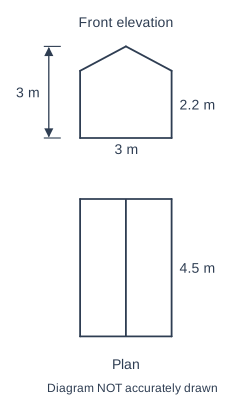
Here are the front elevation and the plan of the shed.
The front elevation is a pentagon: a rectangle 3 m wide and 2.2 m high with an isosceles triangle on top. The total height of the shed is 3 m.
The plan is a rectangle 3 m by 4.5 m. The line down the middle shows the top edge of the roof.

The two sloping rectangular faces of the roof are to be covered with roofing felt.
Roofing felt is sold in rolls. Each roll covers 5 m² and costs £24.50.

Work out the cost of the rolls of felt needed.

Geometry diagram, marked "Diagram NOT accurately drawn". A pentagon with vertices 5 unlabelled points in order. A rectangle with vertices 4 unlabelled points in order. A vertical line with no labelled ends is drawn. Side an unlabelled line going to the right is labelled 3 m. Side an unlabelled line going upwards is labelled 2.2 m. A double-headed dimension arrow alongside an unlabelled line going upwards (the distance from an unlabelled point to an unlabelled point) is labelled 3 m. Side an unlabelled line going upwards is labelled 4.5 m. The text "Front elevation" is written. The text "Plan" is written.

Model answer

Height of the triangle = 3 − 2.2 = 0.8 m; half the width of the shed = 1.5 m.
Sloping edge of the roof \(= \sqrt{1.5^2 + 0.8^2} = \sqrt{2.89} = 1.7\) m
Each sloping face is a rectangle 1.7 m by 4.5 m (the length comes from the plan).
Area of roof \(= 2 \times 1.7 \times 4.5 = 15.3\) m²
Rolls: 15.3 ÷ 5 = 3.06, so 4 rolls are needed.
Cost = 4 × £24.50 = £98

Explanation

The front elevation gives the cross-section of the roof and the plan gives the length of the shed. The sloping width of each roof face is the hypotenuse of a right-angled triangle with sides 1.5 m and 0.8 m. Rolls must be bought whole, so 3.06 rolls means 4. A common mistake is to use the plan's 3 m width as the width of the roof faces.

Mark scheme
  1. 1 mark

    P1 for the height of the triangle = 3 − 2.2 = 0.8 (m) with half the width = 1.5 (m)

    correct answer with no working scores full marks

  2. 1 mark

    P1 for the sloping length of the roof \(= \sqrt{1.5^2 + 0.8^2}\) (= 1.7 m)

  3. 1 mark

    P1 for the area of the roof \(= 2 \times 1.7 \times 4.5\) (= 15.3 m²)

    ft their sloping length

  4. 1 mark

    P1 for their area ÷ 5 rounded up to a whole number of rolls (4 rolls for 15.3)

    3.06 seen with 4

  5. 1 mark

    A1 for £98

    accept £98.00; cao

Ready to try the rest? Every answer you write is marked against the mark scheme, so you can see exactly where the marks are.

AI Tutor Hints first, answers after you try

Hi! Stuck? Ask me for a hint and I’ll help you work it out. Once you’ve checked your answer I can explain exactly where the marks are.