
Level:
Correct: 0
Incorrect: 0
Marks: 0/0
Exam Practice
Course:
Topics:
OCR GCSE Maths (Higher non-calculator) Smart practice A mixed round aimed at your weak spots
Unit 1
Number Operations and Integers
Unit 2
Fractions, Decimals and Percentages
Unit 3
Indices and Surds
Unit 4
Approximation and Estimation
Unit 5
Ratio, Proportion and Rates of Change
Unit 6
Algebra
Unit 7
Graphs of Equations and Functions
Unit 8
Basic Geometry
Unit 9
Congruence and Similarity
Unit 10
Mensuration
Unit 11
Probability
Unit 12
Statistics
Avg
score:
–
Topics
done:
0/121

Writing expressions and formulae

Practise 14 exam-style questions on Writing expressions and formulae for OCR GCSE Maths (Higher non-calculator). Write your answer as you would in the exam and get it marked in seconds against the mark scheme, point by point, with the Study Helper on hand if you get stuck.

  • 14 questions
  • 1–4 marks each
  • Instant marking
  • No sign-up needed
14 questions, marked as you go

Sample questions with model answers

Here are 4 of the questions in this topic, each with a model answer, an explanation of why it earns the marks and the mark scheme an examiner would use.

Question 1

2 marks

A company hires out cars.
It charges £45 for each day plus 12p for each mile driven.

Write a formula for the total cost, C pounds, of hiring a car for d days and driving m miles.

Model answer

Cost of the days: \(45 \times d = 45d\) pounds
Cost of the miles: 12p = £0.12, so \(0.12 \times m = 0.12m\) pounds
\(C = 45d + 0.12m\)

Explanation

A formula has the subject, here C, on its own on one side. Both parts must be in the same units: C is in pounds, so 12p must be written as £0.12. Common errors are leaving out 'C =' and writing 12m (pence) alongside 45d (pounds).

Mark scheme
  1. 2 marks

    B2 for \(C = 45d + 0.12m\) oe

    Accept \(C = 45d + \dfrac{12m}{100}\) or \(C = 45 \times d + 0.12 \times m\). B1 for \(45d + 0.12m\) with no 'C =', or for \(C = 45d + 12m\) (mixing pounds and pence), or for a formula with one of the two terms correct. \(C = 45 + 0.12m\) scores B1.
Question 2

2 marks

In triangle ABC, angle A = \(x^\circ\).
Angle B is \(20^\circ\) more than angle A.

Write an expression, in terms of x, for the size of angle C in degrees.
Give your answer in its simplest form.

Model answer

Angle B \(= x + 20\)
Angles in a triangle add up to \(180^\circ\).
Angle C \(= 180 - x - (x + 20) = 180 - x - x - 20 = 160 - 2x\)

Explanation

Write angle B as \(x + 20\), then subtract both angles from 180. Keeping angle B in a bracket makes sure the 20 is subtracted, not added. Check with a value: if \(x = 50\), the angles are 50, 70 and 60, which add to 180.

Mark scheme
  1. 1 mark

    M1 for \(180 - x - (x + 20)\) oe

    Or \(x + 20\) seen for angle B and angles in a triangle sum to 180 used; correct answer with no working scores full marks

  2. 1 mark

    A1 for \(160 - 2x\)

    Accept \(2(80 - x)\) or \(160 - 2x\) degrees. \(200 - 2x\) (from \(180 - x - x + 20\)) scores M1 A0.

Question 3

3 marks

The mean of four numbers is m.

Three of the numbers are 5, 2x and \(x + 1\).

Write an expression, in terms of m and x, for the fourth number.
Give your answer in its simplest form.

Model answer

Total of the four numbers \(= 4 \times m = 4m\)
Total of the three known numbers \(= 5 + 2x + x + 1 = 3x + 6\)
Fourth number \(= 4m - (3x + 6) = 4m - 3x - 6\)

Explanation

Mean = total ÷ number of values, so the total of the four numbers is 4m. Subtract the three known numbers, keeping them in a bracket so that both \(3x\) and 6 are subtracted. A common error is to use m as the total.

Mark scheme
  1. 1 mark

    M1 for total of the four numbers \(= 4m\)

    correct answer with no working scores full marks

  2. 1 mark

    M1 for \(4m - (5 + 2x + x + 1)\) oe

    Or \(4m - (3x + 6)\). Or M1 for \(\dfrac{5 + 2x + x + 1 + n}{4} = m\) oe.

  3. 1 mark

    A1 for \(4m - 3x - 6\)

    \(4m - 3x + 6\) (sign error) scores M1 M1 A0. \(m - 3x - 6\) scores M0 M1 A0.

Question 4

4 marks

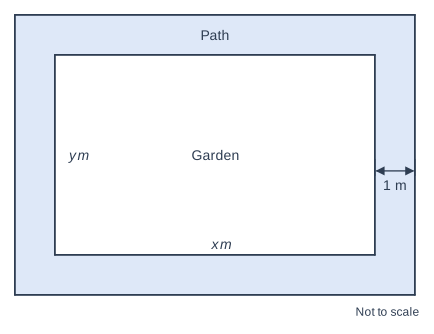
A rectangular garden is x metres long and y metres wide.

A path 1 metre wide is made all the way round the outside of the garden, as shown in the diagram.

Write a formula for the area, A m², of the path.
Give your answer in its simplest form.

Geometry diagram, marked "Not to scale". A rectangle (its vertices are not labelled) (shaded). A rectangle (its vertices are not labelled) (filled white). The unlabelled side going to the right is labelled x m. The unlabelled side going downwards is labelled y m. A double-headed dimension arrow alongside an unlabelled line going to the right (the distance from an unlabelled point to an unlabelled point) is labelled 1 m. The text "Garden" is written inside the shape. The text "Path" is written inside the shape.

Model answer

The garden and path together make a rectangle \((x + 2)\) m by \((y + 2)\) m.
Area of path = outer rectangle − garden
\(= (x + 2)(y + 2) - xy\)
\(= xy + 2x + 2y + 4 - xy\)
\(A = 2x + 2y + 4\)

Explanation

The path adds 1 m on each side, so each outer dimension is 2 m more than the garden's. Subtracting the garden's area from the outer rectangle leaves the path. If you add up strips instead, remember the four 1 m by 1 m corner squares.

Mark scheme
  1. 1 mark

    B1 for the outer dimensions \(x + 2\) and \(y + 2\)

    \(x + 1\) and \(y + 1\) score B0. In a strips method, B1 for the four 1 m by 1 m corner squares (area 4) or for strips of length \(x + 2\) (or \(y + 2\)); correct answer with no working scores full marks

  2. 1 mark

    M1 for \((x + 2)(y + 2) - xy\)

    FT their outer dimensions. Alternative: M1 for splitting the path into strips, e.g. \(2x + 2y + 4 \times 1\) (two long strips, two short strips and four corner squares) or \(2(x + 2) + 2y\).

  3. 1 mark

    M1 for \((x + 2)(y + 2) = xy + 2x + 2y + 4\)

    Implied by a correct strips method.

  4. 1 mark

    A1 for \(A = 2x + 2y + 4\)

    Accept \(A = 2(x + y + 2)\). \(A = 2x + 2y\) (corners missed) scores B0 M1 M0 A0 if from strips. An expression with no 'A =' scores max 3. Correct answer with no working, or from a correct strips method, scores 4 marks.

Ready to try the rest? Every answer you write is marked against the mark scheme, so you can see exactly where the marks are.

Study Helper Hints first, answers after you try

Stuck on this one? Ask for a hint and I’ll point you in the right direction, without giving the answer away. Once you’ve checked your answer, I’ll show you how the marks are awarded.