Practise 16 exam-style questions on Sharing in a ratio for OCR GCSE Maths (Higher non-calculator). Write your answer as you would in the exam and get it marked in seconds against the mark scheme, point by point, with the Study Helper on hand if you get stuck.
16 questions
2–4 marks each
Instant marking
No sign-up needed
16 questions, marked as you go
Sample questions with model answers
Here are 4 of the questions in this topic, each with a model answer, an explanation of why it earns the marks and the mark scheme an examiner would use.
Question 1
2 marks
Mortar is made by mixing sand and cement in the ratio 5 : 2 by mass.
Kai uses 14 kg of cement.
Work out the mass of sand he needs.
Model answer
Cement is 2 parts, so 1 part = 14 ÷ 2 = 7 kg Sand is 5 parts = \(5 \times 7\) = 35 kg
Explanation
Here you know one of the parts, not the total: 2 parts of cement are 14 kg, so 1 part is 7 kg and the 5 parts of sand are 35 kg. A common error is to treat 14 kg as the total and share it in the ratio 5 : 2.
Mark scheme
1 mark
M1 for \(14 \div 2\) or 7 (one part)
Or M1 for \(14 \times \dfrac{5}{2}\) oe; correct answer with no working scores full marks
1 mark
A1 for 35 kg
Correct answer with no working scores 2 marks. 49 (the total mass) scores M1 A0. 5.6 (from \(14 \times \dfrac{2}{5}\)) or 10 (from \(14 \times \dfrac{5}{7}\)) scores 0.
Question 2
3 marks
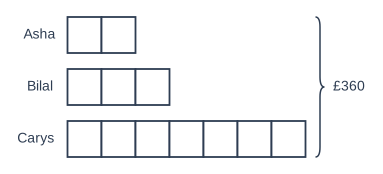
Asha, Bilal and Carys share £360 in the ratio 2 : 3 : 7.
The bar model shows this information.
How much more does Carys get than Asha?
Model answer
Total number of parts = 2 + 3 + 7 = 12 One part = £360 ÷ 12 = £30 Carys has 7 − 2 = 5 more parts than Asha. \(5 \times 30\) = £150
Explanation
Divide £360 by the total number of parts, 12, to get one part, £30. Carys has 5 more parts than Asha, so she gets £150 more. You could also work out both shares (£210 and £60) and subtract. A common error is to stop after finding Carys's share.
Mark scheme
1 mark
M1 for \(360 \div 12\) or 30 (one part)
correct answer with no working scores full marks
1 mark
M1 for \((7 - 2) \times 30\) or \(210 - 60\)
FT their one part. Carys's share 210 and Asha's share 60 both seen implies this mark.
1 mark
A1 for £150
Correct answer with no working scores 3 marks. £210 (Carys's share) scores M1 M0 A0.
Question 3
3 marks
£520 is shared between three charities, A, B and C, in the ratio \(\dfrac{1}{2} : \dfrac{1}{3} : \dfrac{1}{4}\).
How much does charity B get?
Model answer
Multiply each part by 12: \(\dfrac{1}{2} : \dfrac{1}{3} : \dfrac{1}{4} = 6 : 4 : 3\) Total number of parts = 6 + 4 + 3 = 13 One part = £520 ÷ 13 = £40 Charity B gets \(4 \times 40\) = £160
Explanation
Multiply every part by the lowest common multiple of the denominators (12) to get an equivalent ratio of whole numbers, 6 : 4 : 3. Then share £520 into 13 parts. A common error is to think charity B gets \(\dfrac{1}{3}\) of the money: the three fractions add up to more than 1, so they are not fractions of the total.
Mark scheme
1 mark
M1 for 6 : 4 : 3 oe
e.g. from multiplying each part by 12, or \(\dfrac{6}{12} : \dfrac{4}{12} : \dfrac{3}{12}\); correct answer with no working scores full marks
1 mark
M1 for \(520 \div 13\) or 40 (one part)
FT their whole-number ratio. Or M1 for \(\dfrac{4}{13} \times 520\).
1 mark
A1 for £160
Correct answer with no working scores 3 marks. 173.33 (from \(\dfrac{1}{3} \times 520\)) scores 0. £240 (charity A) or £120 (charity C) as the answer: M1 M1 A0.
Question 4
4 marks
Kofi, Lena and Mo share some money in the ratio 2 : 3 : 5. Mo then gives \(\dfrac{2}{5}\) of his share to Kofi. Kofi now has £45 more than Lena.
Work out how much money they shared.
Model answer
Let the shares be 2x, 3x and 5x. Mo gives \(\dfrac{2}{5} \times 5x = 2x\) to Kofi. Kofi now has \(2x + 2x = 4x\). Lena still has 3x. \(4x - 3x = 45\) \(x = 45\) Total = \(2x + 3x + 5x = 10x = 10 \times 45\) = £450
Explanation
Use parts (or 2x, 3x, 5x) for the shares. Mo gives away 2 of his 5 parts, so Kofi ends with 4 parts against Lena's 3: the difference of 1 part is £45. The total is 10 parts, £450. Check: the shares £90, £135, £225 become £180, £135, £135, and £180 − £135 = £45.
Mark scheme
1 mark
M1 for shares written as 2x, 3x and 5x, or for using parts
e.g. a bar model with 2, 3 and 5 equal parts; correct answer with no working scores full marks
1 mark
M1 for Mo giving 2 parts (or 2x) to Kofi, so Kofi has 4 parts (or 4x)
\(\dfrac{2}{5} \times 5x = 2x\) seen.
1 mark
M1 for \(4x - 3x = 45\) or 1 part = 45
FT their number of parts for Kofi.
1 mark
A1 for £450
Correct answer with no working scores 4 marks. 90, 135 and 225 seen as the original shares with no total: M1 M1 M1 A0.
Ready to try the rest? Every answer you write is marked against the mark scheme, so you can see exactly where the marks are.
Ctrl + Enter to check
Study HelperHints first, answers after you try
Stuck on this one? Ask for a hint and I’ll point you in the right direction, without giving the answer away. Once you’ve checked your answer, I’ll show you how the marks are awarded.