Practise 14 exam-style questions on Area of rectangles, parallelograms and trapezia for OCR GCSE Maths (Higher non-calculator). Write your answer as you would in the exam and get it marked in seconds against the mark scheme, point by point, with the Study Helper on hand if you get stuck.
14 questions
1–5 marks each
Instant marking
No sign-up needed
14 questions, marked as you go
Sample questions with model answers
Here are 4 of the questions in this topic, each with a model answer, an explanation of why it earns the marks and the mark scheme an examiner would use.
Question 1
2 marks
A rectangular rug is 2.4 m long and 50 cm wide.
Work out the area of the rug in m².
Model answer
50 cm = 0.5 m Area = \(2.4 \times 0.5 = 1.2\) m²
Explanation
Change both lengths to metres before multiplying, because the answer is wanted in m²: 50 cm = 0.5 m. Then 2.4 × 0.5 = 1.2 m². Multiplying 2.4 by 50 mixes units and gives a meaningless 120.
Mark scheme
1 mark
M1 for \(2.4 \times 0.5\) or \(240 \times 50\) or 12 000 (cm²)
Both lengths must be in the same units; correct answer with no working scores full marks
1 mark
A1 for 1.2
Accept 1.2 m². 120 (from \(2.4 \times 50\)) scores M0 A0. 12 000 cm² given as the final answer scores M1 A0. A correct answer with no working scores 2.
Question 2
3 marks
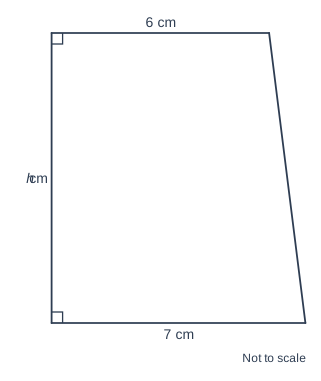
The diagram shows a trapezium. The area of the trapezium is 52 cm².
Substitute what you know into the trapezium formula and solve the equation for h: ½ × 13 × h = 52, so 13h = 104 and h = 8. Doubling first (104 ÷ 13) avoids dividing by a decimal.
Mark scheme
1 mark
M1 for \(\dfrac{1}{2} \times (6 + 7) \times h = 52\) oe
Accept \(6.5h = 52\); correct answer with no working scores full marks
1 mark
M1 for \(52 \div 6.5\) or \(104 \div 13\) oe
A correct first step to isolate h.
1 mark
A1 for 8
A correct answer with no working scores 3. \(52 \div 13 = 4\) (half forgotten) scores M0 M1 A0.
Question 3
3 marks
The lengths of the parallel sides of a trapezium are in the ratio 2 : 3. The perpendicular height of the trapezium is 12 cm. The area of the trapezium is 150 cm².
Work out the length of the longer parallel side.
Model answer
\(\dfrac{1}{2} \times (a + b) \times 12 = 150\) \(6(a + b) = 150\), so \(a + b = 25\) Ratio 2 : 3 has 5 parts, so one part = \(25 \div 5 = 5\) cm Longer side = \(3 \times 5 = 15\) cm
Explanation
Use the area to find the total of the two parallel sides: ½ × (sum) × 12 = 150 gives a sum of 25 cm. Then share 25 in the ratio 2 : 3, giving 10 cm and 15 cm. Check: ½ × 25 × 12 = 150.
Mark scheme
1 mark
M1 for sum of parallel sides = \(150 \div 6\) or \(150 \times 2 \div 12\) or 25, or \(\dfrac{1}{2} \times (2k + 3k) \times 12 = 150\) oe
correct answer with no working scores full marks
1 mark
M1 for \(\dfrac{3}{5} \times\) their 25, or \(k = 5\)
1 mark
A1 for 15
Accept 15 cm. 10 (the shorter side) scores M2 A0. A correct answer with no working scores 3.
Question 4
5 marks
A rectangle has length \((x + 4)\) cm and width \((x - 3)\) cm. The area of the rectangle is 78 cm².
Work out the perimeter of the rectangle.
Model answer
\((x + 4)(x - 3) = 78\) \(x^2 + x - 12 = 78\) \(x^2 + x - 90 = 0\) \((x + 10)(x - 9) = 0\) \(x = -10\) or \(x = 9\) A length cannot be negative, so \(x = 9\). Length = 13 cm, width = 6 cm (check: \(13 \times 6 = 78\)) Perimeter = \(2 \times (13 + 6) = 38\) cm
Explanation
Form an equation from the area, expand and rearrange to a quadratic equal to zero, then factorise. Reject x = −10 because it would make the width −13 cm. The question asks for the perimeter, so finish by working out 2 × (13 + 6).
Mark scheme
1 mark
M1 for \((x + 4)(x - 3) = 78\)
correct answer with no working scores full marks
1 mark
M1 for \(x^2 + x - 12 = 78\) or \(x^2 + x - 90 = 0\)
Allow one sign or arithmetic slip in the expansion for this mark.
1 mark
M1 for \((x + 10)(x - 9) = 0\) or a correct method to solve their three-term quadratic
Accept correct substitution into the quadratic formula. Trial: \(13 \times 6 = 78\) seen with x = 9 implies M3.
1 mark
A1 for \(x = 9\) only
\(x = -10\) must be rejected or ignored: it gives a negative width.
1 mark
A1 for 38
Accept 38 cm. From \(2 \times (13 + 6)\). A correct answer with no working scores 5.
Ready to try the rest? Every answer you write is marked against the mark scheme, so you can see exactly where the marks are.
Ctrl + Enter to check
Study HelperHints first, answers after you try
Stuck on this one? Ask for a hint and I’ll point you in the right direction, without giving the answer away. Once you’ve checked your answer, I’ll show you how the marks are awarded.