Practise 17 exam-style questions on Growth, decay and compound interest for OCR GCSE Maths (Higher non-calculator). Write your answer as you would in the exam and get it marked in seconds against the mark scheme, point by point, with the Study Helper on hand if you get stuck.
17 questions
1–4 marks each
Instant marking
No sign-up needed
17 questions, marked as you go
Sample questions with model answers
Here are 4 of the questions in this topic, each with a model answer, an explanation of why it earns the marks and the mark scheme an examiner would use.
Question 1
2 marks
Ravi invests £2500 in an account that pays simple interest. After 3 years he has earned £300 in interest.
Work out the rate of interest per year.
Model answer
Interest each year = £300 ÷ 3 = £100 Rate = \(\dfrac{100}{2500} \times 100\) = 4% per year
Explanation
With simple interest the same amount is earned each year: £100. Write this as a percentage of the amount invested, £2500. A common error is to give 12%, which is the total percentage over the 3 years.
Mark scheme
1 mark
M1 for \(300 \div 3\) or 100 (interest each year), or \(\dfrac{300}{2500}\) or 12%
correct answer with no working scores full marks
1 mark
A1 for 4(%)
Correct answer with no working scores 2 marks. 12% (the total over 3 years) scores M1 A0.
Question 2
2 marks
The mass of a radioactive substance decreases by 50% every 6 hours.
At the start there is 640 mg of the substance.
Work out the mass of the substance after 1 day.
Model answer
1 day = 24 hours = 4 lots of 6 hours. 640 → 320 → 160 → 80 → 40 After 1 day there is 40 mg.
Explanation
Each 6-hour period halves the mass that is left, and a day contains four of these periods, so the mass is multiplied by \(0.5^4 = \dfrac{1}{16}\). A common error is to halve the wrong number of times, or to think the substance has all gone.
Mark scheme
1 mark
M1 for \(24 \div 6\) or 4 (periods of 6 hours), or 640 halved at least twice correctly (320, 160)
Or M1 for \(640 \times 0.5^4\); correct answer with no working scores full marks
1 mark
A1 for 40 (mg)
Correct answer with no working scores 2 marks. 160 (2 halvings) or 80 (3 halvings) scores M1 A0. 0 (from 4 × 50% = 200%) scores 0.
Question 3
3 marks
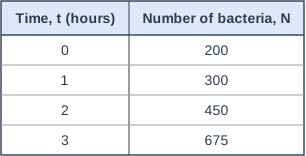
The table shows the number of bacteria, N, in a sample t hours after the start of an experiment.
Show that the number of bacteria is increasing by the same percentage each hour. Find a formula for N in terms of t.
Model answer
\(300 \div 200 = 1.5\) \(450 \div 300 = 1.5\) \(675 \div 450 = 1.5\) The number is multiplied by 1.5 every hour, so it increases by 50% each hour. At t = 0, N = 200, so \(N = 200 \times 1.5^t\).
Explanation
Exponential growth means multiplying by the same number each time, so divide each value by the one before: every ratio is 1.5 (a 50% increase). The formula is the starting value times the multiplier to the power t. Note the differences (100, 150, 225) are not constant, so the growth is not linear.
Mark scheme
1 mark
M1 for one multiplier found, e.g. \(300 \div 200 = 1.5\), or one percentage increase of 50%
1 mark
M1 for all three multipliers shown to be 1.5 (or all three increases 50%)
e.g. \(450 \div 300 = 1.5\) and \(675 \div 450 = 1.5\). Showing the differences (100, 150, 225) are not equal is not enough.
1 mark
B1 for \(N = 200 \times 1.5^t\) oe
Independent of the first two marks. Accept \(N = 200(1.5)^t\). \(N = 200 + 100t\) or \(N = 200 \times 0.5^t\) scores B0. 'Show that': the first two marks need the divisions (or percentage increases) to be shown; a correct formula with no other working scores this B1 only.
Question 4
3 marks
The value of an antique increased by 20% in one year. In the next year, its value decreased by x%. Over the two years, the value of the antique increased by 2%.
Work out the value of x.
Model answer
Suppose the antique was worth £100. After year 1: £120 After year 2 it is worth 2% more than at the start: £102 Decrease in year 2 = 120 − 102 = £18 x = \(\dfrac{18}{120} \times 100\) = 15
Explanation
Use multipliers: \(1.2 \times m = 1.02\), so m = 0.85, a decrease of 15%. Choosing a starting value of £100 makes this easy to see. A common error is to subtract the percentages (20 − 2 = 18), but the second percentage is of the larger value after the increase.
Mark scheme
1 mark
M1 for \(1.2 \times m = 1.02\) or \(1.2\left(1 - \dfrac{x}{100}\right) = 1.02\) oe
Or M1 for a starting value, e.g. £100 → £120 → £102; correct answer with no working scores full marks
1 mark
M1 for \(m = 1.02 \div 1.2 = 0.85\), or a decrease of 18 from 120 and \(\dfrac{18}{120}\)
1 mark
A1 for 15
Correct answer with no working scores 3 marks. 18 (from 20 − 2) scores 0. 85 scores M1 M1 A0.
Ready to try the rest? Every answer you write is marked against the mark scheme, so you can see exactly where the marks are.
Ctrl + Enter to check
Study HelperHints first, answers after you try
Stuck on this one? Ask for a hint and I’ll point you in the right direction, without giving the answer away. Once you’ve checked your answer, I’ll show you how the marks are awarded.