Practise 21 exam-style questions on Surds for OCR GCSE Maths (Higher non-calculator). Write your answer as you would in the exam and get it marked in seconds against the mark scheme, point by point, with the Study Helper on hand if you get stuck.
21 questions
1–4 marks each
Instant marking
No sign-up needed
20 questions, marked as you go
Sample questions with model answers
Here are 4 of the questions in this topic, each with a model answer, an explanation of why it earns the marks and the mark scheme an examiner would use.
Question 1
2 marks
Work out \(\sqrt{98} - \sqrt{32}\).
Give your answer in the form \(a\sqrt{2}\), where \(a\) is an integer.
Surds can only be added or subtracted when they are multiples of the same surd, so write each one as a multiple of \(\sqrt{2}\) first, using the square factors 49 and 16. Then subtract the coefficients: \(7 - 4 = 3\). A common error is to subtract the numbers under the roots, giving \(\sqrt{66}\), which is wrong.
Mark scheme
1 mark
M1 for \(\sqrt{98} = 7\sqrt{2}\) or \(\sqrt{32} = 4\sqrt{2}\)
Either surd correctly written as a multiple of \(\sqrt{2}\), e.g. \(\sqrt{49} \times \sqrt{2}\) or \(\sqrt{16} \times \sqrt{2}\); correct answer with no working scores full marks
1 mark
A1 for \(3\sqrt{2}\)
Accept \(a = 3\). Correct answer with no working scores 2 marks. \(\sqrt{66}\) (from \(\sqrt{98 - 32}\)) scores 0. \(\sqrt{18}\) as the final answer is not in the required form: M1 A0 if a correct simplified surd is seen in the working, otherwise 0.
Question 2
2 marks
Kiera is asked to expand and simplify \((\sqrt{3} + \sqrt{5})^2\).
Explain the mistake Kiera has made. Work out the correct answer.
Model answer
Kiera has squared each term on its own. She has missed out the middle terms, \(\sqrt{3} \times \sqrt{5}\) twice. \((\sqrt{3} + \sqrt{5})^2 = (\sqrt{3} + \sqrt{5})(\sqrt{3} + \sqrt{5})\) \(= 3 + \sqrt{15} + \sqrt{15} + 5\) \(= 8 + 2\sqrt{15}\)
Explanation
Squaring a bracket means multiplying it by itself, which gives four terms, not two. The two middle terms are each \(\sqrt{3} \times \sqrt{5} = \sqrt{15}\), so the answer is \(8 + 2\sqrt{15}\). This is the same mistake as writing \((a + b)^2 = a^2 + b^2\).
Mark scheme
1 mark
B1 for an explanation such as: she has squared each term separately instead of multiplying out \((\sqrt{3} + \sqrt{5})(\sqrt{3} + \sqrt{5})\) / she has missed out the middle terms \(2\sqrt{3}\sqrt{5}\) or \(2\sqrt{15}\)
Accept any clear statement that the two cross terms (\(\sqrt{15}\) twice) are missing. Do not accept 'she added instead of multiplied', 'the answer should be a surd' or 'she did not simplify' on their own.
1 mark
B1 for \(8 + 2\sqrt{15}\)
Accept \(2\sqrt{15} + 8\). \(8 + \sqrt{15}\) scores B0. \(8 + \sqrt{60}\) is not fully simplified: B0 for this mark.
Question 3
3 marks
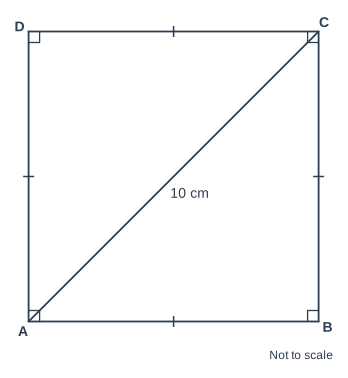
The diagram shows a square ABCD.
The diagonal AC is 10 cm long.
Work out the perimeter of the square. Give your answer as a surd in its simplest form.
Model answer
Let the side of the square be \(x\) cm. \(x^2 + x^2 = 10^2\) \(2x^2 = 100\) \(x^2 = 50\) \(x = \sqrt{50} = \sqrt{25} \times \sqrt{2} = 5\sqrt{2}\) Perimeter = \(4 \times 5\sqrt{2} = 20\sqrt{2}\) cm
Explanation
The diagonal is the hypotenuse of a right-angled isosceles triangle whose two shorter sides are the sides of the square, so \(2x^2 = 100\). Then simplify \(\sqrt{50} = 5\sqrt{2}\) and multiply by 4. A common error is to treat the diagonal as a side, or to halve the diagonal (5 cm) and use it as the side.
Mark scheme
1 mark
M1 for \(x^2 + x^2 = 10^2\) or \(x^2 = 50\), where x is the side length
Or M1 for area of the square = \(\dfrac{1}{2} \times 10 \times 10 = 50\); correct answer with no working scores full marks
1 mark
M1 for \(4 \times \sqrt{50}\) oe
FT their \(x^2\). Accept \(4 \times 5\sqrt{2}\).
1 mark
A1 for \(20\sqrt{2}\) cm
\(4\sqrt{50}\) or \(\sqrt{800}\) as the final answer: M1 M1 A0. 40 (from a side of 10) scores 0. 28.3 or 28.28 with the method seen: M1 M1 A0.
Question 4
4 marks
A cube has a total surface area of 72 cm².
Work out the volume of the cube. Give your answer as a surd in its simplest form.
Model answer
A cube has 6 equal square faces. Area of one face = \(72 \div 6 = 12\) cm² Edge = \(\sqrt{12} = \sqrt{4} \times \sqrt{3} = 2\sqrt{3}\) cm Volume = \((2\sqrt{3})^3 = 2^3 \times (\sqrt{3})^3 = 8 \times 3\sqrt{3}\) \(= 24\sqrt{3}\) cm³
Explanation
Work back from the surface area: 6 faces share 72 cm², so each face is 12 cm² and the edge is \(\sqrt{12} = 2\sqrt{3}\) cm. Cubing gives \(8 \times (\sqrt{3})^3\), and \((\sqrt{3})^3 = 3\sqrt{3}\). Common errors are using 12 as the edge length and writing \((\sqrt{3})^3\) as 9 or 3.
Mark scheme
1 mark
M1 for \(72 \div 6\) or 12 (the area of one face)
correct answer with no working scores full marks
1 mark
M1 for edge \(= \sqrt{12}\) or \(2\sqrt{3}\)
FT \(\sqrt{\text{their face area}}\).
1 mark
M1 for \((\sqrt{12})^3\) or \((2\sqrt{3})^3\) or \(12\sqrt{12}\) oe
FT their edge cubed.
1 mark
A1 for \(24\sqrt{3}\) cm³
cao. \(12\sqrt{12}\) or \(\sqrt{1728}\) or \(8 \times 3\sqrt{3}\) as the final answer: M1 M1 M1 A0. 1728 (from \(12^3\)) scores M1 M0 M0 A0. A decimal such as 41.6 with the method seen: M1 M1 M1 A0.
Ready to try the rest? Every answer you write is marked against the mark scheme, so you can see exactly where the marks are.
Ctrl + Enter to check
Study HelperHints first, answers after you try
Stuck on this one? Ask for a hint and I’ll point you in the right direction, without giving the answer away. Once you’ve checked your answer, I’ll show you how the marks are awarded.