Level:
Correct: 0
Incorrect: 0
Marks: 0/0
Exam Practice
Course:
Topics:
OCR GCSE Maths (Higher non-calculator) Smart practice A mixed round aimed at your weak spots
Unit 1
Number Operations and Integers
Unit 2
Fractions, Decimals and Percentages
Unit 3
Indices and Surds
Unit 4
Approximation and Estimation
Unit 5
Ratio, Proportion and Rates of Change
Unit 6
Algebra
Unit 7
Graphs of Equations and Functions
Unit 8
Basic Geometry
Unit 9
Congruence and Similarity
Unit 10
Mensuration
Unit 11
Probability
Unit 12
Statistics
Avg
score:
–
Topics
done:
0/121

Real-life graphs

Practise 15 exam-style questions on Real-life graphs for OCR GCSE Maths (Higher non-calculator). Write your answer as you would in the exam and get it marked in seconds against the mark scheme, point by point, with the Study Helper on hand if you get stuck.

  • 15 questions
  • 1–4 marks each
  • Instant marking
  • No sign-up needed
15 questions, marked as you go

Sample questions with model answers

Here are 4 of the questions in this topic, each with a model answer, an explanation of why it earns the marks and the mark scheme an examiner would use.

Question 1

1 mark

Lily walked to school.
She drew this distance-time graph of her walk.

Explain why the section BC of the graph cannot be correct.
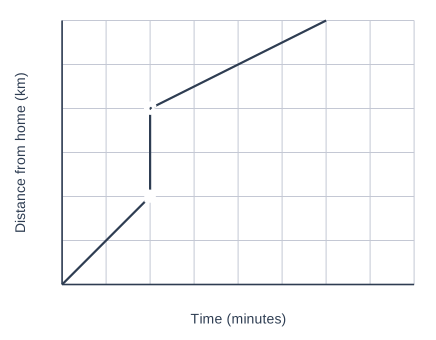
A graph of Distance from home (km) (vertical axis, 0 to 3, marked every 0.5) against Time (minutes) (horizontal axis, 0 to 40, marked every 5), on a grid. The graph is made of straight-line sections joining (0, 0), (10, 1), (10, 2) and (30, 3). Point B is marked at (10, 1). Point C is marked at (10, 2).

Model answer

BC is a vertical line. It shows Lily's distance from home increasing from 1 km to 2 km while the time stays at 10 minutes. She cannot travel 1 km in no time, so this section is impossible.

Explanation

On a distance-time graph, time always moves on, so a graph of a real journey can never be vertical. A vertical section would mean covering a distance in zero time, which needs an infinite speed. Do not confuse a distance-time graph with a picture of the route: a steep line does not mean a hill.

Mark scheme
  1. 1 mark

    B1 for a correct explanation, e.g. BC shows Lily moving 1 km in no time / her distance changes but no time passes / she would need an infinite speed

    Accept 'the line is vertical, so time does not change while distance does' oe. Do not accept 'she is walking up a hill', 'she stopped' or 'she ran'.
Question 2

2 marks

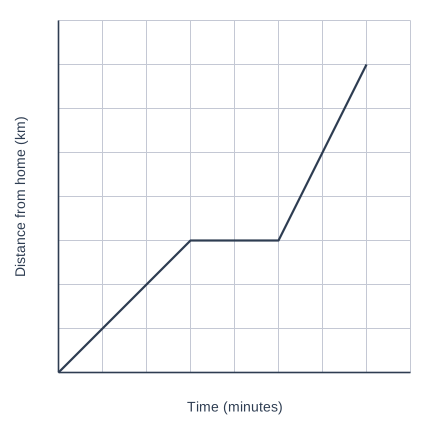
Kwame travels by bus to a lake.

The graph shows his journey.

Work out Kwame's speed, in kilometres per hour, for the first 30 minutes of his journey.

A graph of Distance from home (km) (vertical axis, 0 to 40, marked every 5) against Time (minutes) (horizontal axis, 0 to 80, marked every 10), on a grid. The graph is made of straight-line sections joining (0, 0), (30, 15), (50, 15) and (70, 35).

Model answer

In the first 30 minutes Kwame travels 15 km.
30 minutes = 0.5 hours
Speed = 15 ÷ 0.5 = 30 km/h

Explanation

Read the distance travelled in the first section (15 km) and the time it took (30 minutes). Speed = distance ÷ time, but the time must be in hours to get km/h: 30 minutes is half an hour, so double the distance. Dividing 15 by 30 gives 0.5 km per minute, which is not in the units asked for.

Mark scheme
  1. 1 mark

    M1 for 15 ÷ 30 or 15 × 2 oe

    Or 0.5 km per minute seen. Must use 15 km and 30 minutes from the graph; correct answer with no working scores full marks

  2. 1 mark

    A1 for 30

    Accept 30 km/h. 0.5 (km per minute) scores M1 A0.

Question 3

2 marks

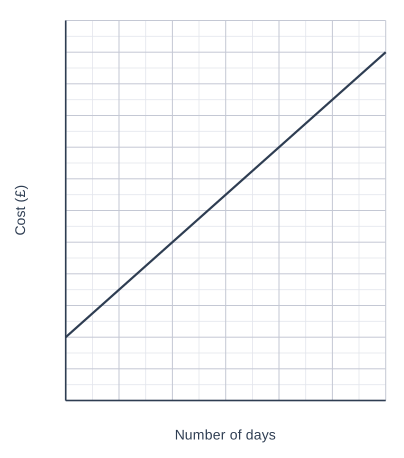
The graph shows the cost of hiring a carpet cleaner for different numbers of days.

Mark hires the carpet cleaner for 3 days.
Sue hires the carpet cleaner for 6 days.

Sue says,

'I paid twice as much as Mark.'

Is Sue correct?
Show how you decide.

A graph of Cost (£) (vertical axis, 0 to 120, marked every 10) against Number of days (horizontal axis, 0 to 6, marked every 1), on a grid with 2 small squares to each large square. The graph is a straight line joining (0, 20) and (6, 110).

Model answer

From the graph, 3 days costs £65 and 6 days costs £110.
Twice Mark's cost = 2 × £65 = £130
£110 is not £130, so Sue is not correct.
(There is a fixed charge of £20, so the cost is not directly proportional to the number of days.)

Explanation

Read both costs from the graph and compare. The line does not start at the origin: there is a fixed charge of £20 plus £15 for each day. Doubling the number of days doubles only the daily part of the cost, not the fixed charge, so the total does not double.

Mark scheme
  1. 1 mark

    B1 for reading £65 for 3 days and £110 for 6 days

    Both readings needed. Accept readings within one small square (£5).

  2. 1 mark

    B1 for No with correct comparison, e.g. 2 × 65 = 130, which is not 110

    FT their readings. Also accept 'No, because there is a fixed charge of £20 / the graph does not go through the origin' with at least one correct reading. 'No' alone scores 0.

Question 4

4 marks

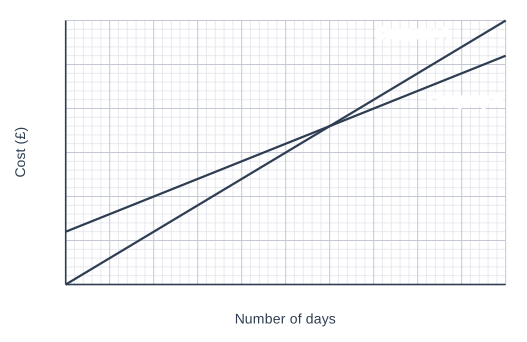
The graph shows the cost of hiring a van from two companies, A and B.

Ava hires a van for 4 days.
Mo hires a van for 8 days.
Each of them uses the company that is cheaper for their number of days.

Work out the total amount that Ava and Mo pay altogether.

A graph of Cost (£) (vertical axis, 0 to 300, marked every 50) against Number of days (horizontal axis, 0 to 10, marked every 1), on a grid with 5 small squares to each large square. The graph labelled "Company A" is a straight line; its values can be read from the grid. The graph labelled "Company B" is a straight line; its values can be read from the grid. The graph labelled "Company A" and the graph labelled "Company B" cross at one point, which can be read from the grid.

Model answer

For 4 days: Company A costs £120 and Company B costs £140, so Ava uses A and pays £120.
For 8 days: Company A costs £240 and Company B costs £220, so Mo uses B and pays £220.
Total = £120 + £220 = £340

Explanation

The lines cross at 6 days, where both companies charge the same. For fewer days Company A is cheaper, and for more days Company B is cheaper, because B has a fixed charge but a lower daily rate. Read both costs for each person and choose the smaller one each time. A common error is to use the same company for both people.

Mark scheme
  1. 1 mark

    M1 for reading both costs for 4 days: £120 (A) and £140 (B)

    Accept readings within one small square (£10); correct answer with no working scores full marks

  2. 1 mark

    M1 for reading both costs for 8 days: £240 (A) and £220 (B)

    Accept readings within one small square (£10).

  3. 1 mark

    A1 for choosing £120 for Ava and £220 for Mo

    Implied by a correct total.

  4. 1 mark

    A1 for £340

    Accept 340. £360 (both using Company A) or £360 (both using Company B: 140 + 220) score M1 M1 A0 A0.

Ready to try the rest? Every answer you write is marked against the mark scheme, so you can see exactly where the marks are.

Study Helper Hints first, answers after you try

Stuck on this one? Ask for a hint and I’ll point you in the right direction, without giving the answer away. Once you’ve checked your answer, I’ll show you how the marks are awarded.