Practise 18 exam-style questions on Area of a triangle for OCR GCSE Maths (Higher non-calculator). Write your answer as you would in the exam and get it marked in seconds against the mark scheme, point by point, with the Study Helper on hand if you get stuck.
18 questions
2–5 marks each
Instant marking
No sign-up needed
18 questions, marked as you go
Sample questions with model answers
Here are 4 of the questions in this topic, each with a model answer, an explanation of why it earns the marks and the mark scheme an examiner would use.
Question 1
2 marks
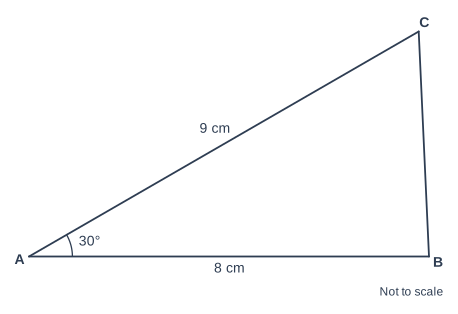
The diagram shows triangle ABC.
AB = 8 cm, AC = 9 cm and angle BAC = 30°.
Work out the area of triangle ABC.
Model answer
The angle of 30° is between the sides of 8 cm and 9 cm. Area = \(\dfrac{1}{2}ab\sin C\) Area = \(\dfrac{1}{2} \times 8 \times 9 \times \sin 30^\circ\) \(\sin 30^\circ = \dfrac{1}{2}\), so Area = \(36 \times \dfrac{1}{2} = 18\) cm²
Explanation
When you know two sides and the angle between them, the area is ½ab sin C. Here a = 8, b = 9 and C = 30°, and you need to recall that sin 30° = ½. Common errors are forgetting the ½ at the front or using cos instead of sin.
Accept sin 30 without the degree sign. \(36 \times \dfrac{1}{2}\), \(36 \times 0.5\) or \(\dfrac{1}{2} \times 8 \times 4.5\) (using the height \(9\sin 30^\circ = 4.5\)) implies M1. Using cos 30° or tan 30° scores M0. \(\dfrac{1}{2} \times 8 \times 9 = 36\) on its own scores M0; correct answer with no working scores full marks
1 mark
A1 for 18
Accept 18 cm². A correct answer with no working scores 2 marks.
Question 2
3 marks
An equilateral triangle has sides of length 6 cm.
Work out the area of the triangle. Give your answer in the form \(a\sqrt{3}\), where \(a\) is an integer.
Model answer
Each angle of an equilateral triangle is 60°. Area = \(\dfrac{1}{2} \times 6 \times 6 \times \sin 60^\circ\) Area = \(18 \times \dfrac{\sqrt{3}}{2}\) Area = \(9\sqrt{3}\) cm²
Explanation
Every angle in an equilateral triangle is 60°, so use ½ab sin C with sin 60° = √3/2. Another method is to find the height with Pythagoras: h² = 6² − 3² = 27, so h = √27 = 3√3, and the area is ½ × 6 × 3√3 = 9√3. Leave the answer as a surd: a decimal is not in the form asked for.
Mark scheme
1 mark
M1 for \(\dfrac{1}{2} \times 6 \times 6 \times \sin 60^\circ\) oe, or for \(h^2 = 6^2 - 3^2\) oe
Either method: ½ab sin C with the 60° angle, or Pythagoras for the perpendicular height h. 27 or \(\sqrt{27}\) seen implies M1; correct answer with no working scores full marks
1 mark
M1 for \(18 \times \dfrac{\sqrt{3}}{2}\) oe, or for \(\dfrac{1}{2} \times 6 \times \sqrt{27}\) oe
A complete method with an exact value: sin 60° = \(\dfrac{\sqrt{3}}{2}\) used, or the exact height used. Accept \(\dfrac{1}{2} \times 6 \times 3\sqrt{3}\).
1 mark
A1 for \(9\sqrt{3}\)
cao. Accept \(9\sqrt{3}\) cm². \(\sqrt{243}\), \(3\sqrt{27}\) or \(\dfrac{18\sqrt{3}}{2}\) score M1 M1 A0. A decimal answer (15.58...) scores M1 M1 A0.
Question 3
3 marks
Triangle P has two sides of length 6 cm and 10 cm, with an angle of 30° between them. Triangle Q has two sides of length 6 cm and 10 cm, with an angle of 150° between them.
Show that triangle P and triangle Q have the same area.
Model answer
Area of P = \(\dfrac{1}{2} \times 6 \times 10 \times \sin 30^\circ = 30 \times \dfrac{1}{2} = 15\) cm² Area of Q = \(\dfrac{1}{2} \times 6 \times 10 \times \sin 150^\circ\) The graph of y = sin x is symmetrical about x = 90°, so \(\sin 150^\circ = \sin 30^\circ = \dfrac{1}{2}\). Area of Q = \(30 \times \dfrac{1}{2} = 15\) cm² Both triangles have an area of 15 cm², so they have the same area.
Explanation
Both areas come from ½ab sin C with the same a and b, so you need sin 150° = sin 30°: the sine graph is symmetrical about 90°, so sin(180° − θ) = sin θ. Or find the height of triangle Q directly: extending the 6 cm side makes a right-angled triangle with a 30° angle, so the height is 10 sin 30° = 5 cm. Because the result is given, you must show both areas and a conclusion.
Mark scheme
1 mark
M1 for area of P = \(\dfrac{1}{2} \times 6 \times 10 \times \sin 30^\circ\) oe
15 seen for triangle P implies M1.
1 mark
M1 for area of Q = \(\dfrac{1}{2} \times 6 \times 10 \times \sin 150^\circ\) with \(\sin 150^\circ = \sin 30^\circ\) or \(\dfrac{1}{2}\) oe, or for the height of Q = \(10\sin 30^\circ\) oe
Accept sin 150° = sin 30° stated as a fact, or justified by the symmetry of the graph of y = sin x about x = 90°. Height method: the perpendicular from the end of the 10 cm side to the 6 cm side extended makes a right-angled triangle with an angle of 180° − 150° = 30°, so the height is 5 cm and the area is \(\dfrac{1}{2} \times 6 \times 5\). Also accept height \(6\sin 30^\circ = 3\) with base 10.
1 mark
A1 for both areas = 15 (cm²) with a conclusion
e.g. 'both areas are 15 cm², so they are the same'. This is a 'show that' question: a statement with no working scores 0. sin 150° = \(-\dfrac{1}{2}\) scores M1 M0 A0.
Question 4
4 marks
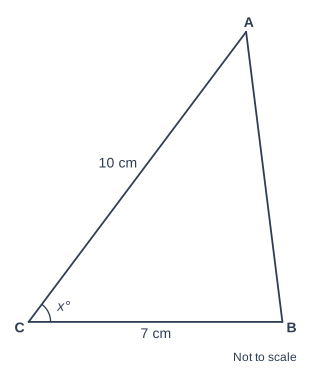
The diagram shows triangle ABC.
CA = 10 cm, CB = 7 cm and angle ACB = \(x^\circ\). \(\cos x^\circ = 0.6\)
Work out the area of triangle ABC.
Model answer
cos x° = 0.6 = \(\dfrac{3}{5}\), so x° is an angle in a right-angled triangle with adjacent side 3 and hypotenuse 5. Opposite side = \(\sqrt{5^2 - 3^2} = 4\), so \(\sin x^\circ = \dfrac{4}{5} = 0.8\) Area = \(\dfrac{1}{2} \times 10 \times 7 \times 0.8\) Area = \(35 \times 0.8 = 28\) cm²
Explanation
The area needs sin x°, but you are given cos x°. Since cos x° = 3/5, draw a 3-4-5 right-angled triangle to see that sin x° = 4/5. Or drop a perpendicular from A to CB: it meets CB 10 × 0.6 = 6 cm from C, and Pythagoras gives the height 8 cm, so the area is ½ × 7 × 8. Using 0.6 in ½ab sin C (giving 21) is the common error.
Mark scheme
1 mark
M1 for a correct method to find \(\sin x^\circ\), or the perpendicular height from A to CB
e.g. a right-angled triangle with adjacent 3 and hypotenuse 5, so the opposite side is 4; or \(\sqrt{1 - 0.6^2}\); or CH = \(10 \times 0.6 = 6\) then \(AH^2 = 10^2 - 6^2\), where H is the foot of the perpendicular from A to CB; correct answer with no working scores full marks
1 mark
A1 for \(\sin x^\circ = 0.8\) oe, or height AH = 8
Accept \(\sin x^\circ = \dfrac{4}{5}\).
1 mark
M1 for \(\dfrac{1}{2} \times 10 \times 7 \times\) their 0.8 oe, or \(\dfrac{1}{2} \times 7 \times\) their 8 oe
Their value must be an attempt at sin x° or the height, not 0.6. \(\dfrac{1}{2} \times 10 \times 7 \times 0.6 = 21\) (using the cosine) scores 0 marks in total.
1 mark
A1 for 28
Accept 28 cm². A correct answer with no working scores 4 marks.
Ready to try the rest? Every answer you write is marked against the mark scheme, so you can see exactly where the marks are.
Ctrl + Enter to check
Study HelperHints first, answers after you try
Stuck on this one? Ask for a hint and I’ll point you in the right direction, without giving the answer away. Once you’ve checked your answer, I’ll show you how the marks are awarded.