
Level:
Correct: 0
Incorrect: 0
Marks: 0/0
Exam Practice
Course:
Topics:
OCR GCSE Maths (Higher non-calculator) Smart practice A mixed round aimed at your weak spots
Unit 1
Number Operations and Integers
Unit 2
Fractions, Decimals and Percentages
Unit 3
Indices and Surds
Unit 4
Approximation and Estimation
Unit 5
Ratio, Proportion and Rates of Change
Unit 6
Algebra
Unit 7
Graphs of Equations and Functions
Unit 8
Basic Geometry
Unit 9
Congruence and Similarity
Unit 10
Mensuration
Unit 11
Probability
Unit 12
Statistics
Avg
score:
–
Topics
done:
0/121

Ratio and proportion problems

Practise 15 exam-style questions on Ratio and proportion problems for OCR GCSE Maths (Higher non-calculator). Write your answer as you would in the exam and get it marked in seconds against the mark scheme, point by point, with the Study Helper on hand if you get stuck.

  • 15 questions
  • 2–5 marks each
  • Instant marking
  • No sign-up needed
15 questions, marked as you go

Sample questions with model answers

Here are 4 of the questions in this topic, each with a model answer, an explanation of why it earns the marks and the mark scheme an examiner would use.

Question 1

2 marks

5 pens cost £3.40.

Work out the cost of 8 pens.

Model answer

Cost of 1 pen = £3.40 ÷ 5 = £0.68
Cost of 8 pens = \(8 \times 0.68\) = £5.44

Explanation

Find the cost of one pen, then multiply by 8 (the unitary method). Working in pence (340 ÷ 5 = 68) makes the division easier. A common error is to add 3 to the price because there are 3 more pens.

Mark scheme
  1. 1 mark

    M1 for \(3.40 \div 5\) or 0.68 or 68p (cost of one pen)

    Or M1 for \(3.40 \times \dfrac{8}{5}\) oe; correct answer with no working scores full marks

  2. 1 mark

    A1 for £5.44

    Accept 544p. Correct answer with no working scores 2 marks. £6.40 (from 3.40 + 3) scores 0.
Question 2

2 marks

Amy mixes white paint and red paint to make pink paint.
She makes batches of different sizes, always mixing the paints in the same ratio.

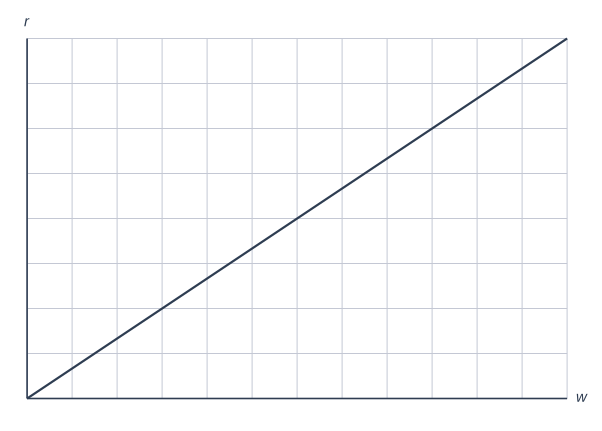
The graph shows the amount of red paint, r litres, she mixes with w litres of white paint.

Find an equation for r in terms of w.

A coordinate grid with w from 0 to 12 and r from 0 to 8; each grid square is 1 unit across, and the axes cross at the origin O. The line is a straight line sloping upwards from left to right passing through (6, 4) and (12, 8).

Model answer

The line passes through (0, 0) and (6, 4).
So 6 litres of white paint is mixed with 4 litres of red paint: w : r = 6 : 4 = 3 : 2.
Gradient = \(\dfrac{4}{6} = \dfrac{2}{3}\), and the line goes through the origin.
\(r = \dfrac{2}{3}w\)

Explanation

When two quantities are always in the same ratio, the graph of one against the other is a straight line through the origin, and its equation is r = kw. The gradient k is red ÷ white, \(\dfrac{2}{3}\), which comes straight from the ratio w : r = 3 : 2. A common error is to turn the ratio upside down and write \(r = \dfrac{3}{2}w\).

Mark scheme
  1. 1 mark

    M1 for a correct pair of values read from the graph, e.g. (3, 2), (6, 4) or (12, 8), or w : r = 3 : 2, or gradient \(\dfrac{8}{12}\) oe

    correct answer with no working scores full marks

  2. 1 mark

    A1 for \(r = \dfrac{2}{3}w\) oe

    Accept \(r = \dfrac{2w}{3}\), \(3r = 2w\), \(r = 0.67w\) or \(r = 0.6\dot{6}w\). \(r = \dfrac{3}{2}w\) or \(r = 1.5w\) scores M1 A0. \(r = \dfrac{2}{3}w + c\) with a non-zero c scores M1 A0. Correct answer with no working scores 2 marks.

Question 3

3 marks

Here are the ingredients needed to make 12 biscuits.

150 g butter
225 g flour
75 g sugar

Leon has 500 g of butter, 600 g of flour and 250 g of sugar.

Work out the greatest number of biscuits Leon can make.

Model answer

Number of batches of 12 each ingredient allows:
Butter: 500 ÷ 150 = \(3\dfrac{1}{3}\), so 40 biscuits
Flour: 600 ÷ 225 = \(2\dfrac{2}{3}\), so \(2\dfrac{2}{3} \times 12\) = 32 biscuits
Sugar: 250 ÷ 75 = \(3\dfrac{1}{3}\), so 40 biscuits
The flour runs out first, so Leon can make 32 biscuits.

Explanation

Work out how many biscuits each ingredient on its own would allow; the smallest answer is the limit, because Leon runs out of that ingredient first. Here the flour limits him to 32 biscuits, and he will have butter and sugar left over. A common error is to use only one ingredient, or to allow only whole batches of 12.

Mark scheme
  1. 1 mark

    M1 for a correct number of biscuits (or batches) for one ingredient, e.g. flour \(600 \div 225 \times 12 = 32\), butter 40 or sugar 40

    Or M1 for the amount of one ingredient per biscuit, e.g. 12.5 g butter, 18.75 g flour or 6.25 g sugar; correct answer with no working scores full marks

  2. 1 mark

    M1 for all three ingredients compared, or flour identified as the ingredient that runs out first

    e.g. 40, 32 and 40 seen; or \(2\dfrac{2}{3}\) batches of flour compared with \(3\dfrac{1}{3}\) batches of butter and sugar.

  3. 1 mark

    A1 for 32

    Correct answer with no working scores 3 marks. 24 (whole batches of 12 only) scores M1 M1 A0. 40 scores M1 M0 A0.

Question 4

4 marks

Paint A is made by mixing blue paint and yellow paint in the ratio 2 : 3.
Paint B is made by mixing blue paint and yellow paint in the ratio 1 : 4.

Zak mixes some of paint A with some of paint B.
In Zak's mixture, blue paint : yellow paint = 1 : 3.

Work out the ratio of paint A to paint B that Zak uses.

Model answer

Let Zak use a litres of A and b litres of B.
Blue in A = \(\dfrac{2}{5}a\), blue in B = \(\dfrac{1}{5}b\)
Blue is \(\dfrac{1}{4}\) of the mixture:
\(\dfrac{2}{5}a + \dfrac{1}{5}b = \dfrac{1}{4}(a + b)\)
Multiply by 20: \(8a + 4b = 5a + 5b\)
\(3a = b\)
A : B = 1 : 3
Check: 4 litres of A has 1.6 litres blue; 12 litres of B has 2.4 litres blue; 4 litres blue out of 16 litres is \(\dfrac{1}{4}\).

Explanation

Change each ratio into the fraction of blue paint: \(\dfrac{2}{5}\) in A, \(\dfrac{1}{5}\) in B and \(\dfrac{1}{4}\) in the mixture. Then the blue paint from both must make up \(\dfrac{1}{4}\) of the total, which gives b = 3a. Trying amounts (such as 5 litres of each) and adjusting is also a valid method if the final check is shown.

Mark scheme
  1. 1 mark

    M1 for blue as a fraction of each paint: \(\dfrac{2}{5}\) and \(\dfrac{1}{5}\), or \(\dfrac{1}{4}\) for the mixture

    Or M1 for a correct trial, e.g. 5 litres of A (2 blue, 3 yellow) with 5 litres of B (1 blue, 4 yellow) giving 3 : 7; correct answer with no working scores full marks

  2. 1 mark

    M1 for \(\dfrac{2}{5}a + \dfrac{1}{5}b = \dfrac{1}{4}(a + b)\) oe

    a litres of A and b litres of B. Or M1 for a second trial that is closer to or reaches 1 : 3.

  3. 1 mark

    M1 for \(8a + 4b = 5a + 5b\) or \(3a = b\) oe

  4. 1 mark

    A1 for 1 : 3

    A correct trial showing that 1 part A to 3 parts B gives 1 : 3, e.g. 5 litres of A and 15 litres of B give 5 blue and 15 yellow, scores 4 marks. 3 : 1 (reversed) scores M1 M1 M1 A0.

Ready to try the rest? Every answer you write is marked against the mark scheme, so you can see exactly where the marks are.

Study Helper Hints first, answers after you try

Stuck on this one? Ask for a hint and I’ll point you in the right direction, without giving the answer away. Once you’ve checked your answer, I’ll show you how the marks are awarded.