Practise 17 exam-style questions on Transformations of graphs for OCR GCSE Maths (Higher non-calculator). Write your answer as you would in the exam and get it marked in seconds against the mark scheme, point by point, with the Study Helper on hand if you get stuck.
17 questions
1–5 marks each
Instant marking
No sign-up needed
17 questions, marked as you go
Sample questions with model answers
Here are 4 of the questions in this topic, each with a model answer, an explanation of why it earns the marks and the mark scheme an examiner would use.
Question 1
2 marks
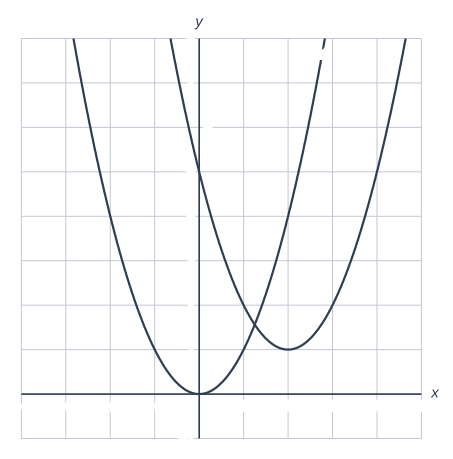
The diagram shows the graph of \(y = x^2\) and curve C.
Curve C is a translation of the graph of \(y = x^2\).
Write down the equation of curve C.
Model answer
The minimum point of C is (2, 1). The minimum point of \(y = x^2\) is (0, 0), so C is \(y = x^2\) translated by \(\begin{pmatrix} 2 \\ 1 \end{pmatrix}\). \(y = (x - 2)^2 + 1\)
Explanation
Read the minimum point of C from the grid: (2, 1). Moving 2 to the right replaces x with x − 2, and moving 1 up adds 1, giving \(y = (x - 2)^2 + 1\). You can check with the y-intercept: when x = 0, y = 4 + 1 = 5, which matches the graph. A common error is writing (x + 2)² for a move to the right.
Mark scheme
2 marks
B2 for \(y = (x - 2)^2 + 1\)
Accept the expanded form \(y = x^2 - 4x + 5\) oe. B1 for \(y = (x - 2)^2 + k\) with k ≠ 1, or for \(y = (x + 2)^2 + 1\), or for minimum point (2, 1) identified. Condone the omission of 'y ='.
Question 2
2 marks
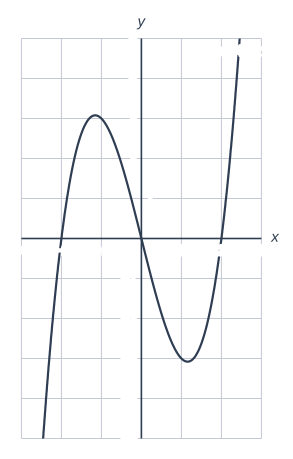
The diagram shows the graph of \(y = x^3 - 4x\).
The graph is translated by the vector \(\begin{pmatrix} 3 \\ 0 \end{pmatrix}\).
Write down the coordinates of the points where the translated graph crosses the x-axis.
Model answer
The graph of \(y = x^3 - 4x\) crosses the x-axis at x = −2, 0 and 2. A translation by \(\begin{pmatrix} 3 \\ 0 \end{pmatrix}\) adds 3 to each x-coordinate. (1, 0), (3, 0) and (5, 0)
Explanation
Read the roots from the graph: −2, 0 and 2. The translation moves every point 3 units right and 0 units up, so the points on the x-axis stay on the x-axis and their x-coordinates increase by 3. A common error is to subtract 3, which moves the graph left.
Mark scheme
2 marks
B2 for (1, 0), (3, 0) and (5, 0)
B1 for two of these points correct, or for x = 1, 3 and 5 given without coordinates, or for (−5, 0), (−3, 0) and (−1, 0) (translation in the wrong direction). Extra incorrect points: B1 max.
Question 3
3 marks
Mia says,
'The graph of \(y = \cos(x + 90)\) is the same as the graph of \(y = \sin x\) reflected in the x-axis.'
Is Mia correct? Show how you decide.
Model answer
\(y = \cos(x + 90)\) is \(y = \cos x\) translated 90 units to the left. Values of \(\cos(x + 90)\): x = 0 gives cos 90 = 0; x = 90 gives cos 180 = −1; x = 180 gives cos 270 = 0; x = 270 gives cos 360 = 1; x = 360 gives cos 450 = 0. Reflecting \(y = \sin x\) in the x-axis gives \(y = -\sin x\). Values of \(-\sin x\): x = 0 gives 0; x = 90 gives −1; x = 180 gives 0; x = 270 gives 1; x = 360 gives 0. The two graphs have the same roots, the same minimum (90, −1) and the same maximum (270, 1). Yes, Mia is correct.
Explanation
Compare the two graphs at their key points: roots, maximum and minimum. Translating y = cos x 90 units left moves its maximum from (0, 1) to (−90, 1), which repeats at (270, 1), and its minimum from (180, −1) to (90, −1). Reflecting y = sin x in the x-axis turns its maximum (90, 1) into a minimum (90, −1) and its minimum into a maximum (270, 1). The key points all match, so the graphs are the same.
Mark scheme
1 mark
B1 for correct values or key points of \(y = \cos(x + 90)\), e.g. y = 0, −1, 0, 1, 0 at x = 0, 90, 180, 270, 360, or describing it as y = cos x translated 90 units to the left
At least three correct values or key points (maximum, minimum, roots) are needed if values are used. Values outside 0 to 360 are acceptable, e.g. maximum at (−90, 1).
1 mark
B1 for the reflection of y = sin x in the x-axis being \(y = -\sin x\), or its correct values or key points, e.g. minimum (90, −1), maximum (270, 1), roots 0, 180, 360
Accept a description of the shape with key points, e.g. 'it goes down first, to −1 at 90°'.
1 mark
B1 for Yes with a complete comparison showing the graphs match
Needs both previous marks, and the matching points must be stated, e.g. 'both have a minimum at (90, −1), a maximum at (270, 1) and roots at 0, 180 and 360'. Answer 'Yes' with no working scores 0.
Question 4
4 marks
The graph of \(y = \dfrac{1}{x}\) is translated by the vector \(\begin{pmatrix} 2 \\ 3 \end{pmatrix}\).
Find the coordinates of the point where the translated graph crosses the x-axis.
Model answer
The translated graph is \(y = \dfrac{1}{x - 2} + 3\). It crosses the x-axis when y = 0: \(\dfrac{1}{x - 2} + 3 = 0\) \(\dfrac{1}{x - 2} = -3\) \(x - 2 = -\dfrac{1}{3}\) \(x = \dfrac{5}{3}\) The point is \(\left(\dfrac{5}{3}, 0\right)\).
Explanation
The translation replaces x with x − 2 (2 units right) and adds 3 (3 units up). Set y = 0 and solve: take the reciprocal of both sides, or multiply both sides by x − 2. The translated graph has asymptotes x = 2 and y = 3, so it crosses the x-axis just to the left of x = 2, which agrees with \(x = 1\dfrac{2}{3}\). Writing \(\dfrac{1}{x + 2}\) for a move to the right is a common error.
Mark scheme
1 mark
B1 for \(y = \dfrac{1}{x - 2} + 3\) oe
Accept \(y - 3 = \dfrac{1}{x - 2}\) or \(y = \dfrac{3x - 5}{x - 2}\); correct answer with no working scores full marks
1 mark
M1 for \(\dfrac{1}{x - 2} + 3 = 0\) oe
FT their equation of the form \(y = \dfrac{1}{x + p} + q\).
1 mark
M1 for \(x - 2 = -\dfrac{1}{3}\) oe or \(1 + 3(x - 2) = 0\) oe
A correct step that removes the fraction.
1 mark
A1 for \(\left(\dfrac{5}{3}, 0\right)\) oe
Accept \(x = \dfrac{5}{3}\) or \(1\dfrac{2}{3}\). Accept 1.67 or better (1.666...). Do not accept 1.6 or 1.7 alone.
Ready to try the rest? Every answer you write is marked against the mark scheme, so you can see exactly where the marks are.
Ctrl + Enter to check
Study HelperHints first, answers after you try
Stuck on this one? Ask for a hint and I’ll point you in the right direction, without giving the answer away. Once you’ve checked your answer, I’ll show you how the marks are awarded.