Practise 17 exam-style questions on Angles in polygons for OCR GCSE Maths (Higher non-calculator). Write your answer as you would in the exam and get it marked in seconds against the mark scheme, point by point, with the Study Helper on hand if you get stuck.
17 questions
2–5 marks each
Instant marking
No sign-up needed
17 questions, marked as you go
Sample questions with model answers
Here are 4 of the questions in this topic, each with a model answer, an explanation of why it earns the marks and the mark scheme an examiner would use.
Question 1
2 marks
Priya says, "The sum of the interior angles of a heptagon is \(7 \times 180^\circ = 1260^\circ\)."
Explain Priya's mistake and find the correct sum.
Model answer
A heptagon has 7 sides, but it splits into only \(7 - 2 = 5\) triangles from one vertex, so Priya should multiply by 5, not 7. Correct sum = \(5 \times 180^\circ = 900^\circ\)
Explanation
The sum of the interior angles of an n-sided polygon is (n − 2) × 180°, because the polygon divides into n − 2 triangles. Multiplying by n counts 360° too much: that extra is the angles around a point in the middle.
Mark scheme
1 mark
B1 for: she should multiply by \(7 - 2 = 5\), not 7 / a heptagon splits into 5 triangles, not 7
Accept 'the formula is (n − 2) × 180' oe, or 'she has added an extra 360°'. Do not accept 'she used the wrong number' with no detail.
1 mark
B1 for 900°
Accept 900.
Question 2
3 marks
Owen says, "A regular polygon can have an interior angle of 130°."
Is Owen correct? Show how you decide.
Model answer
Exterior angle = \(180^\circ - 130^\circ = 50^\circ\) Number of sides = \(360 \div 50 = 7.2\) The number of sides must be a whole number, so Owen is not correct.
Explanation
For a regular polygon, 360° divided by the exterior angle gives the number of sides, which must be a whole number. 50° does not divide exactly into 360°, so no regular polygon has interior angles of 130°. Working with the exterior angle is quicker than using the interior angle sum.
Mark scheme
1 mark
M1 for exterior angle = \(180 - 130\) or 50
Or M1 for \((n - 2) \times 180 = 130n\) oe.
1 mark
M1 for \(360 \div 50\) or 7.2
FT their exterior angle. Or \(50n = 360\) leading to \(n = 7.2\).
1 mark
A1 for No, because the number of sides would be 7.2, which is not a whole number
Accept 'No, 50 does not divide exactly into 360' oe. A conclusion with reason is needed.
Question 3
3 marks
A polygon has \(n\) sides.
Prove that the exterior angles of the polygon add up to 360°. You may use the fact that the interior angles add up to \((n - 2) \times 180^\circ\).
Model answer
At each vertex the interior angle and the exterior angle lie on a straight line, so they add up to 180°. There are \(n\) vertices, so all the interior and exterior angles together add up to \(180n\) degrees. Sum of exterior angles = \(180n - (n - 2) \times 180\) \(= 180n - 180n + 360\) \(= 360^\circ\)
Explanation
Each vertex gives a straight line made of one interior and one exterior angle. Take away the interior angle sum from the total of 180° per vertex and the n terms cancel, leaving 360°. The proof must use n so that it works for every polygon.
Mark scheme
1 mark
B1 for: at each vertex, interior angle + exterior angle = 180° (angles on a straight line)
The reason is needed.
1 mark
B1 for: so all the interior and exterior angles together add up to \(180n\)
The algebra must be shown. A numerical check for one polygon (e.g. a pentagon) is not a proof: max B1. Answer only scores 0.
Question 4
4 marks
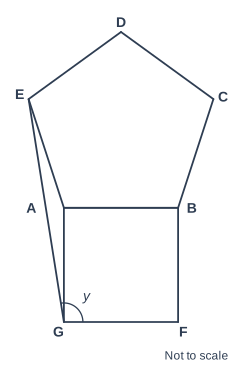
The diagram shows a regular pentagon ABCDE and a square ABFG. The square is outside the pentagon. E is joined to G.
Work out the size of angle EGF, marked \(y\). Give reasons for your working.
Model answer
Interior angle of a regular pentagon = \(540^\circ \div 5 = 108^\circ\). Angles at a point add up to 360°, so angle EAG = \(360^\circ - 108^\circ - 90^\circ = 162^\circ\). AE = AB (sides of the regular pentagon) and AB = AG (sides of the square), so triangle AEG is isosceles. Base angles of an isosceles triangle are equal: angle AGE = \((180^\circ - 162^\circ) \div 2 = 9^\circ\). Angle EGF = angle AGF + angle AGE = \(90^\circ + 9^\circ = 99^\circ\).
Explanation
The key is spotting that AE and AG are both equal to AB, so triangle AEG is isosceles. Find the angle at A from the angles at a point, then the base angles, then add the right angle of the square. The reasons (angles at a point, isosceles triangle) are part of the answer.
Mark scheme
1 mark
B1 for interior angle of the pentagon = 108°
1 mark
M1 for angle EAG = \(360 - 108 - 90\) or 162 (angles at a point add up to 360°)
FT their 108.
1 mark
M1 for angle AGE = \((180 - 162) \div 2\) or 9, because triangle AEG is isosceles (AE = AB = AG)
FT their 162. The isosceles triangle must be recognised (equal sides of the regular pentagon and the square).
1 mark
A1 for 99°
From \(90 + 9\). Accept 99. 9 as the final answer scores B1 M1 M1 A0. Correct answer with no reasons scores B1 M1 M1 A0.
Ready to try the rest? Every answer you write is marked against the mark scheme, so you can see exactly where the marks are.
Ctrl + Enter to check
Study HelperHints first, answers after you try
Stuck on this one? Ask for a hint and I’ll point you in the right direction, without giving the answer away. Once you’ve checked your answer, I’ll show you how the marks are awarded.