Practise 14 exam-style questions on Parts of a circle for OCR GCSE Maths (Higher non-calculator). Write your answer as you would in the exam and get it marked in seconds against the mark scheme, point by point, with the Study Helper on hand if you get stuck.
14 questions
1–4 marks each
Instant marking
No sign-up needed
14 questions, marked as you go
Sample questions with model answers
Here are 4 of the questions in this topic, each with a model answer, an explanation of why it earns the marks and the mark scheme an examiner would use.
Question 1
1 mark
Ali says, "Every diameter of a circle is also a chord."
Is Ali correct? Give a reason for your answer.
Model answer
Yes. A chord is a straight line segment joining two points on the circumference. A diameter also joins two points on the circumference, so it is a chord (the one that passes through the centre).
Explanation
Check the definition: any line segment with both ends on the circumference is a chord. A diameter is the special chord that passes through the centre, which makes it the longest chord.
Mark scheme
1 mark
B1 for Yes, with a reason: a chord joins two points on the circumference, and a diameter joins two points on the circumference (passing through the centre)
Accept 'yes, a diameter is a chord that goes through the centre' oe. 'Yes' with no reason, or with an incorrect reason, scores 0.
Question 2
2 marks
A and B are points on a circle with centre O. The length of the minor arc AB is \(\dfrac{1}{5}\) of the circumference of the circle.
Work out the size of angle AOB.
Model answer
The whole circumference corresponds to 360° at the centre. Angle AOB = \(\dfrac{1}{5} \times 360^\circ = 72^\circ\)
Explanation
An arc is part of the circumference, and the fraction of the circumference it covers is the same as the fraction of 360° that it makes at the centre. A full turn at the centre is 360°, not 180°.
Mark scheme
1 mark
M1 for \(\dfrac{1}{5} \times 360\) oe
correct answer with no working scores full marks
1 mark
A1 for 72°
Accept 72. Correct answer with no working scores 2 marks. 36 (using 180) scores M0 A0.
Question 3
3 marks
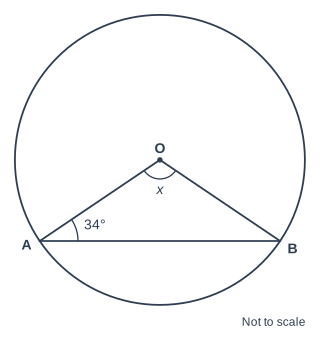
The diagram shows a circle with centre O. A and B are points on the circle, and angle OAB = 34°.
Work out the size of angle AOB, marked \(x\). Give reasons for your working.
Model answer
OA = OB (radii of the same circle), so triangle OAB is isosceles. Angle OBA = angle OAB = 34° (base angles of an isosceles triangle are equal). \(x = 180^\circ - 34^\circ - 34^\circ = 112^\circ\) (angles in a triangle add up to 180°).
Explanation
Any triangle with two vertices on the circle and one at the centre is isosceles, because two of its sides are radii. That gives a second 34° angle at B, and the angle sum of the triangle gives the angle at O.
Mark scheme
1 mark
B1 for OA = OB because they are radii, so triangle OAB is isosceles
Accept 'OA and OB are both radii' oe.
1 mark
M1 for angle OBA = 34° and \(180 - 34 - 34\) oe
Base angles of an isosceles triangle are equal.
1 mark
A1 for 112°
Accept x = 112. Correct answer with no reasons scores M1 A1. 146 (from 180 − 34) scores 0.
Question 4
4 marks
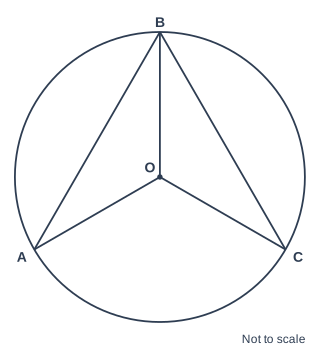
The diagram shows a circle with centre O. A, B and C are points on the circle, and O lies inside angle ABC.
Prove that angle ABC = angle OAB + angle OCB.
Model answer
OA = OB = OC (radii of the same circle). Triangle OAB is isosceles, so angle OBA = angle OAB (base angles of an isosceles triangle are equal). Triangle OBC is isosceles, so angle OBC = angle OCB. OB splits angle ABC into two parts, so angle ABC = angle OBA + angle OBC = angle OAB + angle OCB.
Explanation
Join O to each point: the radii make two isosceles triangles that share the side OB. Each base angle at B equals the base angle at the other end, and together they make angle ABC. Results like this are the building blocks of the circle theorem proofs.
Mark scheme
1 mark
B1 for OA = OB = OC because they are radii
1 mark
B1 for angle OBA = angle OAB, because triangle OAB is isosceles (base angles of an isosceles triangle are equal)
1 mark
B1 for angle OBC = angle OCB, because triangle OBC is isosceles
1 mark
B1 for angle ABC = angle OBA + angle OBC = angle OAB + angle OCB, completing the proof
Dep on the previous mark. Using numerical values is not a proof. Using a circle theorem as the only reason scores 0 for this mark.
Ready to try the rest? Every answer you write is marked against the mark scheme, so you can see exactly where the marks are.
Ctrl + Enter to check
Study HelperHints first, answers after you try
Stuck on this one? Ask for a hint and I’ll point you in the right direction, without giving the answer away. Once you’ve checked your answer, I’ll show you how the marks are awarded.