Practise 14 exam-style questions on Equation of a circle for OCR GCSE Maths (Higher non-calculator). Write your answer as you would in the exam and get it marked in seconds against the mark scheme, point by point, with the Study Helper on hand if you get stuck.
14 questions
1–4 marks each
Instant marking
No sign-up needed
14 questions, marked as you go
Sample questions with model answers
Here are 4 of the questions in this topic, each with a model answer, an explanation of why it earns the marks and the mark scheme an examiner would use.
Question 1
2 marks
Jack says, "The circle with centre \((0, 0)\) and radius 4 has equation \(x^2 + y^2 = 8\)."
Jack is wrong.
Explain the mistake Jack has made and write down the correct equation of the circle.
Model answer
The equation of a circle with centre \((0, 0)\) and radius r is \(x^2 + y^2 = r^2\). Jack has worked out \(2 \times 4 = 8\) instead of \(4^2 = 16\). The correct equation is \(x^2 + y^2 = 16\).
Explanation
Every point (x, y) on the circle is a distance r from the origin, so by Pythagoras x² + y² = r². The right-hand side is the radius squared. Check with a point: (4, 0) is on the circle, and 4² + 0² = 16, not 8.
Mark scheme
1 mark
B1 for he has doubled the radius instead of squaring it oe
Accept 'the right-hand side should be the radius squared, 4² = 16, not 2 × 4'. Do not accept 'the number should be bigger' on its own.
1 mark
B1 for \(x^2 + y^2 = 16\)
Independent of the first mark. Accept \(x^2 + y^2 = 4^2\).
Question 2
2 marks
A circle has equation \(x^2 + y^2 = 48\).
Find the radius of the circle. Give your answer in the form \(a\sqrt{b}\), where a and b are integers and b is as small as possible.
The radius is the square root of the number on the right-hand side. To simplify the surd, find the largest square factor of 48, which is 16. A common error is to use the square factor 4 and stop at 2√12.
Mark scheme
1 mark
M1 for \(\sqrt{48}\) or \(48 = 16 \times 3\) seen
Or \(\sqrt{16} \times \sqrt{3}\); correct answer with no working scores full marks
1 mark
A1 for \(4\sqrt{3}\)
\(2\sqrt{12}\) scores M1 A0 (b is not as small as possible). 24 scores 0.
Question 3
3 marks
The line \(y = 2x\) meets the circle \(x^2 + y^2 = 45\) at the points A and B.
Find the coordinates of A and B.
Model answer
Substitute \(y = 2x\) into \(x^2 + y^2 = 45\): \(x^2 + (2x)^2 = 45\) \(x^2 + 4x^2 = 45\) \(5x^2 = 45\) \(x^2 = 9\), so \(x = 3\) or \(x = -3\) \(y = 2x\): when \(x = 3\), \(y = 6\); when \(x = -3\), \(y = -6\) A and B are \((3, 6)\) and \((-3, -6)\).
Explanation
Substitute the equation of the line into the equation of the circle, then solve. Squaring 2x gives 4x², not 2x². The line passes through the centre of the circle, so the two points are at opposite ends of a diameter: check that (3, 6) and (−3, −6) both satisfy x² + y² = 45.
Mark scheme
1 mark
M1 for \(x^2 + (2x)^2 = 45\)
Or for substituting \(x = \dfrac{y}{2}\) into the circle; correct answer with no working scores full marks
Either order. (3, 6) only scores M1 A0 A0 unless x = −3 is also seen.
Question 4
4 marks
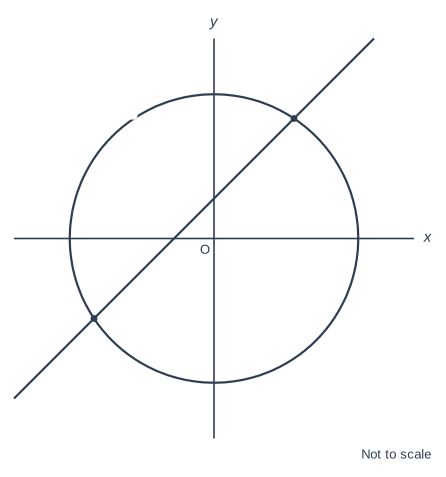
The sketch shows the line \(y = x + 1\) and the circle \(x^2 + y^2 = 13\).
The line meets the circle at the points A and B.
Find the coordinates of A and B. You must show your working.
Model answer
Substitute \(y = x + 1\) into \(x^2 + y^2 = 13\): \(x^2 + (x + 1)^2 = 13\) \(x^2 + x^2 + 2x + 1 = 13\) \(2x^2 + 2x - 12 = 0\) \(x^2 + x - 6 = 0\) \((x + 3)(x - 2) = 0\) \(x = 2\) or \(x = -3\) When \(x = 2\), \(y = 3\). When \(x = -3\), \(y = -2\). A and B are \((2, 3)\) and \((-3, -2)\). Check: \(2^2 + 3^2 = 13\) and \((-3)^2 + (-2)^2 = 13\)
Explanation
Substitute the linear equation into the circle to get a quadratic in x; its two solutions are the x-coordinates of the intersections. Then use the line (not the circle) to find each y-coordinate, so you do not get extra wrong points. The most common error is expanding (x + 1)² as x² + 1.
Mark scheme
1 mark
M1 for \(x^2 + (x + 1)^2 = 13\)
Or substituting \(x = y - 1\).
1 mark
M1 for \(2x^2 + 2x - 12 = 0\) or \(x^2 + x - 6 = 0\) oe
Expanding \((x + 1)^2\) as \(x^2 + 1\) scores M0 for this mark.
1 mark
A1 for \(x = 2\) and \(x = -3\)
From \((x + 3)(x - 2) = 0\) or a correct use of the formula.
1 mark
A1 for \((2, 3)\) and \((-3, -2)\)
Either order. Answer only scores 0 (the question asks for working); answers found by trial and checked in both equations score SC2.
Ready to try the rest? Every answer you write is marked against the mark scheme, so you can see exactly where the marks are.
Ctrl + Enter to check
Study HelperHints first, answers after you try
Stuck on this one? Ask for a hint and I’ll point you in the right direction, without giving the answer away. Once you’ve checked your answer, I’ll show you how the marks are awarded.