
Level:
Correct: 0
Incorrect: 0
Marks: 0/0
Exam Practice
Course:
Topics:
OCR GCSE Maths (Higher non-calculator) Smart practice A mixed round aimed at your weak spots
Unit 1
Number Operations and Integers
Unit 2
Fractions, Decimals and Percentages
Unit 3
Indices and Surds
Unit 4
Approximation and Estimation
Unit 5
Ratio, Proportion and Rates of Change
Unit 6
Algebra
Unit 7
Graphs of Equations and Functions
Unit 8
Basic Geometry
Unit 9
Congruence and Similarity
Unit 10
Mensuration
Unit 11
Probability
Unit 12
Statistics
Avg
score:
–
Topics
done:
0/121

Loci

Practise 13 exam-style questions on Loci for OCR GCSE Maths (Higher non-calculator). Write your answer as you would in the exam and get it marked in seconds against the mark scheme, point by point, with the Study Helper on hand if you get stuck.

  • 13 questions
  • 2–4 marks each
  • Instant marking
  • No sign-up needed
13 questions, marked as you go

Sample questions with model answers

Here are 4 of the questions in this topic, each with a model answer, an explanation of why it earns the marks and the mark scheme an examiner would use.

Question 1

2 marks

The diagram shows triangle ABC and three lines, AD, AE and MN.
D, E and M are points on BC.

Which of the three lines is the locus of points equidistant from B and C?
Which of the three lines is the locus of points equidistant from the lines AB and AC?
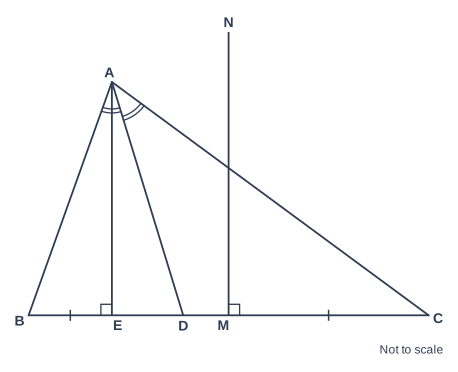
Geometry diagram, marked "Not to scale". Triangle ABC. Line segments MN, AD and AE are drawn. M lies on side BC. D lies on side BC. E lies on side BC. Angle CMN is marked as a right angle (90°). Angle BEA is marked as a right angle (90°). Angle BAD and angle DAC are each marked with a double arc (equal angles). BM and MC are each marked with one short dash (equal lengths).

Model answer

Equidistant from B and C: MN (the perpendicular bisector of BC).
Equidistant from the lines AB and AC: AD (the bisector of angle BAC).

Explanation

Points equidistant from two points lie on the perpendicular bisector of the line joining them: MN is at right angles to BC through its midpoint M. Points equidistant from two lines that meet lie on the bisector of the angle between them: AD splits angle BAC into two equal angles. AE is the perpendicular from A to BC, which is neither locus.

Mark scheme
  1. 1 mark

    B1 for MN (equidistant from B and C)

    MN is the perpendicular bisector of BC: it is perpendicular to BC and M is the midpoint of BC (BM = MC). The two answers must be clearly matched to the two loci; correct answer with no working scores full marks

  2. 1 mark

    B1 for AD (equidistant from the lines AB and AC)

    AD is the bisector of angle BAC (angle BAD = angle DAC). If the two answers are given the wrong way round, award B0 B0. AE (the perpendicular from A to BC) is neither locus.
Question 2

2 marks

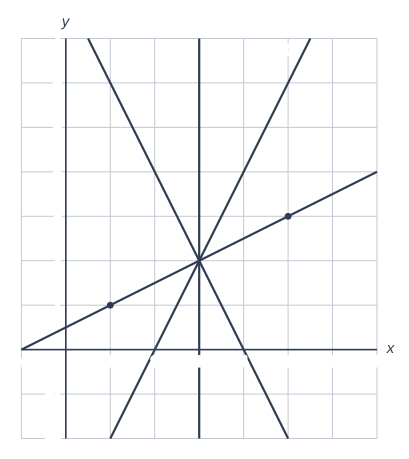
The grid shows the points P and Q and four straight lines, A, B, C and D.

Which line, A, B, C or D, is the locus of points that are equidistant from P and Q?
Give a reason for your answer.

A coordinate grid with x from −1 to 7 and y from −2 to 7; each grid square is 1 unit across, and the axes cross at the origin O. Line A is a straight line sloping downwards from left to right crossing the x-axis at (4, 0) and passing through (2, 4). Line B is a straight line sloping upwards from left to right crossing the y-axis at (0, 0.5) and crossing the x-axis at (−1, 0). Line C is a vertical straight line crossing the x-axis at (3, 0) (the line x = 3). Line D is a straight line sloping upwards from left to right crossing the x-axis at (2, 0) and passing through (3, 2). Line A and line B cross at (3, 2). Line A and line C cross at (3, 2). Line A and line D cross at (3, 2). Line B and line C cross at (3, 2). Line B and line D cross at (3, 2). Line C and line D cross at (3, 2). Point P is marked with a dot at (1, 1). Point Q is marked with a dot at (5, 3).

Model answer

Line A.
The locus is the perpendicular bisector of PQ.
Midpoint of PQ = (3, 2). Gradient of PQ = \(\dfrac{2}{4} = \dfrac{1}{2}\), so the perpendicular gradient is \(-2\).
Line A passes through (3, 2) with gradient \(-2\), so it is the perpendicular bisector of PQ.

Explanation

Points equidistant from P and Q lie on the perpendicular bisector of PQ, which goes through the midpoint and is at right angles to PQ. All four lines pass through the midpoint, so you must check the gradient: B is the line PQ itself, C is vertical, and D has gradient 2, which is not the negative reciprocal of ½.

Mark scheme
  1. 1 mark

    B1 for A

  2. 1 mark

    B1 for a correct reason: line A passes through the midpoint of PQ, (3, 2), and is perpendicular to PQ / line A is the perpendicular bisector of PQ

    Accept 'the gradient of A is −2 and the gradient of PQ is ½, and −2 × ½ = −1' oe. Accept a point on line A shown to be equidistant from P and Q, e.g. (2, 4) is \(\sqrt{10}\) from both. 'It goes through the midpoint' alone is not enough (all four lines pass through (3, 2)). Award only with the answer A.

Question 3

3 marks

A is the point \((1, 2)\) and B is the point \((7, 2)\).

The point P is equidistant from A and B.
P is also 5 units from A.

Find the coordinates of the two possible positions of P.

Model answer

P is equidistant from A and B, so P lies on the perpendicular bisector of AB, the line \(x = 4\).
The horizontal distance from A to this line is \(4 - 1 = 3\).
PA = 5, so the vertical distance h satisfies \(3^2 + h^2 = 5^2\), giving \(h^2 = 16\) and \(h = 4\).
P is 4 units above or below AB: \((4, 6)\) or \((4, -2)\).

Explanation

P lies on two loci: the perpendicular bisector of AB (the line x = 4) and the circle of radius 5 centred on A. These meet in two points, one above and one below AB. Use Pythagoras with the 3-4-5 triangle. A common error is to give only one position.

Mark scheme
  1. 1 mark

    B1 for P lies on \(x = 4\)

    The perpendicular bisector of AB. May be implied by both answers having x-coordinate 4; correct answer with no working scores full marks

  2. 1 mark

    M1 for \(3^2 + h^2 = 5^2\) oe or \(h = 4\)

    Where h is the vertical distance of P from AB. Or M1 for \((4 - 1)^2 + (y - 2)^2 = 25\) oe.

  3. 1 mark

    A1 for \((4, 6)\) and \((4, -2)\)

    Both points needed for this mark. One correct point only scores B1 M1 A0. Correct answer with no working scores 3 marks.

Question 4

4 marks

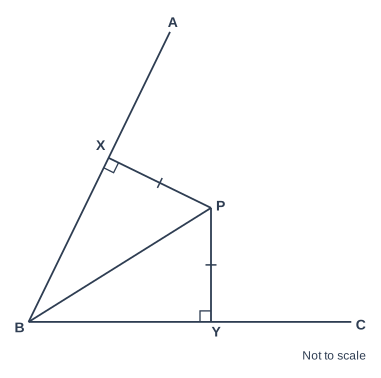
The diagram shows two straight lines, BA and BC, which meet at B.
P is a point inside angle ABC.
X is the point on BA and Y is the point on BC such that PX is perpendicular to BA and PY is perpendicular to BC.

P is equidistant from the two lines, so PX = PY.

Prove that BP bisects angle ABC.

Geometry diagram, marked "Not to scale". Line segments BA, BC, PX, PY and BP are drawn. X lies on BA. Y lies on BC. Angle BXP is marked as a right angle (90°). Angle BYP is marked as a right angle (90°). PX and PY are each marked with one short dash (equal lengths).

Model answer

In triangles BXP and BYP:
angle BXP = angle BYP = 90° (PX is perpendicular to BA and PY is perpendicular to BC)
PX = PY (given: P is equidistant from the two lines)
BP is common to both triangles (the hypotenuse of each).
So triangles BXP and BYP are congruent (RHS).
So angle XBP = angle YBP (corresponding angles of congruent triangles), which means BP bisects angle ABC.

Explanation

The distance from a point to a line is the perpendicular distance, so PX and PY meet the lines at right angles. The two right-angled triangles share the hypotenuse BP and have PX = PY, so they are congruent by RHS. This proves that the locus of points equidistant from two lines is the angle bisector.

Mark scheme
  1. 3 marks

    M3 for three correct statements with reasons, e.g.: angle BXP = angle BYP = 90° (PX and PY are perpendicular to the lines); PX = PY (given); BP is common

    M2 for two correct statements with reasons, or three correct statements with incorrect or no reasons. M1 for one correct statement with reason, or two correct statements with incorrect or no reasons. Statements must be clear equalities of named sides or angles. Alternative: BX = BY with reason (Pythagoras: \(BX^2 = BP^2 - PX^2 = BP^2 - PY^2 = BY^2\)) may replace the right angles statement, leading to SSS.

  2. 1 mark

    A1 for: triangles BXP and BYP are congruent (RHS), so angle XBP = angle YBP, so BP bisects angle ABC

    Dep on M3. The condition must fit the statements (RHS, or SSS with the Pythagoras alternative). Must conclude that the two angles at B are equal. Answer only scores 0.

Ready to try the rest? Every answer you write is marked against the mark scheme, so you can see exactly where the marks are.

Study Helper Hints first, answers after you try

Stuck on this one? Ask for a hint and I’ll point you in the right direction, without giving the answer away. Once you’ve checked your answer, I’ll show you how the marks are awarded.