
Level:
Correct: 0
Incorrect: 0
Marks: 0/0
Exam Practice
Course:
Topics:
OCR GCSE Maths (Higher non-calculator) Smart practice A mixed round aimed at your weak spots
Unit 1
Number Operations and Integers
Unit 2
Fractions, Decimals and Percentages
Unit 3
Indices and Surds
Unit 4
Approximation and Estimation
Unit 5
Ratio, Proportion and Rates of Change
Unit 6
Algebra
Unit 7
Graphs of Equations and Functions
Unit 8
Basic Geometry
Unit 9
Congruence and Similarity
Unit 10
Mensuration
Unit 11
Probability
Unit 12
Statistics
Avg
score:
–
Topics
done:
0/121

Area of composite shapes

Practise 15 exam-style questions on Area of composite shapes for OCR GCSE Maths (Higher non-calculator). Write your answer as you would in the exam and get it marked in seconds against the mark scheme, point by point, with the Study Helper on hand if you get stuck.

  • 15 questions
  • 2–5 marks each
  • Instant marking
  • No sign-up needed
15 questions, marked as you go

Sample questions with model answers

Here are 4 of the questions in this topic, each with a model answer, an explanation of why it earns the marks and the mark scheme an examiner would use.

Question 1

3 marks

The diagram shows a shape.
All the corners are right angles.

Work out the area of the shape.
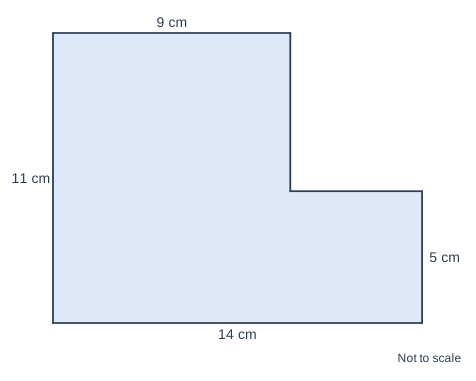
Geometry diagram, marked "Not to scale". A hexagon (its vertices are not labelled) (shaded). The unlabelled side going to the right is labelled 14 cm. The unlabelled side going upwards is labelled 5 cm. The unlabelled side going to the left is labelled 9 cm. The unlabelled side going downwards is labelled 11 cm.

Model answer

Split the shape into two rectangles.
Bottom rectangle: \(14 \times 5 = 70\) cm²
Top rectangle: width 9 cm, height \(11 - 5 = 6\) cm, area \(9 \times 6 = 54\) cm²
Total area = \(70 + 54 = 124\) cm²

Explanation

Split the shape into rectangles, or take a small rectangle away from the surrounding 14 cm by 11 cm rectangle (154 − 30 = 124). Find any missing lengths first: the top rectangle is 11 − 5 = 6 cm high. Take care not to count the overlapping part twice.

Mark scheme
  1. 1 mark

    M1 for a correct method for one part of a split, e.g. \(14 \times 5\) or \(9 \times 6\) or \(9 \times 11\) or \(5 \times 5\), or \(14 \times 11\) for the surrounding rectangle

    The missing lengths are 6 (from \(11 - 5\)) and 5 (from \(14 - 9\)); correct answer with no working scores full marks

  2. 1 mark

    M1 for a complete correct method, e.g. \(14 \times 5 + 9 \times 6\) or \(9 \times 11 + 5 \times 5\) or \(14 \times 11 - 5 \times 6\)

  3. 1 mark

    A1 for 124

    Accept 124 cm². A correct answer with no working scores 3. 154 (the whole surrounding rectangle) scores M1 M0 A0. 169 (from \(14 \times 5 + 9 \times 11\), the overlap counted twice) scores M1 M0 A0.
Question 2

3 marks

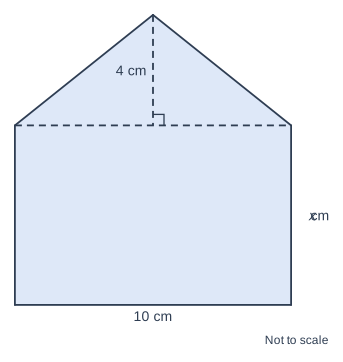
The diagram shows a shape made from a rectangle and an isosceles triangle.
The rectangle is 10 cm wide and \(x\) cm high.
The triangle has base 10 cm and perpendicular height 4 cm.

The area of the shape is 85 cm².

Work out the value of \(x\).

Geometry diagram, marked "Not to scale". A pentagon (its vertices are not labelled) (shaded). A dashed horizontal line with no labelled ends is drawn. A dashed vertical line with no labelled ends is drawn. The unlabelled side going to the right is labelled 10 cm. The unlabelled side going upwards is labelled x cm. An unlabelled line going downwards is labelled 4 cm. The angle at an unlabelled point is marked as a right angle (90°).

Model answer

Area of triangle = \(\dfrac{1}{2} \times 10 \times 4 = 20\) cm²
Area of rectangle = \(10x\) cm²
\(10x + 20 = 85\)
\(10x = 65\)
\(x = 6.5\)

Explanation

Write the total area as rectangle + triangle, set it equal to 85 and solve. The triangle's area does not depend on x: it is ½ × 10 × 4 = 20 cm², so the rectangle must be 65 cm² and its height 6.5 cm.

Mark scheme
  1. 1 mark

    M1 for area of triangle = \(\dfrac{1}{2} \times 10 \times 4\) or 20

    correct answer with no working scores full marks

  2. 1 mark

    M1 for \(10x +\) their \(20 = 85\) or \(10x = 65\) oe

    Accept \((85 - 20) \div 10\).

  3. 1 mark

    A1 for 6.5

    Accept \(\dfrac{13}{2}\) or \(6\dfrac{1}{2}\). 4.5 (from \(10x + 40 = 85\), half missed) scores M0 M1 A0. A correct answer with no working scores 3.

Question 3

4 marks

A rectangular garden is 20 m long and 12 m wide.
In the garden there is a circular pond with diameter 4 m.
The rest of the garden is to be covered with grass seed.

One box of grass seed covers 25 m².

Use \(\pi = 3\) to estimate the number of boxes of grass seed needed.

Model answer

Area of garden = \(20 \times 12 = 240\) m²
Radius of pond = 2 m, area \(\approx 3 \times 2^2 = 12\) m²
Area to seed \(\approx 240 - 12 = 228\) m²
\(228 \div 25 = 9.12\)
9 boxes cover only 225 m², so 10 boxes are needed.

Explanation

Take the pond away from the garden: 240 − 12 = 228 m². 228 ÷ 25 = 9.12, so 9 boxes are not quite enough and you must round up to 10. Use the radius (2 m), not the diameter, in πr².

Mark scheme
  1. 1 mark

    M1 for area of garden = \(20 \times 12\) or 240

  2. 1 mark

    M1 for area of pond \(\approx 3 \times 2^2\) or 12

    Accept \(4\pi\) or 12.5(...). \(3 \times 4^2 = 48\) scores M0.

  3. 1 mark

    M1 for (their 240 − their 12) \(\div 25\) oe

    Accept 228 ÷ 25 or 9.12 seen, or a build-up such as \(9 \times 25 = 225\) compared with 228.

  4. 1 mark

    A1 for 10

    9 (rounded down) scores M3 A0. A correct answer with no working scores 4.

Question 4

4 marks

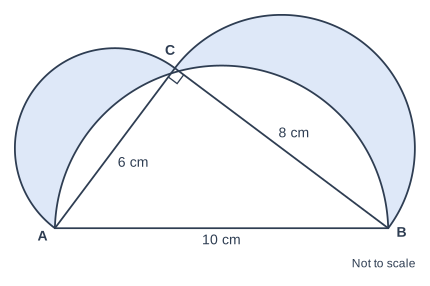
The diagram shows a right-angled triangle ABC.
AC = 6 cm, BC = 8 cm and AB = 10 cm.
A semicircle is drawn on each side of the triangle, with that side as its diameter.
The semicircles on AC and BC are outside the triangle. The semicircle on AB passes through C.

Show that the total area of the two shaded regions is equal to the area of triangle ABC.

Geometry diagram, marked "Not to scale". A semicircle on CA as diameter, drawn above and to the left of CA (the region between the arc and CA is shaded). A semicircle on BC as diameter, drawn above and to the right of BC (the region between the arc and BC is shaded). A semicircle on BA as diameter, drawn above BA (the region between the arc and BA is filled white). Triangle ABC. Angle ACB is marked as a right angle (90°). Side AC is labelled 6 cm. Side CB is labelled 8 cm. Side AB is labelled 10 cm.

Model answer

Area of triangle ABC = \(\dfrac{1}{2} \times 6 \times 8 = 24\) cm²
Semicircle on AC: \(\dfrac{1}{2} \times \pi \times 3^2 = \dfrac{9\pi}{2}\)
Semicircle on BC: \(\dfrac{1}{2} \times \pi \times 4^2 = 8\pi = \dfrac{16\pi}{2}\)
Semicircle on AB: \(\dfrac{1}{2} \times \pi \times 5^2 = \dfrac{25\pi}{2}\)
The part of the semicircle on AB outside the triangle = \(\dfrac{25\pi}{2} - 24\)
The shaded regions are the two small semicircles without the parts that lie inside the semicircle on AB:
Shaded area = \(\dfrac{9\pi}{2} + \dfrac{16\pi}{2} - \left(\dfrac{25\pi}{2} - 24\right) = \dfrac{25\pi}{2} - \dfrac{25\pi}{2} + 24 = 24\) cm²
This equals the area of triangle ABC.

Explanation

Each shaded region is a small semicircle minus the curved strip it shares with the big semicircle. Those strips together are the big semicircle minus the triangle. Because 6² + 8² = 10², the two small semicircles have exactly the same total area as the big one, so the π terms cancel and the triangle's 24 cm² is all that is left.

Mark scheme
  1. 1 mark

    B1 for areas of the semicircles on AC and BC: \(\dfrac{1}{2} \times \pi \times 3^2 = \dfrac{9\pi}{2}\) and \(\dfrac{1}{2} \times \pi \times 4^2 = 8\pi\)

    Both needed. Accept 4.5π.

  2. 1 mark

    B1 for area of semicircle on AB = \(\dfrac{1}{2} \times \pi \times 5^2 = \dfrac{25\pi}{2}\)

    Accept 12.5π.

  3. 1 mark

    M1 for shaded area = (semicircle on AC + semicircle on BC) − (semicircle on AB − triangle), or a correct equivalent strategy

    The part of the large semicircle outside the triangle is \(\dfrac{25\pi}{2} - 24\).

  4. 1 mark

    A1 for \(\dfrac{9\pi}{2} + 8\pi - \dfrac{25\pi}{2} + 24 = 24\) and triangle area = \(\dfrac{1}{2} \times 6 \times 8 = 24\)

    Both 24s must be seen with a conclusion. The \(\pi\) terms must be shown to cancel: \(\dfrac{9\pi}{2} + \dfrac{16\pi}{2} = \dfrac{25\pi}{2}\). Decimal working that only shows approximately 24 scores A0. Answer only scores 0.

Ready to try the rest? Every answer you write is marked against the mark scheme, so you can see exactly where the marks are.

Study Helper Hints first, answers after you try

Stuck on this one? Ask for a hint and I’ll point you in the right direction, without giving the answer away. Once you’ve checked your answer, I’ll show you how the marks are awarded.