Practise 20 exam-style questions on Pythagoras' theorem for OCR GCSE Maths (Higher non-calculator). Write your answer as you would in the exam and get it marked in seconds against the mark scheme, point by point, with the Study Helper on hand if you get stuck.
20 questions
1–5 marks each
Instant marking
No sign-up needed
20 questions, marked as you go
Sample questions with model answers
Here are 4 of the questions in this topic, each with a model answer, an explanation of why it earns the marks and the mark scheme an examiner would use.
Question 1
2 marks
A triangle has sides of length 7 cm, 11 cm and 13 cm.
Leah says,
"This triangle is a right-angled triangle."
Is Leah correct? Show how you decide.
Model answer
If the triangle were right-angled, the longest side, 13 cm, would be the hypotenuse. \(7^2 + 11^2 = 49 + 121 = 170\) \(13^2 = 169\) 170 is not equal to 169, so the triangle is not right-angled. Leah is not correct.
Explanation
Use the converse of Pythagoras' theorem: a triangle is right-angled only if the square of the longest side equals the sum of the squares of the other two. Here 170 and 169 are close but not equal, so the triangle is not right-angled (its largest angle is just under 90°). A conclusion needs the numbers to support it.
Mark scheme
1 mark
M1 for \(7^2 + 11^2\) and \(13^2\) both evaluated
170 and 169 seen. Or M1 for \(\sqrt{7^2 + 11^2} = \sqrt{170}\) compared with 13, or \(13^2 - 11^2 = 48\) compared with \(7^2 = 49\).
1 mark
A1 for No, with 170 ≠ 169 oe
e.g. 'No, because 7² + 11² = 170 but 13² = 169'. 'No' with no correct comparison scores A0.
Question 2
3 marks
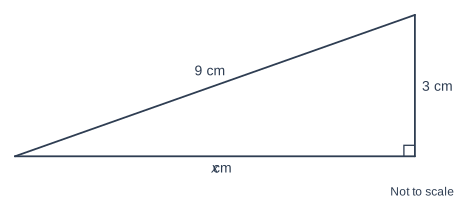
The diagram shows a right-angled triangle.
Work out the exact value of \(x\). Give your answer in the form \(a\sqrt{2}\), where \(a\) is an integer.
Model answer
The side of 9 cm is the hypotenuse. \(x^2 = 9^2 - 3^2 = 81 - 9 = 72\) \(x = \sqrt{72} = \sqrt{36 \times 2} = 6\sqrt{2}\)
Explanation
Subtract the squares because x is a shorter side, giving x = √72. To simplify the surd, find the largest square factor of 72, which is 36: √72 = √36 × √2 = 6√2. Using a smaller square factor (√72 = 2√18) is correct but not fully simplified.
Mark scheme
1 mark
M1 for \(9^2 - 3^2\) oe
72 or \(\sqrt{72}\) seen implies M1. \(9^2 + 3^2\) scores M0; correct answer with no working scores full marks
1 mark
M1 for \(\sqrt{72} = \sqrt{36} \times \sqrt{2}\) oe
A correct first step in simplifying their surd, e.g. \(\sqrt{4 \times 18}\) or \(\sqrt{9 \times 8}\).
1 mark
A1 for \(6\sqrt{2}\)
cao. \(2\sqrt{18}\) or \(3\sqrt{8}\) score M1 M1 A0. A decimal answer (8.48...) scores M1 M0 A0.
Question 3
4 marks
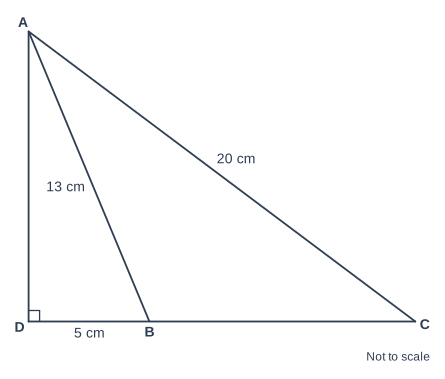
The diagram shows two right-angled triangles, ABD and ACD. B is a point on CD.
AB = 13 cm, BD = 5 cm and AC = 20 cm.
Work out the length BC.
Model answer
Triangle ABD: \(AD^2 = 13^2 - 5^2 = 169 - 25 = 144\), so AD = 12 cm Triangle ACD: \(CD^2 = 20^2 - 12^2 = 400 - 144 = 256\), so CD = 16 cm BC = CD − BD = 16 − 5 = 11 cm
Explanation
The side AD is shared by both triangles, so find it first from triangle ABD. Then use it in triangle ACD to find CD. BC is the part of CD that is not BD, so subtract 5. Stopping at CD = 16 is a common error.
Mark scheme
1 mark
M1 for \(13^2 - 5^2\) oe
144 seen implies M1; correct answer with no working scores full marks
1 mark
A1 for AD = 12
1 mark
M1 for \(20^2 -\) their \(12^2\) oe
Pythagoras in triangle ACD with their AD. 256 or CD = 16 seen implies M1.
1 mark
A1 for 11
Accept 11 cm. 16 (the length CD) scores M1 A1 M1 A0. A correct answer with no working scores 4 marks.
Question 4
4 marks
The distance between the points \((2, k)\) and \((8, 1)\) is 10 units.
Find the two possible values of \(k\).
Model answer
The horizontal distance is \(8 - 2 = 6\) and the vertical distance is \(k - 1\). \(6^2 + (k - 1)^2 = 10^2\) \((k - 1)^2 = 100 - 36 = 64\) \(k - 1 = 8\) or \(k - 1 = -8\) \(k = 9\) or \(k = -7\)
Explanation
The distance between two points is the hypotenuse of a right-angled triangle whose other sides are the differences in the coordinates. This gives (k − 1)² = 64, and a square root can be positive or negative, so k − 1 = ±8. One point is above (8, 1) and one is below. Missing the negative root is the usual error.
Mark scheme
1 mark
M1 for \(6^2 + (k - 1)^2 = 10^2\) oe
Accept \((8 - 2)^2 + (1 - k)^2 = 100\); correct answer with no working scores full marks
1 mark
M1 for \((k - 1)^2 = 64\) oe or \(k - 1 = 8\) or \(k - 1 = -8\)
Or a correct 3-term quadratic \(k^2 - 2k - 63 = 0\) with a correct method to solve it.
2 marks
A2 for \(k = 9\) and \(k = -7\)
1 mark for each correct value, max 2. Both correct values with no working score 4 marks. k = 9 only, from k − 1 = 8 with the negative root missed, scores M1 M1 A1.
Ready to try the rest? Every answer you write is marked against the mark scheme, so you can see exactly where the marks are.
Ctrl + Enter to check
Study HelperHints first, answers after you try
Stuck on this one? Ask for a hint and I’ll point you in the right direction, without giving the answer away. Once you’ve checked your answer, I’ll show you how the marks are awarded.