
Level:
Correct: 0
Incorrect: 0
Marks: 0/0
Exam Practice
Course:
Topics:
OCR GCSE Maths (Higher non-calculator) Smart practice A mixed round aimed at your weak spots
Unit 1
Number Operations and Integers
Unit 2
Fractions, Decimals and Percentages
Unit 3
Indices and Surds
Unit 4
Approximation and Estimation
Unit 5
Ratio, Proportion and Rates of Change
Unit 6
Algebra
Unit 7
Graphs of Equations and Functions
Unit 8
Basic Geometry
Unit 9
Congruence and Similarity
Unit 10
Mensuration
Unit 11
Probability
Unit 12
Statistics
Avg
score:
–
Topics
done:
0/121

Volume and surface area of pyramids

Practise 14 exam-style questions on Volume and surface area of pyramids for OCR GCSE Maths (Higher non-calculator). Write your answer as you would in the exam and get it marked in seconds against the mark scheme, point by point, with the Study Helper on hand if you get stuck.

  • 14 questions
  • 2–5 marks each
  • Instant marking
  • No sign-up needed
14 questions, marked as you go

Sample questions with model answers

Here are 4 of the questions in this topic, each with a model answer, an explanation of why it earns the marks and the mark scheme an examiner would use.

Question 1

2 marks

A pyramid has a triangular base.
The base is a right-angled triangle with shorter sides 6 cm and 5 cm.
The perpendicular height of the pyramid is 8 cm.

Work out the volume of the pyramid.

\(\text{Volume of a pyramid} = \dfrac{1}{3} \times \text{area of base} \times \text{perpendicular height}\)

Model answer

Area of base = \(\dfrac{1}{2} \times 6 \times 5 = 15\) cm²
Volume = \(\dfrac{1}{3} \times 15 \times 8 = 40\) cm³

Explanation

The formula works for a pyramid with any shape of base. Here the base is a triangle, so its area is ½ × 6 × 5 = 15 cm². Then one third of 15 × 8 is 40 cm³. There are two different fractions to use: ½ for the triangle and ⅓ for the pyramid.

Mark scheme
  1. 1 mark

    M1 for \(\dfrac{1}{3} \times \dfrac{1}{2} \times 6 \times 5 \times 8\) oe

    Area of base 15 seen and used; correct answer with no working scores full marks

  2. 1 mark

    A1 for 40

    Accept 40 cm³. 80 (from \(\dfrac{1}{3} \times 30 \times 8\), the half missing) scores M0 A0. A correct answer with no working scores 2.
Question 2

3 marks

A cube has edges of length 6 cm.
A pyramid has the same square base as the cube.
The pyramid and the cube have the same volume.

Work out the perpendicular height of the pyramid.

\(\text{Volume of a pyramid} = \dfrac{1}{3} \times \text{area of base} \times \text{perpendicular height}\)

Model answer

Volume of cube = \(6^3 = 216\) cm³
Area of base = \(6 \times 6 = 36\) cm²
\(\dfrac{1}{3} \times 36 \times h = 216\)
\(12h = 216\)
\(h = 18\) cm

Explanation

A pyramid has one third of the volume of a prism with the same base and height, so to match the cube's volume it must be three times as tall: 3 × 6 = 18 cm. Setting up the equation ⅓ × 36 × h = 216 gives the same answer.

Mark scheme
  1. 1 mark

    M1 for volume of cube = \(6^3\) or 216

    correct answer with no working scores full marks

  2. 1 mark

    M1 for \(\dfrac{1}{3} \times 36 \times h =\) their 216 oe

    Accept \(12h = 216\).

  3. 1 mark

    A1 for 18

    Accept 18 cm. 2 (from \(\dfrac{1}{3} \times 6 \times 6 = 12\) and \(12 \div 6\)) scores 0. A correct answer with no working scores 3.

Question 3

3 marks

A cube has edges of length \(x\) cm.
The cube is split into six identical pyramids. Each pyramid has one face of the cube as its base, and its apex at the centre of the cube.

Use the formula for the volume of a pyramid to show that the volume of each pyramid is one sixth of the volume of the cube.

\(\text{Volume of a pyramid} = \dfrac{1}{3} \times \text{area of base} \times \text{perpendicular height}\)

Model answer

The apex is at the centre of the cube, which is \(\dfrac{x}{2}\) cm from each face, so each pyramid has perpendicular height \(\dfrac{x}{2}\).
Volume of each pyramid = \(\dfrac{1}{3} \times x^2 \times \dfrac{x}{2} = \dfrac{x^3}{6}\)
Volume of cube = \(x^3\)
\(\dfrac{x^3}{6}\) is one sixth of \(x^3\), as required.

Explanation

Each pyramid has a face of the cube (area x²) as its base and its apex at the centre, half an edge away. The formula gives ⅓ × x² × x/2 = x³/6, which agrees with six identical pyramids filling the cube. This is one way to see why the ⅓ appears in the pyramid formula.

Mark scheme
  1. 1 mark

    B1 for the perpendicular height of each pyramid = \(\dfrac{x}{2}\)

    From the centre of the cube to the middle of a face is half an edge.

  2. 1 mark

    M1 for volume of pyramid = \(\dfrac{1}{3} \times x^2 \times \dfrac{x}{2}\) oe

    FT their height in terms of x.

  3. 1 mark

    A1 for \(\dfrac{x^3}{6}\) and comparing with the volume of the cube, \(x^3\), to conclude it is one sixth

    Needs the B1. Stating only 'there are 6 identical pyramids so each is one sixth' does not use the formula and scores 0. Answer only scores 0.

Question 4

5 marks

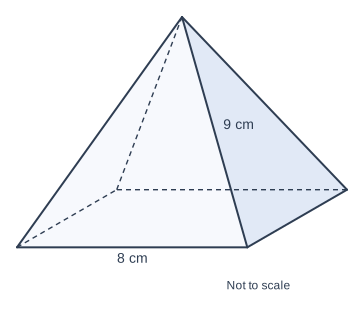
The diagram shows a square-based pyramid.
The base has sides of 8 cm.
Each of the four sloping edges is 9 cm long.
The apex is directly above the centre of the base.

Work out the volume of the pyramid.

\(\text{Volume of a pyramid} = \dfrac{1}{3} \times \text{area of base} \times \text{perpendicular height}\)

A square-based pyramid drawn in 3D with hidden edges shown as dashed lines. The length of the base is labelled 8 cm (along the front edge of the base). The length of a sloping edge is labelled 9 cm (along the sloping edge from the apex to the front right corner of the base). The diagram is labelled "Not to scale".

Model answer

The apex is above the centre of the base, which is half a diagonal from each corner.
Diagonal of base = \(\sqrt{8^2 + 8^2} = \sqrt{128} = 8\sqrt{2}\) cm
Half-diagonal = \(4\sqrt{2}\) cm, and \((4\sqrt{2})^2 = 32\)
Perpendicular height: \(h^2 = 9^2 - 32 = 81 - 32 = 49\), so \(h = 7\) cm
Volume = \(\dfrac{1}{3} \times 8^2 \times 7 = \dfrac{448}{3} = 149\dfrac{1}{3}\) cm³

Explanation

The sloping edge, the perpendicular height and half of the base diagonal form a right-angled triangle, with the 9 cm edge as the hypotenuse. Find the half-diagonal squared (32) by Pythagoras in the base, then h² = 81 − 32 = 49. A common error is to use half the base edge (4 cm) instead of half the diagonal.

Mark scheme
  1. 1 mark

    M1 for diagonal of base = \(\sqrt{8^2 + 8^2}\) or \(\sqrt{128}\), or half-diagonal² = \(4^2 + 4^2 = 32\)

    Accept \(8\sqrt{2}\) or \(4\sqrt{2}\); correct answer with no working scores full marks

  2. 1 mark

    M1 for \(h^2 = 9^2 -\) their 32 oe

    Their half-diagonal must be used, not 4 (half the base edge) or the whole diagonal.

  3. 1 mark

    A1 for \(h = 7\)

  4. 1 mark

    M1 for \(\dfrac{1}{3} \times 64 \times\) their 7

    Their h must come from a Pythagoras method.

  5. 1 mark

    A1 for \(\dfrac{448}{3}\) oe

    Accept \(149\dfrac{1}{3}\) or 149.3 or better. Using 4 instead of the half-diagonal gives \(h = \sqrt{65}\): M1 M0 A0 M1 A0 at most. A correct answer with no working scores 5.

Ready to try the rest? Every answer you write is marked against the mark scheme, so you can see exactly where the marks are.

Study Helper Hints first, answers after you try

Stuck on this one? Ask for a hint and I’ll point you in the right direction, without giving the answer away. Once you’ve checked your answer, I’ll show you how the marks are awarded.