Practise 16 exam-style questions on Trigonometric graphs for OCR GCSE Maths (Higher non-calculator). Write your answer as you would in the exam and get it marked in seconds against the mark scheme, point by point, with the Study Helper on hand if you get stuck.
16 questions
1–4 marks each
Instant marking
No sign-up needed
16 questions, marked as you go
Sample questions with model answers
Here are 4 of the questions in this topic, each with a model answer, an explanation of why it earns the marks and the mark scheme an examiner would use.
Question 1
1 mark
Ella says, "The largest value of \(\tan x\) is 1."
Is Ella correct? Give a reason for your answer.
Model answer
No. For example, \(\tan 60^\circ = \sqrt{3}\), which is more than 1. The graph of \(y = \tan x\) gets steeper and steeper as x approaches \(90^\circ\), so \(\tan x\) can be as large as you like. It has no largest value.
Explanation
Unlike sin x and cos x, tan x is not limited to values between −1 and 1. Its graph has vertical asymptotes at x = 90°, 270°, ... and goes up without limit as x approaches each one from the left. Ella may be thinking of the largest value of sin x or cos x.
Mark scheme
1 mark
B1 for No, with a correct reason
e.g. '\(\tan 60^\circ = \sqrt{3}\), which is more than 1', 'the graph of y = tan x keeps going up as x gets close to 90°', 'tan x has no maximum value / can be any number'. 'No' with no reason, or 'No, it is −1', scores 0.
Question 2
2 marks
Given that \(\sin 30^\circ = 0.5\), find the other value of x between \(0^\circ\) and \(360^\circ\) for which \(\sin x = 0.5\).
Model answer
The graph of \(y = \sin x\) is symmetrical about \(x = 90^\circ\) between \(0^\circ\) and \(180^\circ\). \(30^\circ\) is \(60^\circ\) before \(90^\circ\), so the other solution is \(60^\circ\) after \(90^\circ\). \(x = 180^\circ - 30^\circ = 150^\circ\)
Explanation
The line y = 0.5 crosses the sine graph twice between 0° and 360°, both times in the first half where sin x is positive. By symmetry about x = 90°, the second solution is 180° − 30°. A common error is to add 180° (or use 360° − 30°), which gives angles where sin x is negative.
Mark scheme
1 mark
M1 for \(180 - 30\)
Or for a correct use of the symmetry of the sine graph about x = 90°, e.g. 90 + 60; correct answer with no working scores full marks
1 mark
A1 for 150
Accept 150°. 210 or 330 (where sin x = −0.5) scores 0. Correct answer with no working scores 2 marks.
Question 3
3 marks
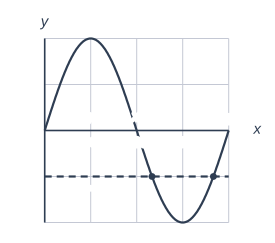
The diagram shows the graph of \(y = \sin x\) for \(0^\circ \leqslant x \leqslant 360^\circ\) and the line \(y = -0.5\).
The line meets the graph at the points A and B.
Find the coordinates of A and B.
Model answer
\(\sin 30^\circ = 0.5\) \(\sin x = -0.5\) where the graph is below the x-axis, between \(180^\circ\) and \(360^\circ\). \(x = 180^\circ + 30^\circ = 210^\circ\) and \(x = 360^\circ - 30^\circ = 330^\circ\) A is \((210, -0.5)\) and B is \((330, -0.5)\).
Explanation
Use the exact value sin 30° = 0.5 and the symmetry of the graph: the negative values come 30° after 180° and 30° before 360°. Both points lie on the line y = −0.5, so that is their y-coordinate. A common error is to give 150°, where sin x = +0.5.
Mark scheme
1 mark
B1 for \(\sin 30^\circ = 0.5\) seen or used
correct answer with no working scores full marks
1 mark
M1 for \(180 + 30\) or \(360 - 30\)
Or for a correct use of symmetry about x = 270°.
1 mark
A1 for A\((210, -0.5)\) and B\((330, -0.5)\)
Accept with A and B either way round, and with ° signs. x = 210 and x = 330 only scores B1 M1 A0. Readings from the graph that are not exact (e.g. 208) score A0.
Question 4
4 marks
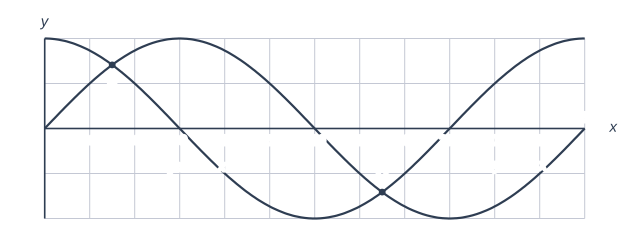
The diagram shows the graphs of \(y = \sin x\) and \(y = \cos x\) for \(0^\circ \leqslant x \leqslant 360^\circ\).
The graphs meet at the points P and Q.
Find the exact coordinates of P and Q.
Model answer
At P and Q, \(\sin x = \cos x\), so \(\tan x = \dfrac{\sin x}{\cos x} = 1\). \(\tan 45^\circ = 1\), and tan repeats every \(180^\circ\), so \(x = 45^\circ\) or \(x = 225^\circ\). \(\sin 45^\circ = \dfrac{\sqrt{2}}{2}\), so P is \(\left(45, \dfrac{\sqrt{2}}{2}\right)\). \(\sin 225^\circ = -\sin 45^\circ = -\dfrac{\sqrt{2}}{2}\), so Q is \(\left(225, -\dfrac{\sqrt{2}}{2}\right)\).
Explanation
Where the graphs meet, sin x = cos x. Dividing by cos x gives tan x = 1; alternatively recall that sin 45° = cos 45°. Use the exact value √2/2 for the y-coordinate, and the symmetry of the sine graph to see that sin 225° is negative. A common error is to give decimal readings from the graph instead of exact values.
Mark scheme
1 mark
M1 for \(\sin x = \cos x\) leading to \(\tan x = 1\), or for \(\sin 45^\circ = \cos 45^\circ\) used
Or for using the symmetry of the two graphs (the graphs are reflections of each other in x = 45°); correct answer with no working scores full marks
1 mark
A1 for \(x = 45\) and \(x = 225\)
Both needed.
1 mark
B1 for \(y = \dfrac{\sqrt{2}}{2}\) oe at P
Accept \(\dfrac{1}{\sqrt{2}}\). Decimals such as 0.7 or 0.71 score B0 (exact values are asked for).
1 mark
B1 for \(y = -\dfrac{\sqrt{2}}{2}\) oe at Q
Accept \(-\dfrac{1}{\sqrt{2}}\). So P\(\left(45, \dfrac{\sqrt{2}}{2}\right)\) and Q\(\left(225, -\dfrac{\sqrt{2}}{2}\right)\).
Ready to try the rest? Every answer you write is marked against the mark scheme, so you can see exactly where the marks are.
Ctrl + Enter to check
Study HelperHints first, answers after you try
Stuck on this one? Ask for a hint and I’ll point you in the right direction, without giving the answer away. Once you’ve checked your answer, I’ll show you how the marks are awarded.