Practise 16 exam-style questions on Angles and parallel lines for OCR GCSE Maths (Higher non-calculator). Write your answer as you would in the exam and get it marked in seconds against the mark scheme, point by point, with the Study Helper on hand if you get stuck.
16 questions
2–4 marks each
Instant marking
No sign-up needed
16 questions, marked as you go
Sample questions with model answers
Here are 4 of the questions in this topic, each with a model answer, an explanation of why it earns the marks and the mark scheme an examiner would use.
Question 1
2 marks
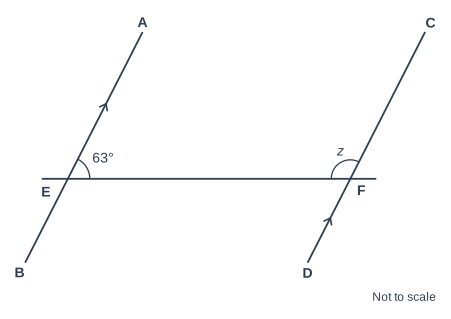
In the diagram, the lines AB and CD are parallel. A straight line crosses AB at E and CD at F.
Work out the value of \(z\). Give a reason for your answer.
Model answer
\(z = 180 - 63 = 117\) Co-interior angles add up to 180°.
Explanation
Angles AEF and EFC are both between the parallel lines and on the same side of EF, so they are co-interior (allied) angles, which add up to 180°. A common error is to think they are equal. 'C angles' is not accepted as a reason.
Mark scheme
1 mark
B1 for 117
Accept 117°. 63 scores B0.
1 mark
B1 for: co-interior angles add up to 180°
Accept 'allied angles add up to 180°' or 'interior angles on parallel lines are supplementary' oe. Also accept a correct two-step reason, e.g. 'corresponding angles are equal and angles on a straight line add up to 180°'. Do not accept 'C angles' or 'co-interior angles are equal'.
Question 2
3 marks
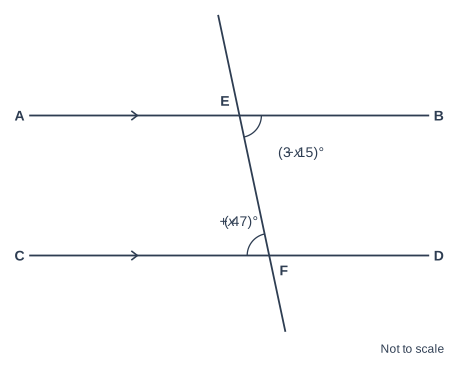
The diagram shows two parallel lines, AB and CD, and a straight line that crosses them at E and F.
Find the value of \(x\). Give a reason for your answer.
Model answer
Alternate angles are equal, so \(3x - 15 = x + 47\) \(2x = 62\) \(x = 31\)
Explanation
The two marked angles are on opposite sides of EF, between the parallel lines, so they are alternate angles and must be equal. Set the expressions equal and solve. Check: both angles are 78°.
Mark scheme
1 mark
M1 for \(3x - 15 = x + 47\) oe
Setting the two angles equal.
1 mark
A1 for \(x = 31\)
Correct answer with no working scores M1 A1.
1 mark
B1 for: alternate angles are equal
Do not accept 'Z angles'. An equation adding the angles to 180 (x = 37) scores M0 A0, but B1 may still be awarded for the correct reason.
Question 3
3 marks
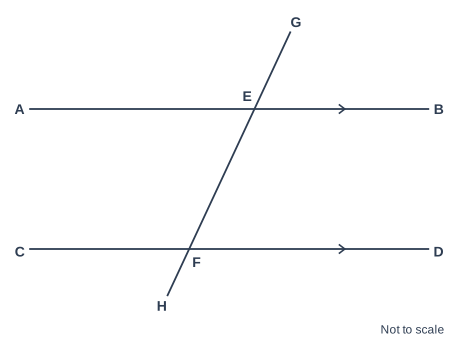
In the diagram, AB is parallel to CD. The straight line GH crosses AB at E and CD at F.
Use corresponding angles to prove that angle BEF + angle EFD = 180°.
Model answer
Angle GEB = angle EFD (corresponding angles are equal, because AB is parallel to CD). GEF is a straight line, so angle GEB + angle BEF = 180° (angles on a straight line add up to 180°). Replacing angle GEB by angle EFD: angle EFD + angle BEF = 180°.
Explanation
This proves that co-interior angles add up to 180°. The corresponding angle GEB equals angle EFD, and GEB sits on a straight line with angle BEF. Each step needs its reason, and you cannot use the co-interior angle fact itself.
Mark scheme
1 mark
B1 for angle GEB = angle EFD, because corresponding angles are equal
The reason is needed. Accept letters for the angles if defined clearly.
1 mark
B1 for angle GEB + angle BEF = 180°, because angles on a straight line add up to 180°
The straight line is GH (through E). The reason is needed.
1 mark
B1 for: so angle BEF + angle EFD = 180°, completing the proof
Replacing angle GEB by angle EFD. Using 'co-interior angles add up to 180°' as a reason scores 0 (it is the result being proved). Answer only scores 0.
Question 4
4 marks
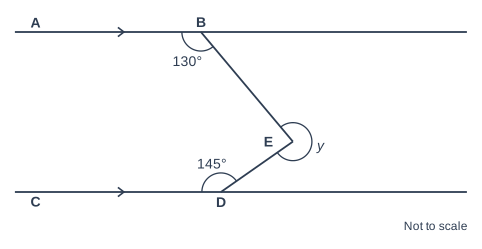
In the diagram, AB is parallel to CD. Angle ABE = 130° and angle CDE = 145°.
Work out the size of the reflex angle BED, marked \(y\). Give a reason for each stage of your working.
Model answer
Draw a line EX through E parallel to AB and CD, pointing away from A and C. Angle BEX = angle ABE = 130° (alternate angles are equal). Angle DEX = angle CDE = 145° (alternate angles are equal). Reflex angle BED = \(130^\circ + 145^\circ = 275^\circ\) Check: the other angle BED = \((180 - 130) + (180 - 145) = 85^\circ\), and \(275 + 85 = 360\).
Explanation
Add a line through E parallel to AB: it splits the reflex angle at E into two parts that are alternate to the given angles. Or find the smaller angle BED using co-interior angles (50° + 35° = 85°) and subtract it from 360°. Read the question carefully: it asks for the reflex angle.
Mark scheme
1 mark
M1 for a line through E parallel to AB (and CD)
May be described in words or implied by correct angles at E. Or M1 for extending BE to meet CD.
1 mark
B1 for correct angles at E with reasons, e.g. 130° and 145° as alternate angles (alternate angles are equal), or 50° and 35° from co-interior angles add up to 180°
With a line EX through E parallel to AB, on the side away from A and C: angle BEX = 130° and angle DEX = 145° (alternate angles). On the side towards A and C: 180 − 130 = 50 and 180 − 145 = 35 (co-interior angles add up to 180°).
1 mark
M1 for \(130 + 145\) or \(360 - (50 + 35)\)
FT their angles. Angles at a point add up to 360°.
1 mark
A1 for 275°
Accept y = 275. A final answer of 85 (the angle that is not reflex) scores M1 B1 M0 A0. A correct answer with a clear method but no reasons scores M1 B0 M1 A1.
Ready to try the rest? Every answer you write is marked against the mark scheme, so you can see exactly where the marks are.
Ctrl + Enter to check
Study HelperHints first, answers after you try
Stuck on this one? Ask for a hint and I’ll point you in the right direction, without giving the answer away. Once you’ve checked your answer, I’ll show you how the marks are awarded.