
Level:
Correct: 0
Incorrect: 0
Marks: 0/0
Exam Practice
Course:
Topics:
OCR GCSE Maths (Higher non-calculator) Smart practice A mixed round aimed at your weak spots
Unit 1
Number Operations and Integers
Unit 2
Fractions, Decimals and Percentages
Unit 3
Indices and Surds
Unit 4
Approximation and Estimation
Unit 5
Ratio, Proportion and Rates of Change
Unit 6
Algebra
Unit 7
Graphs of Equations and Functions
Unit 8
Basic Geometry
Unit 9
Congruence and Similarity
Unit 10
Mensuration
Unit 11
Probability
Unit 12
Statistics
Avg
score:
–
Topics
done:
0/121

Tree diagrams

Practise 18 exam-style questions on Tree diagrams for OCR GCSE Maths (Higher non-calculator). Write your answer as you would in the exam and get it marked in seconds against the mark scheme, point by point, with the Study Helper on hand if you get stuck.

  • 18 questions
  • 2–5 marks each
  • Instant marking
  • No sign-up needed
18 questions, marked as you go

Sample questions with model answers

Here are 4 of the questions in this topic, each with a model answer, an explanation of why it earns the marks and the mark scheme an examiner would use.

Question 1

2 marks

Ama either cycles or walks to school.
The probability that she cycles is 0.3.
The probability that she cycles and arrives on time is 0.24.

The tree diagram shows some of the probabilities.

Work out the probability on the branch labelled y.
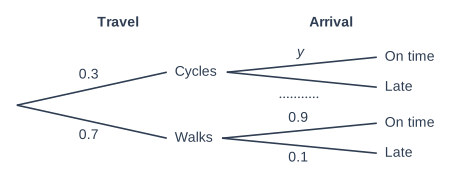
A probability tree diagram drawn from left to right with 2 stages of branches, headed "Travel" and "Arrival". Each branch has its outcome written at its end and its probability written beside it. First stage, 2 branches: "Cycles" with probability 0.3, "Walks" with probability 0.7. After "Cycles", the second stage branches are "On time" with probability y, "Late" with probability left blank (a dotted line to fill in). After "Walks", the second stage branches are "On time" with probability 0.9, "Late" with probability 0.1.

Model answer

Cycles and on time: \(0.3 \times y = 0.24\)
\(y = 0.24 \div 0.3 = 2.4 \div 3 = 0.8\)

Explanation

The probability of a path is the product of the probabilities along it, so 0.3 × y must equal 0.24. Dividing gives y = 0.8. To divide decimals without a calculator, multiply both numbers by 10: 2.4 ÷ 3 = 0.8.

Mark scheme
  1. 1 mark

    M1 for \(0.3 \times y = 0.24\) oe

    Or 0.24 ÷ 0.3.

  2. 1 mark

    A1 for 0.8

    Accept 4/5 or 80%. Answer only scores 2 marks. 0.072 (0.3 × 0.24) or 0.54 (0.3 + 0.24) scores 0.
Question 2

3 marks

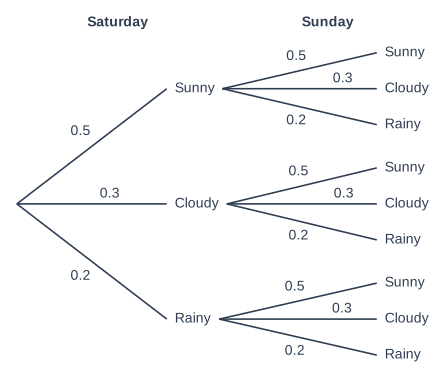
The tree diagram shows the probabilities that the weather on Saturday and on Sunday is sunny, cloudy or rainy.

Work out the probability that the weather is the same on both days.

A probability tree diagram drawn from left to right with 2 stages of branches, headed "Saturday" and "Sunday". Each branch has its outcome written at its end and its probability written beside it. First stage, 3 branches: "Sunny" with probability 0.5, "Cloudy" with probability 0.3, "Rainy" with probability 0.2. After "Sunny", the second stage branches are "Sunny" with probability 0.5, "Cloudy" with probability 0.3, "Rainy" with probability 0.2. After "Cloudy", the second stage branches are "Sunny" with probability 0.5, "Cloudy" with probability 0.3, "Rainy" with probability 0.2. After "Rainy", the second stage branches are "Sunny" with probability 0.5, "Cloudy" with probability 0.3, "Rainy" with probability 0.2.

Model answer

P(sunny, sunny) = \(0.5 \times 0.5 = 0.25\)
P(cloudy, cloudy) = \(0.3 \times 0.3 = 0.09\)
P(rainy, rainy) = \(0.2 \times 0.2 = 0.04\)
P(same weather) = 0.25 + 0.09 + 0.04 = 0.38

Explanation

There are three paths where the weather is the same: sunny-sunny, cloudy-cloudy and rainy-rainy. Multiply along each path, then add the three results. Forgetting one of the paths, or adding along the branches, are the usual errors.

Mark scheme
  1. 1 mark

    M1 for one of \(0.5 \times 0.5\), \(0.3 \times 0.3\), \(0.2 \times 0.2\)

    Implied by 0.25, 0.09 or 0.04 used for a 'same' path.

  2. 1 mark

    M1 for \(0.5 \times 0.5 + 0.3 \times 0.3 + 0.2 \times 0.2\)

    All three products added, with no extra terms.

  3. 1 mark

    A1 for 0.38

    Accept 38/100 or 19/50. Answer only scores 3 marks. 0.25 + 0.09 + 0.04 written as 0.34 (an addition slip) scores M1 M1 A0.

Question 3

3 marks

A biased spinner can land on red or blue.
The probability that it lands on red is x.

The spinner is spun twice.
The probability that it lands on red both times is 0.16.

Work out the probability that the spinner lands on red once and blue once.

Model answer

P(red, red) = \(x \times x = x^2 = 0.16\), so \(x = 0.4\)
P(blue) = 1 − 0.4 = 0.6
P(red once and blue once) = \(0.4 \times 0.6 + 0.6 \times 0.4 = 0.24 + 0.24 = 0.48\)

Explanation

On a tree diagram both red branches have probability x, so the red-red path gives \(x^2 = 0.16\) and \(x = 0.4\) (a probability cannot be negative). Red once and blue once has two paths, red-blue and blue-red. Halving 0.16 instead of square rooting, or using only one order, are common errors.

Mark scheme
  1. 1 mark

    M1 for \(x^2 = 0.16\) leading to \(x = 0.4\)

    Implied by 0.4 and 0.6 used as the probabilities of red and blue.

  2. 1 mark

    M1 for \(0.4 \times 0.6 + 0.6 \times 0.4\) oe

    Or 2 × their 0.4 × (1 − their 0.4), or 1 − 0.16 − 0.6 × 0.6.

  3. 1 mark

    A1 for 0.48

    Accept 12/25. Answer only scores 3 marks. 0.24 (one order only) scores M1 M0 A0. 0.08 (from x = 0.08, halving 0.16) scores M0.

Question 4

4 marks

A bag contains 4 red counters and 6 blue counters.

Ella takes a counter at random from the bag and does not put it back.
She then puts 2 counters of the other colour into the bag:
if she took a red counter she puts in 2 blue counters, and if she took a blue counter she puts in 2 red counters.

Ella then takes a second counter at random from the bag.

Work out the probability that the second counter is blue.

Model answer

If the first counter is red (probability \(\dfrac{4}{10}\)): the bag then has 3 red and 6 + 2 = 8 blue, so P(blue) = \(\dfrac{8}{11}\)
If the first counter is blue (probability \(\dfrac{6}{10}\)): the bag then has 4 + 2 = 6 red and 5 blue, so P(blue) = \(\dfrac{5}{11}\)
P(second is blue) = \(\dfrac{4}{10} \times \dfrac{8}{11} + \dfrac{6}{10} \times \dfrac{5}{11} = \dfrac{32}{110} + \dfrac{30}{110} = \dfrac{62}{110} = \dfrac{31}{55}\)

Explanation

Draw a tree diagram and work out the contents of the bag after each first outcome: one counter is removed and two are added, so there are 11 counters either way, but the colours differ. Then add the two paths that end in blue. Forgetting to remove the first counter, or adding the counters of the same colour, are the usual errors.

Mark scheme
  1. 1 mark

    B1 for \(\dfrac{8}{11}\) or \(\dfrac{5}{11}\) as a second-stage probability of blue

    After red: 3 red and 8 blue. After blue: 6 red and 5 blue. May be seen on a tree diagram.

  2. 1 mark

    M1 for \(\dfrac{4}{10} \times \dfrac{8}{11}\) or \(\dfrac{6}{10} \times \dfrac{5}{11}\)

    Implied by 32/110 or 30/110. FT their second-stage fractions.

  3. 1 mark

    M1 for \(\dfrac{4}{10} \times \dfrac{8}{11} + \dfrac{6}{10} \times \dfrac{5}{11}\)

    FT their second-stage fractions, provided the denominators are 11.

  4. 1 mark

    A1 for \(\dfrac{62}{110}\) oe

    Accept 31/55 or 0.563... or 0.56 if from 62/110. Answer only scores 4 marks.

Ready to try the rest? Every answer you write is marked against the mark scheme, so you can see exactly where the marks are.

Study Helper Hints first, answers after you try

Stuck on this one? Ask for a hint and I’ll point you in the right direction, without giving the answer away. Once you’ve checked your answer, I’ll show you how the marks are awarded.