Level:
Correct: 0
Incorrect: 0
Marks: 0/0
Exam Practice
Course:
Topics:
OCR GCSE Maths (Higher non-calculator) Smart practice A mixed round aimed at your weak spots
Unit 1
Number Operations and Integers
Unit 2
Fractions, Decimals and Percentages
Unit 3
Indices and Surds
Unit 4
Approximation and Estimation
Unit 5
Ratio, Proportion and Rates of Change
Unit 6
Algebra
Unit 7
Graphs of Equations and Functions
Unit 8
Basic Geometry
Unit 9
Congruence and Similarity
Unit 10
Mensuration
Unit 11
Probability
Unit 12
Statistics
Avg
score:
–
Topics
done:
0/121

Trigonometry in right-angled triangles

Practise 21 exam-style questions on Trigonometry in right-angled triangles for OCR GCSE Maths (Higher non-calculator). Write your answer as you would in the exam and get it marked in seconds against the mark scheme, point by point, with the Study Helper on hand if you get stuck.

  • 21 questions
  • 1–5 marks each
  • Instant marking
  • No sign-up needed
20 questions, marked as you go

Sample questions with model answers

Here are 4 of the questions in this topic, each with a model answer, an explanation of why it earns the marks and the mark scheme an examiner would use.

Question 1

2 marks

The diagram shows a right-angled triangle PQR.

PQ = 6 cm and PR = 12 cm.

Work out the size of angle \(\theta\).
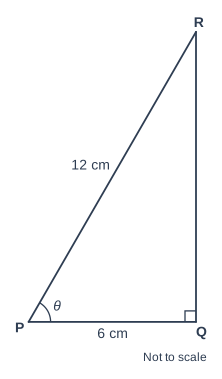
Geometry diagram, marked "Not to scale". Triangle PQR. Angle PQR is marked as a right angle (90°). Angle QPR is marked θ. Side PQ is labelled 6 cm. Side PR is labelled 12 cm.

Model answer

PQ is adjacent to \(\theta\) and PR is the hypotenuse.
\(\cos \theta = \dfrac{6}{12} = \dfrac{1}{2}\)
\(\cos 60^\circ = \dfrac{1}{2}\), so \(\theta = 60^\circ\)

Explanation

The 6 cm side is next to θ and the 12 cm side is the hypotenuse, so use cos θ = adjacent ÷ hypotenuse = ½. Without a calculator you must recognise ½ as the exact value of cos 60°. Writing 30° confuses cos 60° = ½ with sin 30° = ½.

Mark scheme
  1. 1 mark

    M1 for \(\cos \theta = \dfrac{6}{12}\) oe

    Accept \(\cos \theta = \dfrac{1}{2}\) or \(\cos \theta = 0.5\). Or M1 for QR = \(\sqrt{108}\) found with Pythagoras and a correct trig ratio using it; correct answer with no working scores full marks

  2. 1 mark

    A1 for 60

    Accept 60°. 30 (from \(\sin \theta = \dfrac{1}{2}\), the wrong ratio) scores M0 A0. A correct answer with no working scores 2 marks.
Question 2

3 marks

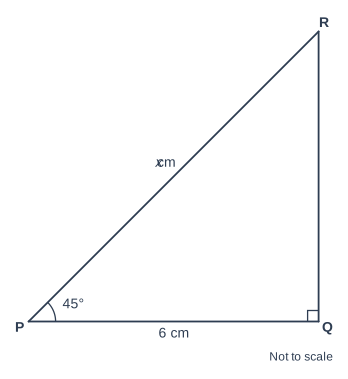
The diagram shows a right-angled triangle PQR.

PQ = 6 cm and angle QPR = 45°.

Show that \(x = 6\sqrt{2}\).

Geometry diagram, marked "Not to scale". Triangle PQR. Angle PQR is marked as a right angle (90°). Angle QPR is marked 45°. Side PQ is labelled 6 cm. Side PR is labelled x cm.

Model answer

PQ is adjacent to the 45° angle and \(x\) is the hypotenuse.
\(\cos 45^\circ = \dfrac{6}{x}\)
\(x = \dfrac{6}{\cos 45^\circ} = \dfrac{6}{\dfrac{1}{\sqrt{2}}} = 6\sqrt{2}\)

Explanation

Use cos 45° = 1/√2 (= √2/2) with the adjacent side and the hypotenuse. Dividing by 1/√2 is the same as multiplying by √2. Another way: the third angle is also 45°, so QR = 6 cm and Pythagoras gives x = √72 = 6√2. Every step must be shown because the answer is given.

Mark scheme
  1. 1 mark

    M1 for \(\cos 45^\circ = \dfrac{6}{x}\) oe

    Alternative method: M1 for QR = 6 (the triangle is isosceles because angle PRQ = 45°), M1 for \(x^2 = 6^2 + 6^2 = 72\), A1 for \(\sqrt{72} = \sqrt{36} \times \sqrt{2} = 6\sqrt{2}\).

  2. 1 mark

    M1 for \(x = \dfrac{6}{\dfrac{\sqrt{2}}{2}}\) oe or \(x = \dfrac{12}{\sqrt{2}}\) oe

    Exact value \(\cos 45^\circ = \dfrac{\sqrt{2}}{2}\) or \(\dfrac{1}{\sqrt{2}}\) substituted and rearranged, e.g. \(x = 6\sqrt{2}\) from \(6 \div \dfrac{1}{\sqrt{2}}\).

  3. 1 mark

    A1 for \(\dfrac{12}{\sqrt{2}} \times \dfrac{\sqrt{2}}{\sqrt{2}} = \dfrac{12\sqrt{2}}{2} = 6\sqrt{2}\) oe

    A complete, correct final step to reach \(6\sqrt{2}\) (with \(\cos 45^\circ = \dfrac{1}{\sqrt{2}}\), \(6 \div \dfrac{1}{\sqrt{2}} = 6\sqrt{2}\) directly is fine). This is a 'show that' question: answer only scores 0.

Question 3

4 marks

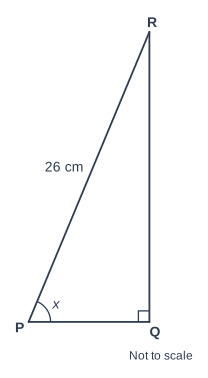
The diagram shows a right-angled triangle PQR.

PR = 26 cm and angle QPR = \(x\).
\(\cos x = \dfrac{5}{13}\)

Work out the perimeter of triangle PQR.

Geometry diagram, marked "Not to scale". Triangle PQR. Angle PQR is marked as a right angle (90°). Angle QPR is marked x. Side PR is labelled 26 cm.

Model answer

PQ is adjacent to \(x\) and PR is the hypotenuse.
\(PQ = 26 \cos x = 26 \times \dfrac{5}{13} = 10\) cm
\(QR^2 = 26^2 - 10^2 = 676 - 100 = 576\), so QR = 24 cm
Perimeter = 26 + 10 + 24 = 60 cm

Explanation

cos x links the adjacent side PQ with the hypotenuse PR, so PQ = 26 × 5/13 = 10 cm. Then the third side comes from Pythagoras (or from sin x = 12/13, using a 5, 12, 13 triangle). The question asks for the perimeter, so add all three sides.

Mark scheme
  1. 1 mark

    M1 for \(26 \times \dfrac{5}{13}\) oe

    PQ = 26 cos x; correct answer with no working scores full marks

  2. 1 mark

    A1 for PQ = 10

  3. 1 mark

    M1 for \(26^2 -\) their \(10^2\) oe

    Or \(\sin x = \dfrac{12}{13}\) found and QR = \(26 \times \dfrac{12}{13}\). QR = 24 seen implies M1.

  4. 1 mark

    A1 for 60

    Accept 60 cm. A correct answer with no working scores 4 marks.

Question 4

4 marks

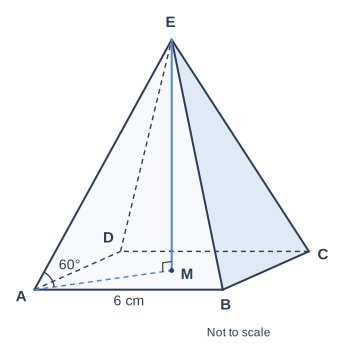
The diagram shows a pyramid with a square base ABCD and apex E.
M is the centre of the base and E is vertically above M.

AB = 6 cm and angle EAM = 60°.

Work out the height, EM, of the pyramid.
Give your answer in the form \(a\sqrt{b}\), where \(a\) and \(b\) are integers and \(b\) is as small as possible.

A square-based pyramid drawn in 3D with hidden edges shown as dashed lines. The length of the base is labelled 6 cm (along the front edge of the base). The base is ABCD (A front left, B front right, C back right, D back left) and the apex is E. M is the midpoint of AC. A straight line is drawn from E to M. A straight line is drawn from A to M. The angle MAE at A is marked 60°. A right angle is marked at M between MA and ME. The diagram is labelled "Not to scale".

Model answer

AC is a diagonal of the base: \(AC^2 = 6^2 + 6^2 = 72\), so AC = \(\sqrt{72} = 6\sqrt{2}\)
AM = half of AC = \(3\sqrt{2}\) cm
Triangle AME has a right angle at M.
\(\tan 60^\circ = \dfrac{EM}{AM}\)
\(EM = 3\sqrt{2} \times \sqrt{3} = 3\sqrt{6}\) cm

Explanation

The height EM, the sloping edge EA and AM (half of a base diagonal) form a right-angled triangle with the 60° angle at A. Find AM with Pythagoras, then EM is opposite the 60° angle and AM is adjacent, so multiply by tan 60° = √3. Using half of the side AB instead of half of the diagonal is the most common error.

Mark scheme
  1. 1 mark

    M1 for \(6^2 + 6^2\) oe or \(3^2 + 3^2\) oe

    Pythagoras for AC or AM. 72 or 18 seen implies M1; correct answer with no working scores full marks

  2. 1 mark

    A1 for AM = \(3\sqrt{2}\) oe

    Accept \(\sqrt{18}\), or AC = \(\sqrt{72}\) with AM as half of it.

  3. 1 mark

    M1 for EM = their AM \(\times \tan 60^\circ\) oe

    Accept \(\tan 60^\circ = \dfrac{EM}{AM}\) with their AM, or their AM \(\times \sqrt{3}\). Or EA = 2 × their AM (from \(\cos 60^\circ = \dfrac{1}{2}\)) followed by Pythagoras.

  4. 1 mark

    A1 for \(3\sqrt{6}\)

    cao. \(\sqrt{54}\) or \(3\sqrt{2} \times \sqrt{3}\) unsimplified scores M1 A1 M1 A0. 3√3 (using AM = 3, half of AB) scores M0 A0 M1 A0.

Ready to try the rest? Every answer you write is marked against the mark scheme, so you can see exactly where the marks are.

Study Helper Hints first, answers after you try

Stuck on this one? Ask for a hint and I’ll point you in the right direction, without giving the answer away. Once you’ve checked your answer, I’ll show you how the marks are awarded.