
Level:
Correct: 0
Incorrect: 0
Marks: 0/0
Exam Practice
Course:
Topics:
OCR GCSE Maths (Higher non-calculator) Smart practice A mixed round aimed at your weak spots
Unit 1
Number Operations and Integers
Unit 2
Fractions, Decimals and Percentages
Unit 3
Indices and Surds
Unit 4
Approximation and Estimation
Unit 5
Ratio, Proportion and Rates of Change
Unit 6
Algebra
Unit 7
Graphs of Equations and Functions
Unit 8
Basic Geometry
Unit 9
Congruence and Similarity
Unit 10
Mensuration
Unit 11
Probability
Unit 12
Statistics
Avg
score:
–
Topics
done:
0/121

Inequalities and regions on graphs

Practise 15 exam-style questions on Inequalities and regions on graphs for OCR GCSE Maths (Higher non-calculator). Write your answer as you would in the exam and get it marked in seconds against the mark scheme, point by point, with the Study Helper on hand if you get stuck.

  • 15 questions
  • 1–4 marks each
  • Instant marking
  • No sign-up needed
15 questions, marked as you go

Sample questions with model answers

Here are 4 of the questions in this topic, each with a model answer, an explanation of why it earns the marks and the mark scheme an examiner would use.

Question 1

2 marks

The region R is shaded on the grid.

R is defined by the inequalities

\(x \geqslant 1\)   \(y \geqslant 2\)   \(x + y \leqslant 6\)

Is the point (3, 3) in the region R?
Give a reason for your answer.
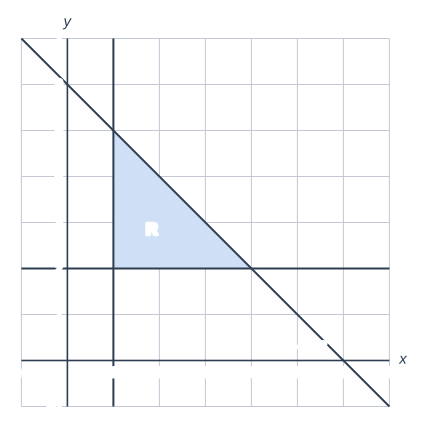
A coordinate grid with x from −1 to 7 and y from −1 to 7; each grid square is 1 unit across, and the axes cross at the origin O. Three boundary lines are drawn across the grid: x = 1 (solid), y = 2 (solid) and x + y = 6 (solid). The region labelled R satisfying x ≥ 1, y ≥ 2 and x + y ≤ 6 is shaded.

Model answer

Check each inequality at (3, 3):
\(3 \geqslant 1\) true; \(3 \geqslant 2\) true; \(3 + 3 = 6 \leqslant 6\) true.
The point is on the boundary line \(x + y = 6\), which is a solid line, so it is included.
Yes, (3, 3) is in R.

Explanation

A point is in the region if its coordinates satisfy every inequality. (3, 3) lies on the line x + y = 6; because the inequality is ≤, points on this line are included, which is why the line is drawn solid. A dashed line would mean the points on it are not included.

Mark scheme
  1. 1 mark

    M1 for checking (3, 3) in the inequalities, e.g. \(3 + 3 = 6\), or for identifying that (3, 3) lies on the line \(x + y = 6\)

  2. 1 mark

    A1 for 'Yes' with a reason, e.g. it is on the solid line x + y = 6, which is included because the inequality is ≤, and \(3 \geqslant 1\), \(3 \geqslant 2\)

    Accept '3 + 3 = 6, which is ≤ 6, and 3 ≥ 1 and 3 ≥ 2', or 'it is on a solid boundary line, so it is included'. 'Yes' with no reason scores 0. 'No, because it is on the line' scores M1 A0.
Question 2

2 marks

Explain why no point \((x, y)\) satisfies both of these inequalities.

\(y > x + 2\)
\(y < x - 1\)

Model answer

The lines \(y = x + 2\) and \(y = x - 1\) are parallel (both have gradient 1), and for every x the line \(y = x + 2\) is 3 units above \(y = x - 1\).
\(y > x + 2\) is the region above the upper line; \(y < x - 1\) is the region below the lower line.
These regions do not overlap, so no point satisfies both.
(Algebraically: both would need \(x + 2 < y < x - 1\), so \(2 < -1\), which is false.)

Explanation

Two regions defined by parallel boundary lines either overlap in a strip or not at all. Here the region must be above the higher line and below the lower line, which is impossible. Combining the inequalities algebraically gives the false statement 2 < −1, which proves it.

Mark scheme
  1. 1 mark

    B1 for: the lines \(y = x + 2\) and \(y = x - 1\) are parallel (both have gradient 1), with \(y = x + 2\) always above \(y = x - 1\)

    Or: for every x, \(x + 2 > x - 1\).

  2. 1 mark

    B1 for: a point cannot be above the higher line and below the lower line at the same time, so the regions do not overlap

    Accept the algebraic argument: \(y > x + 2\) and \(y < x - 1\) would need \(x + 2 < y < x - 1\), so \(x + 2 < x - 1\), giving \(2 < -1\), which is impossible.

Question 3

3 marks

Sam buys \(x\) pens and \(y\) pencils.

Pens cost 50p each and pencils cost 20p each.
Sam spends at most £3.
He buys at least 2 pens.
He buys more pencils than pens.

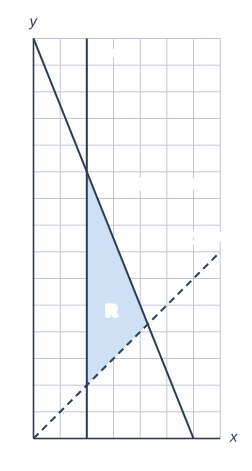
The region R on the grid shows the possible values of \(x\) and \(y\).

Work out the greatest total number of pens and pencils that Sam can buy.

A coordinate grid with x from 0 to 7 and y from 0 to 15; each grid square is 1 unit across, and the axes cross at the origin O. Three boundary lines are drawn across the grid: 5x + 2y = 30 (solid), x = 2 (solid) and y = x (dashed). The region labelled R satisfying 5x + 2y ≤ 30, x ≥ 2 and y > x is shaded.

Model answer

The inequalities are \(5x + 2y \leqslant 30\) (cost in 10p units), \(x \geqslant 2\) and \(y > x\).
Pencils are cheaper, so buy as few pens as allowed: \(x = 2\).
Then \(2y \leqslant 30 - 10 = 20\), so \(y \leqslant 10\). (2, 10) is in R: cost \(100 + 200 = 300\)p = £3.
Other edge points: (3, 7) gives 10 items, (4, 5) gives 9 items.
The greatest total is \(2 + 10 = 12\).

Explanation

The points in R with whole-number coordinates are the possible purchases. To get the most items, buy as many of the cheaper item as possible: at x = 2 (the least number of pens allowed) Sam can afford 10 pencils. Check the totals at the other corners of R to be sure that 12 is the greatest.

Mark scheme
  1. 1 mark

    M1 for identifying integer points in R, or for testing a point such as (2, 10) against all three conditions

    Points in R include (2, 3) to (2, 10), (3, 4) to (3, 7) and (4, 5); correct answer with no working scores full marks

  2. 1 mark

    M1 for (2, 10) shown to be allowed, e.g. \(2 \times 50 + 10 \times 20 = 300\)p

    Or for comparing totals of points on the edge of R, e.g. 2 + 10 = 12, 3 + 7 = 10, 4 + 5 = 9.

  3. 1 mark

    A1 for 12

    Correct answer with no working scores 3 marks. 15 (from (0, 15), which breaks 'at least 2 pens') scores M0.

Question 4

4 marks

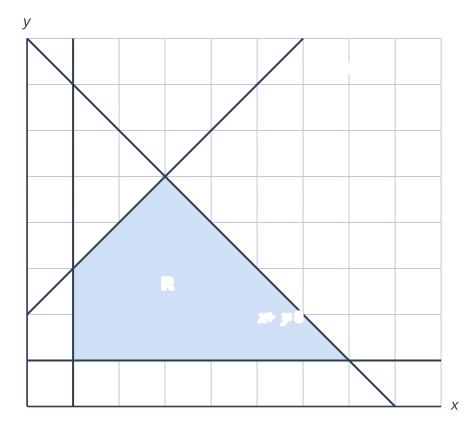
The region R is shaded on the grid.

R is defined by the inequalities

\(x \geqslant 1\)   \(y \geqslant 1\)   \(y \leqslant x + 2\)   \(x + y \leqslant 8\)

Work out the area of R.

A coordinate grid with x from 0 to 9 and y from 0 to 8; each grid square is 1 unit across, and the axes cross at the origin O. Four boundary lines are drawn across the grid: x = 1 (solid), y = 1 (solid), y = x + 2 (solid) and x + y = 8 (solid). The region labelled R satisfying x ≥ 1, y ≥ 1, y ≤ x + 2 and x + y ≤ 8 is shaded.

Model answer

Vertices: (1, 1), (7, 1), (3, 5) and (1, 3).
(3, 5): \(y = x + 2\) and \(x + y = 8\) give \(2x + 2 = 8\), so \(x = 3\), \(y = 5\).
Split R with the vertical line \(x = 3\):
Left part: trapezium with parallel sides 2 (from y = 1 to 3 at x = 1) and 4 (from y = 1 to 5 at x = 3), width 2: \(\dfrac{1}{2}(2 + 4) \times 2 = 6\)
Right part: triangle with base 4 (x = 3 to 7) and height 4: \(\dfrac{1}{2} \times 4 \times 4 = 8\)
Area of R \(= 6 + 8 = 14\)

Explanation

Find the corners of the region first: each is where two boundary lines meet. Then split the quadrilateral into shapes whose areas you know, such as a trapezium and a triangle, using vertical lines through the corners. A common error is to use the wrong corner where y = x + 2 meets x + y = 8.

Mark scheme
  1. 1 mark

    B1 for (3, 5) found as the intersection of \(y = x + 2\) and \(x + y = 8\)

    May be read from the grid or found by solving; correct answer with no working scores full marks

  2. 1 mark

    B1 for the other vertices (1, 1), (7, 1) and (1, 3)

    May be seen on the diagram or implied by correct lengths, e.g. base 6, side 2.

  3. 1 mark

    M1 for a correct method for the area of their quadrilateral

    e.g. splitting into a trapezium and a triangle: \(\dfrac{1}{2}(2 + 4) \times 2 + \dfrac{1}{2} \times 4 \times 4\), or the 6 by 4 rectangle round R minus two triangles: \(6 \times 4 - \dfrac{1}{2} \times 2 \times 2 - \dfrac{1}{2} \times 4 \times 4\). Any complete correct method, FT their vertices.

  4. 1 mark

    A1 for 14

    Correct answer with no working scores 4 marks.

Ready to try the rest? Every answer you write is marked against the mark scheme, so you can see exactly where the marks are.

Study Helper Hints first, answers after you try

Stuck on this one? Ask for a hint and I’ll point you in the right direction, without giving the answer away. Once you’ve checked your answer, I’ll show you how the marks are awarded.