
Level:
Correct: 0
Incorrect: 0
Marks: 0/0
Exam Practice
Course:
Topics:
OCR GCSE Maths (Higher non-calculator) Smart practice A mixed round aimed at your weak spots
Unit 1
Number Operations and Integers
Unit 2
Fractions, Decimals and Percentages
Unit 3
Indices and Surds
Unit 4
Approximation and Estimation
Unit 5
Ratio, Proportion and Rates of Change
Unit 6
Algebra
Unit 7
Graphs of Equations and Functions
Unit 8
Basic Geometry
Unit 9
Congruence and Similarity
Unit 10
Mensuration
Unit 11
Probability
Unit 12
Statistics
Avg
score:
–
Topics
done:
0/121

Combined transformations

Practise 13 exam-style questions on Combined transformations for OCR GCSE Maths (Higher non-calculator). Write your answer as you would in the exam and get it marked in seconds against the mark scheme, point by point, with the Study Helper on hand if you get stuck.

  • 13 questions
  • 1–4 marks each
  • Instant marking
  • No sign-up needed
13 questions, marked as you go

Sample questions with model answers

Here are 4 of the questions in this topic, each with a model answer, an explanation of why it earns the marks and the mark scheme an examiner would use.

Question 1

2 marks

The diagram shows quadrilateral S and the line \(y = x\).

S is reflected in the line \(y = x\).

Write down the coordinates of the vertices of S that are invariant.
Give a reason for your answer.
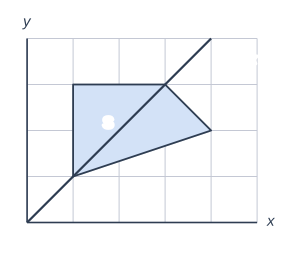
A coordinate grid with x from 0 to 5 and y from 0 to 4; each grid square is 1 unit across, and the axes cross at the origin O. Shape S is a shaded quadrilateral with vertices (1, 1), (4, 2), (3, 3) and (1, 3). The line labelled "y = x" is a straight line sloping upwards from left to right passing through the origin and (2, 2).

Model answer

A reflection in \(y = x\) maps \((a, b)\) to \((b, a)\).
A point is invariant if it maps to itself, which happens only for points on the mirror line.
The vertices \((1, 1)\) and \((3, 3)\) lie on \(y = x\), so they are invariant.
\((4, 2) \rightarrow (2, 4)\) and \((1, 3) \rightarrow (3, 1)\) move.

Explanation

An invariant point is one that is mapped onto itself. Under a reflection, exactly the points on the mirror line are invariant, so look for the vertices with equal coordinates. A common error is to list every vertex near the line, or to give the images of the vertices instead.

Mark scheme
  1. 1 mark

    B1 for \((1, 1)\) and \((3, 3)\) only

    Both needed, with no other vertices listed.

  2. 1 mark

    B1 for a correct reason, e.g. they lie on the mirror line / on \(y = x\)

    Accept 'their x- and y-coordinates are equal, so swapping them leaves them unchanged'. Do not accept 'they do not move' on its own, which only restates invariant.

Question 2

2 marks

A shape is reflected in the line \(x = 3\).
The image is then translated by the vector \(\begin{pmatrix} 0 \\ 4 \end{pmatrix}\).

Show that no point is invariant under this combined transformation.

Model answer

Reflecting \((x, y)\) in \(x = 3\) gives \((6 - x, y)\).
Translating by \(\begin{pmatrix} 0 \\ 4 \end{pmatrix}\) gives \((6 - x, y + 4)\).
For a point to be invariant we need \(y + 4 = y\), which is impossible.
So every point moves: no point is invariant.

Explanation

The reflection fixes only the points on the mirror line x = 3, but the translation then moves every point 4 units up, so nothing ends where it started. Writing the image of a general point (x, y) proves it for every point at once; checking a few points does not prove it.

Mark scheme
  1. 1 mark

    M1 for the image of a general point, \((x, y) \rightarrow (6 - x, y + 4)\), or the argument that only points on \(x = 3\) keep their x-coordinate

    Testing one or two particular points is not enough for this mark.

  2. 1 mark

    A1 for a complete argument, e.g. the y-coordinate always increases by 4, so \(y + 4 = y\) is impossible and no point maps to itself

    Answer only scores 0.

Question 3

3 marks

A shape is rotated 90° clockwise about the origin.
The image is then reflected in the line \(y = x\).

Describe fully the single transformation that is equivalent to these two transformations.

Model answer

Rotating 90° clockwise about the origin: \((x, y) \rightarrow (y, -x)\).
Reflecting in \(y = x\) swaps the coordinates: \((y, -x) \rightarrow (-x, y)\).
\((x, y) \rightarrow (-x, y)\) is a reflection in the y-axis.
Check with \((2, 1)\): \((2, 1) \rightarrow (1, -2) \rightarrow (-2, 1)\).
Reflection in the y-axis.

Explanation

Track a point, ideally one with different coordinates such as (2, 1), through both transformations, or use the coordinate rules. The result changes only the sign of x, which is a reflection in the y-axis. A rotation followed by a reflection reverses the orientation, so the answer must be a reflection, not a rotation.

Mark scheme
  1. 1 mark

    M1 for a point or shape taken correctly through both transformations

    e.g. \((2, 1) \rightarrow (1, -2) \rightarrow (-2, 1)\), or \((x, y) \rightarrow (y, -x) \rightarrow (-x, y)\). Implied by a correct final answer.

  2. 1 mark

    B1 for reflection

    If more than one transformation is described as the answer, score 0 for the whole question.

  3. 1 mark

    B1 for (in) the y-axis

    Accept x = 0. Do not accept the x-axis or y = 0.

Question 4

4 marks

Triangle T has vertices \((1, 1)\), \((4, 1)\) and \((1, 3)\).

T is reflected in the line \(x = -1\) to give triangle U.
U is reflected in the line \(y = 2\) to give triangle V.

Describe fully the single transformation that maps triangle T onto triangle V.

Model answer

Reflect T in \(x = -1\): \((1, 1) \rightarrow (-3, 1)\), \((4, 1) \rightarrow (-6, 1)\), \((1, 3) \rightarrow (-3, 3)\).
Reflect U in \(y = 2\): \((-3, 1) \rightarrow (-3, 3)\), \((-6, 1) \rightarrow (-6, 3)\), \((-3, 3) \rightarrow (-3, 1)\).
V is T turned upside down. The midpoint of \((1, 1)\) and \((-3, 3)\) is \((-1, 2)\); the midpoint of \((4, 1)\) and \((-6, 3)\) is also \((-1, 2)\).
Rotation of 180° about \((-1, 2)\).

Explanation

Two reflections in perpendicular lines combine to a half turn about the point where the lines cross, here (−1, 2). You can confirm it by finding V and checking that (−1, 2) is the midpoint of each vertex of T and its image. A common error is to give the origin as the centre.

Mark scheme
  1. 1 mark

    M1 for U with at least two correct vertices: \((-3, 1)\), \((-6, 1)\), \((-3, 3)\)

    Implied by a correct V.

  2. 1 mark

    M1 for V with at least two correct vertices: \((-3, 3)\), \((-6, 3)\), \((-3, 1)\)

    FT their U. Implied by a correct final answer.

  3. 1 mark

    B1 for rotation of 180°

    Enlargement, scale factor −1 is the same transformation and scores this mark. If more than one transformation is described as the answer, score 0 for the whole question.

  4. 1 mark

    B1 for centre \((-1, 2)\)

    A correct full description with no working scores 4 marks.

Ready to try the rest? Every answer you write is marked against the mark scheme, so you can see exactly where the marks are.

Study Helper Hints first, answers after you try

Stuck on this one? Ask for a hint and I’ll point you in the right direction, without giving the answer away. Once you’ve checked your answer, I’ll show you how the marks are awarded.