
Level:
Correct: 0
Incorrect: 0
Marks: 0/0
Exam Practice
Course:
Topics:
OCR GCSE Maths (Higher non-calculator) Smart practice A mixed round aimed at your weak spots
Unit 1
Number Operations and Integers
Unit 2
Fractions, Decimals and Percentages
Unit 3
Indices and Surds
Unit 4
Approximation and Estimation
Unit 5
Ratio, Proportion and Rates of Change
Unit 6
Algebra
Unit 7
Graphs of Equations and Functions
Unit 8
Basic Geometry
Unit 9
Congruence and Similarity
Unit 10
Mensuration
Unit 11
Probability
Unit 12
Statistics
Avg
score:
–
Topics
done:
0/121

Ruler and compass constructions

Practise 13 exam-style questions on Ruler and compass constructions for OCR GCSE Maths (Higher non-calculator). Write your answer as you would in the exam and get it marked in seconds against the mark scheme, point by point, with the Study Helper on hand if you get stuck.

  • 13 questions
  • 2–4 marks each
  • Instant marking
  • No sign-up needed
13 questions, marked as you go

Sample questions with model answers

Here are 4 of the questions in this topic, each with a model answer, an explanation of why it earns the marks and the mark scheme an examiner would use.

Question 1

2 marks

A is the point \((-2, 5)\) and B is the point \((6, 1)\).

The perpendicular bisector of AB crosses AB at the point M.

Work out the coordinates of M.

Model answer

The perpendicular bisector of AB crosses AB at its midpoint.
\(x = \dfrac{-2 + 6}{2} = 2\)
\(y = \dfrac{5 + 1}{2} = 3\)
M is \((2, 3)\).

Explanation

The perpendicular bisector cuts AB into two equal halves at right angles, so M is the midpoint of AB. Find the mean of the x-coordinates and the mean of the y-coordinates. Common errors are adding the coordinates without halving, or subtracting them.

Mark scheme
  1. 1 mark

    B1 for x-coordinate 2

    From \((-2 + 6) \div 2\). Accept the answer written as (2, 3); correct answer with no working scores full marks

  2. 1 mark

    B1 for y-coordinate 3

    From \((5 + 1) \div 2\). Coordinates written the wrong way round, (3, 2), score B1 only. (4, 6) from adding without halving scores 0; (4, −2) or (8, −4) from subtracting scores 0.
Question 2

3 marks

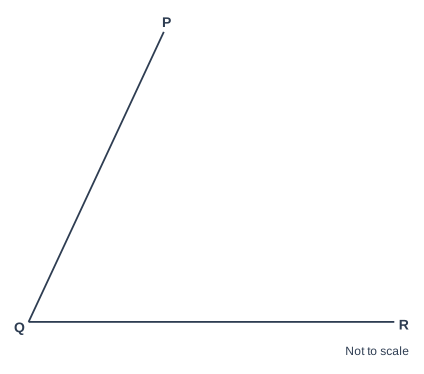
The diagram shows angle PQR.

Describe the steps you would take to bisect angle PQR, using only a ruler and a pair of compasses.

Geometry diagram, marked "Not to scale". Line segments QP and QR are drawn.

Model answer

1. Put the compass point on Q and draw an arc that crosses QP at X and QR at Y.
2. Keeping the same radius (or any fixed radius), put the compass point on X and draw an arc inside the angle, then put the point on Y and draw another arc that crosses it at Z.
3. Use the ruler to draw a straight line from Q through Z. This line bisects angle PQR.

Explanation

The first arc makes QX = QY. The next two arcs, drawn with equal radii, make XZ = YZ, so triangles QXZ and QYZ are congruent and QZ splits the angle into two equal parts. A common error is to forget that the second pair of arcs must use the same radius as each other.

Mark scheme
  1. 1 mark

    B1 for: with the compass point on Q, draw an arc that crosses both QP and QR (at two points, e.g. X on QP and Y on QR)

    Accept 'an arc cutting both arms (lines) of the angle'. The arc must be centred at Q.

  2. 1 mark

    B1 for: with the compass point on X and then on Y, using the same radius, draw two arcs that cross inside the angle

    The idea of the same radius (or same compass setting) for both arcs, centred on the two points found in the first step, is needed. The radius may differ from the first arc.

  3. 1 mark

    B1 for: draw a straight line with the ruler from Q through the point where the two arcs cross

    Accept 'join Q to the crossing point and extend' oe. Each mark is independent: award each correct step wherever it appears.

Question 3

3 marks

A is a point on a straight line L.

Describe how you could make an angle of exactly 45° at A, between L and a new line, using only a ruler and a pair of compasses.
No protractor may be used.

Model answer

1. Put the compass point on A and draw arcs that cut L at X and Y, one each side of A.
2. Open the compasses wider. With the point on X and then on Y (same radius), draw arcs that cross at Z above L. Draw the line AZ: it is perpendicular to L, so the angle between AZ and L is 90°.
3. Bisect this right angle: with the point on A, draw an arc cutting L at U and AZ at V. With the same radius, draw arcs from U and from V that cross at W. The line AW makes an angle of \(90^\circ \div 2 = 45^\circ\) with L.

Explanation

Ruler-and-compass constructions can combine: the perpendicular to a line at a point gives 90°, and bisecting it gives 45°. Each step needs equal radii in the right places. A common error is to describe only the right angle and forget to bisect it.

Mark scheme
  1. 1 mark

    B1 for: with the compass point on A, draw arcs that cut L at two points X and Y, one on each side of A

    This is the first step of constructing the perpendicular to L at A. Accept 'construct the perpendicular to L at A' only if the method is described (this mark and the next).

  2. 1 mark

    B1 for: with a larger radius and the compass point on X and then Y (same radius), draw arcs that cross at Z; the line AZ is perpendicular to L (makes 90°)

    The same radius for both arcs is needed. Accept any correct ruler-and-compass method for a right angle at A.

  3. 1 mark

    B1 for: bisect the right angle: arc centred at A cutting L and AZ, then equal arcs from these two points crossing, and a line from A through the crossing point, which makes 45° with L

    Accept 'bisect the 90° angle' with a correct description of the angle-bisector construction. Award this mark even if the right angle was not described correctly. Using a protractor at any stage scores 0 for that stage.

Question 4

4 marks

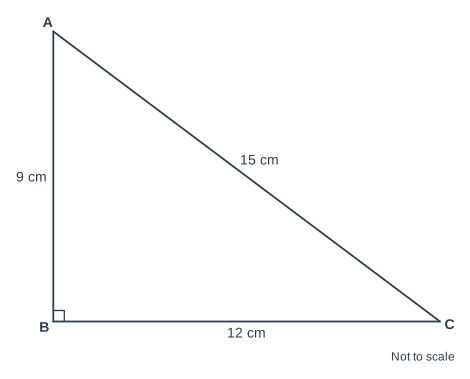
The diagram shows a right-angled triangle ABC.
AB = 9 cm, BC = 12 cm, AC = 15 cm and angle ABC = 90°.

Work out the shortest distance from B to the line AC.

Geometry diagram, marked "Not to scale". Triangle ABC. Angle ABC is marked as a right angle (90°). Side AB is labelled 9 cm. Side BC is labelled 12 cm. Side AC is labelled 15 cm.

Model answer

The shortest distance from B to AC is the perpendicular distance, h, from B to AC.
Area of triangle ABC = \(\dfrac{1}{2} \times 9 \times 12 = 54 \text{ cm}^2\)
Using AC as the base: \(\dfrac{1}{2} \times 15 \times h = 54\)
\(h = \dfrac{108}{15} = 7.2\) cm

Explanation

The shortest distance from a point to a line is the perpendicular distance. Here that is the height of the triangle when AC is the base, so work out the area using the two perpendicular sides and then use the area again with base AC. A common error is to give BA or BC, which are not perpendicular to AC.

Mark scheme
  1. 1 mark

    B1 for recognising that the shortest distance is the perpendicular distance from B to AC

    May be implied by a correct method using the perpendicular height from B to AC, e.g. \(\dfrac{1}{2} \times 15 \times h\); correct answer with no working scores full marks

  2. 1 mark

    M1 for area of triangle = \(\dfrac{1}{2} \times 9 \times 12\) or 54

  3. 1 mark

    M1 for \(\dfrac{1}{2} \times 15 \times h = 54\) oe

    FT their area. E.g. \(h = \dfrac{2 \times 54}{15}\) or \(\dfrac{108}{15}\). Alternative methods: M2 for \(h = 9 \times \dfrac{12}{15}\) (using sin A or similar triangles).

  4. 1 mark

    A1 for 7.2 cm

    Accept \(\dfrac{36}{5}\) or \(7\dfrac{1}{5}\). Correct answer with no working scores 4 marks. Answers of 9 or 12 (the lengths of the other sides) score 0.

Ready to try the rest? Every answer you write is marked against the mark scheme, so you can see exactly where the marks are.

Study Helper Hints first, answers after you try

Stuck on this one? Ask for a hint and I’ll point you in the right direction, without giving the answer away. Once you’ve checked your answer, I’ll show you how the marks are awarded.