Practise 16 exam-style questions on Calculating with standard form for OCR GCSE Maths (Higher non-calculator). Write your answer as you would in the exam and get it marked in seconds against the mark scheme, point by point, with the Study Helper on hand if you get stuck.
16 questions
2–5 marks each
Instant marking
No sign-up needed
16 questions, marked as you go
Sample questions with model answers
Here are 4 of the questions in this topic, each with a model answer, an explanation of why it earns the marks and the mark scheme an examiner would use.
Question 1
2 marks
Kofi works out \((4 \times 10^5) \times (5 \times 10^3)\).
Explain the mistake Kofi has made and write the correct answer in standard form.
Model answer
Kofi's last line is wrong. 20 is \(2 \times 10\), so \(20 \times 10^8 = 2 \times 10 \times 10^8 = 2 \times 10^9\) He made the number smaller instead of keeping it the same.
Explanation
When the front number is divided by 10 to bring it between 1 and 10, the power of 10 must go up by 1 so the value stays the same. Check the size: \(400\,000 \times 5000 = 2\,000\,000\,000 = 2 \times 10^9\).
Mark scheme
1 mark
B1 for: \(20 = 2 \times 10^1\), so the power should go up by 1, not down
Accept 'he divided by 10 instead of multiplying by 10' or 'when 20 becomes 2 the power must increase' oe. Do not accept 'the last line is wrong' with no detail.
1 mark
B1 for \(2 \times 10^9\)
Independent of the explanation.
Question 2
3 marks
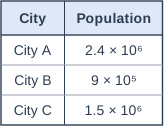
The table shows the populations of three cities.
Work out the mean population of the three cities. Give your answer in standard form.
The mean is the total divided by 3. The populations do not all have the same power of 10, so convert \(9 \times 10^5\) to \(0.9 \times 10^6\) (or use ordinary numbers) before adding. Adding 9 to 2.4 and 1.5 is a common error.
Mark scheme
1 mark
M1 for adding the three populations with correct place values
e.g. \(2\,400\,000 + 900\,000 + 1\,500\,000\), or \(2.4 \times 10^6 + 0.9 \times 10^6 + 1.5 \times 10^6\); correct answer with no working scores full marks
1 mark
A1 for \(4.8 \times 10^6\) or 4 800 000
1 mark
A1 for \(1.6 \times 10^6\)
1 600 000 as the final answer scores M1 A1 A0. Common wrong answer: \(4.3 \times 10^6\) from \(2.4 + 9 + 1.5 = 12.9\), then \(\div 3\). Correct answer with no working scores 3 marks.
Question 3
3 marks
Work out \(\dfrac{6 \times 10^5 + 3 \times 10^4}{9 \times 10^{-2}}\).
Work out the numerator first, as the fraction line groups it: the two terms have different powers, so add them as ordinary numbers. Then divide the front numbers and subtract the powers. \(0.7 \times 10^7\) is not standard form; moving to 7 lowers the power by 1.
Mark scheme
1 mark
M1 for numerator \(= 630\,000\) or \(6.3 \times 10^5\) oe
correct answer with no working scores full marks
1 mark
M1 for their \(6.3 \times 10^5 \div (9 \times 10^{-2})\) with \(6.3 \div 9 = 0.7\) or \(10^5 \div 10^{-2} = 10^7\)
Or \(630\,000 \div 0.09\) attempted, e.g. \(63\,000\,000 \div 9\).
1 mark
A1 for \(7 \times 10^6\)
7 000 000 or \(0.7 \times 10^7\) as the final answer scores M2 A0. Correct answer with no working scores 3 marks.
Question 4
4 marks
The mass of one carbon atom is \(2 \times 10^{-23}\) grams.
Work out the number of carbon atoms in 1.2 kg of carbon. Give your answer in standard form.
Model answer
1.2 kg = 1200 g \(= 1.2 \times 10^3\) g Number of atoms \(= (1.2 \times 10^3) \div (2 \times 10^{-23})\) \(1.2 \div 2 = 0.6\) \(10^3 \div 10^{-23} = 10^{3 - (-23)} = 10^{26}\) \(0.6 \times 10^{26} = 6 \times 10^{25}\)
Explanation
The mass of one atom is in grams, so convert 1.2 kg to grams first. The number of atoms is the total mass divided by the mass of one atom. 0.6 is less than 1, so write it as \(6 \times 10^{-1}\), which reduces the power by 1.
Mark scheme
1 mark
B1 for 1.2 kg = 1200 g or \(1.2 \times 10^3\) g
correct answer with no working scores full marks
1 mark
M1 for their \(1200 \div (2 \times 10^{-23})\)
Dividing the total mass by the mass of one atom. Multiplying scores M0.
1 mark
M1 for \(1.2 \div 2 = 0.6\) and \(10^3 \div 10^{-23} = 10^{26}\) oe
Or \(600 \times 10^{23}\) or \(0.6 \times 10^{26}\) seen. FT their mass in grams.
1 mark
A1 for \(6 \times 10^{25}\)
\(6 \times 10^{22}\) (mass left in kg) scores M2 at most. Correct answer with no working scores 4 marks.
Ready to try the rest? Every answer you write is marked against the mark scheme, so you can see exactly where the marks are.
Ctrl + Enter to check
Study HelperHints first, answers after you try
Stuck on this one? Ask for a hint and I’ll point you in the right direction, without giving the answer away. Once you’ve checked your answer, I’ll show you how the marks are awarded.