Practise 18 exam-style questions on Volume and surface area of prisms and cylinders for OCR GCSE Maths (Higher non-calculator). Write your answer as you would in the exam and get it marked in seconds against the mark scheme, point by point, with the Study Helper on hand if you get stuck.
18 questions
2–5 marks each
Instant marking
No sign-up needed
18 questions, marked as you go
Sample questions with model answers
Here are 4 of the questions in this topic, each with a model answer, an explanation of why it earns the marks and the mark scheme an examiner would use.
Question 1
2 marks
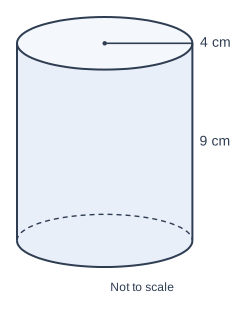
The diagram shows a cylinder with radius 4 cm and height 9 cm.
Work out the volume of the cylinder. Give your answer in terms of \(\pi\).
Model answer
Area of circular cross-section = \(\pi \times 4^2 = 16\pi\) cm² Volume = \(16\pi \times 9 = 144\pi\) cm³
Explanation
A cylinder is a prism with a circular cross-section, so its volume is πr² × height. Square the radius (16), not double it. Leave π in the answer when asked for terms of π.
Mark scheme
1 mark
M1 for \(\pi \times 4^2 \times 9\)
correct answer with no working scores full marks
1 mark
A1 for \(144\pi\)
Accept \(144\pi\) cm³. Do not accept a decimal only (452.4). \(72\pi\) (from \(\pi \times 4 \times 2 \times 9\)) scores M0 A0.
Question 2
3 marks
A cube has a total surface area of 150 cm².
Work out the volume of the cube.
Model answer
A cube has 6 identical square faces. Area of one face = \(150 \div 6 = 25\) cm² Side length = \(\sqrt{25} = 5\) cm Volume = \(5^3 = 125\) cm³
Explanation
Work backwards: divide the surface area by 6 to get one face, square root to get the edge, then cube the edge for the volume. Cubing the face area (25) instead of the edge is a common slip.
Mark scheme
1 mark
M1 for \(150 \div 6\) or 25
Area of one face; correct answer with no working scores full marks
1 mark
M1 for \(\sqrt{25}\) or side = 5
FT square root of their face area.
1 mark
A1 for 125
Accept 125 cm³. A correct answer with no working scores 3. 15 625 (from \(25^3\)) scores M1 M0 A0.
Question 3
3 marks
A cuboid container measures 20 cm by 15 cm by 12 cm and is full of water. All of the water is poured into an empty cylinder with radius 10 cm. No water is spilled.
Work out the depth of the water in the cylinder. Give your answer in terms of \(\pi\).
Model answer
Volume of water = \(20 \times 15 \times 12 = 3600\) cm³ In the cylinder: \(\pi \times 10^2 \times h = 3600\) \(100\pi h = 3600\) \(h = \dfrac{3600}{100\pi} = \dfrac{36}{\pi}\) cm
Explanation
The volume of water stays the same when it is poured. In the cylinder it forms a shorter cylinder of radius 10 cm, so πr²h = 3600. Dividing by 100π gives h = 36/π cm, about 11.5 cm. The answer is exact when π is left in.
Mark scheme
1 mark
M1 for volume of water = \(20 \times 15 \times 12\) or 3600
correct answer with no working scores full marks
1 mark
M1 for \(\pi \times 10^2 \times h =\) their 3600 oe
Accept \(3600 \div 100\pi\).
1 mark
A1 for \(\dfrac{36}{\pi}\) oe
Accept \(\dfrac{3600}{100\pi}\) or \(36 \div \pi\). Do not accept a decimal only (11.5). \(\dfrac{360}{\pi}\) (from \(\pi \times 10\)) scores M1 M0 A0.
Question 4
4 marks
A solid cylinder has radius \(r\) cm. The height of the cylinder is twice its radius. The total surface area of the cylinder is \(54\pi\) cm².
Work out the volume of the cylinder. Give your answer in terms of \(\pi\).
Model answer
Height = \(2r\) Total surface area = two ends + curved surface = \(2\pi r^2 + 2\pi r \times 2r = 2\pi r^2 + 4\pi r^2 = 6\pi r^2\) \(6\pi r^2 = 54\pi\) \(r^2 = 9\), so \(r = 3\) cm and the height is 6 cm. Volume = \(\pi \times 3^2 \times 6 = 54\pi\) cm³
Explanation
Write the surface area in terms of r only, using h = 2r: 2πr² for the ends and 2πr × 2r for the curved surface, 6πr² in total. Solving 6πr² = 54π gives r = 3. It is a coincidence of these numbers that the volume is also 54π (in cm³, not cm²).
Mark scheme
1 mark
M1 for total surface area = \(2\pi r^2 + 2\pi r \times 2r\) oe
Accept \(6\pi r^2\); correct answer with no working scores full marks
1 mark
M1 for \(6\pi r^2 = 54\pi\) or \(r^2 = 9\)
FT their expression of the form \(k\pi r^2\).
1 mark
A1 for \(r = 3\)
1 mark
A1 for \(54\pi\)
From \(\pi \times 3^2 \times 6\). Accept \(54\pi\) cm³. A correct answer with no working scores 4.
Ready to try the rest? Every answer you write is marked against the mark scheme, so you can see exactly where the marks are.
Ctrl + Enter to check
Study HelperHints first, answers after you try
Stuck on this one? Ask for a hint and I’ll point you in the right direction, without giving the answer away. Once you’ve checked your answer, I’ll show you how the marks are awarded.