
Level:
Correct: 0
Incorrect: 0
Marks: 0/0
Exam Practice
Course:
Topics:
OCR GCSE Maths (Higher non-calculator) Smart practice A mixed round aimed at your weak spots
Unit 1
Number Operations and Integers
Unit 2
Fractions, Decimals and Percentages
Unit 3
Indices and Surds
Unit 4
Approximation and Estimation
Unit 5
Ratio, Proportion and Rates of Change
Unit 6
Algebra
Unit 7
Graphs of Equations and Functions
Unit 8
Basic Geometry
Unit 9
Congruence and Similarity
Unit 10
Mensuration
Unit 11
Probability
Unit 12
Statistics
Avg
score:
–
Topics
done:
0/121

Percentages of amounts

Practise 15 exam-style questions on Percentages of amounts for OCR GCSE Maths (Higher non-calculator). Write your answer as you would in the exam and get it marked in seconds against the mark scheme, point by point, with the Study Helper on hand if you get stuck.

  • 15 questions
  • 2–5 marks each
  • Instant marking
  • No sign-up needed
15 questions, marked as you go

Sample questions with model answers

Here are 4 of the questions in this topic, each with a model answer, an explanation of why it earns the marks and the mark scheme an examiner would use.

Question 1

2 marks

Work out 17.5% of 360.

Model answer

10% of 360 = 36
5% of 360 = 18
2.5% of 360 = 9
17.5% of 360 = 36 + 18 + 9 = 63

Explanation

17.5% = 10% + 5% + 2.5%, and each part is half of the one before. Adding them gives 63. Another quick route: 20% is 72, and 2.5% is 9, so 17.5% is 72 − 9 = 63.

Mark scheme
  1. 1 mark

    M1 for 10% = 36, 5% = 18 and 2.5% = 9, or \(0.175 \times 360\) oe

    Any correct build-up method, e.g. 1% = 3.6 then \(\times 17.5\), or 20% − 2.5% = 72 − 9; correct answer with no working scores full marks

  2. 1 mark

    A1 for 63

    cao. Correct answer with no working scores 2 marks.
Question 2

2 marks

Write 45 cm as a percentage of 1.2 m.

Model answer

1.2 m = 120 cm
\(\dfrac{45}{120} = \dfrac{3}{8}\)
\(\dfrac{3}{8} = 0.375\) = 37.5%

Explanation

The two lengths must be in the same units before comparing them: 1.2 m is 120 cm. Then \(\dfrac{45}{120}\) simplifies to \(\dfrac{3}{8}\), which is 37.5%. A common error is to divide 45 by 1.2 without converting units.

Mark scheme
  1. 1 mark

    M1 for \(\dfrac{45}{120} \times 100\) oe

    Both lengths in the same units, e.g. \(\dfrac{0.45}{1.2}\), or \(\dfrac{3}{8}\). \(\dfrac{45}{1.2}\) (units not matched) scores M0; correct answer with no working scores full marks

  2. 1 mark

    A1 for 37.5%

    Accept \(37\dfrac{1}{2}\)%. 3750% scores M0 A0. Correct answer with no working scores 2 marks.

Question 3

3 marks

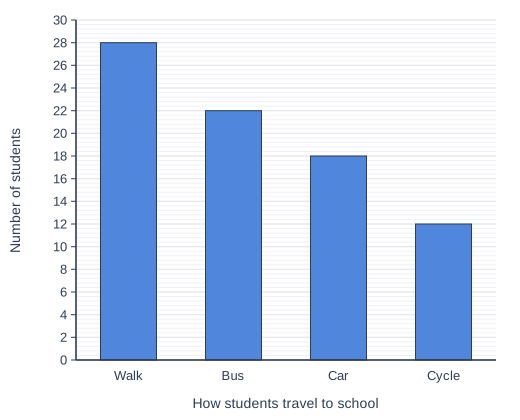
The bar chart shows how some students travel to school.

What percentage of these students travel by bus?

Bar chart of number of students for each how students travel to school: Walk 28, Bus 22, Car 18, Cycle 12.

Model answer

From the bar chart: walk 28, bus 22, car 18, cycle 12
Total = 28 + 22 + 18 + 12 = 80
Bus: \(\dfrac{22}{80} = \dfrac{11}{40} = \dfrac{27.5}{100}\)
27.5% of the students travel by bus.

Explanation

First find the total number of students by adding the heights of all the bars. Then write the bus number as a fraction of the total and change it to a percentage. A common error is to give 22% because 22 students travel by bus; that is only right if there are 100 students.

Mark scheme
  1. 1 mark

    M1 for total 80

    28 + 22 + 18 + 12; correct answer with no working scores full marks

  2. 1 mark

    M1 for \(\dfrac{22}{80} \times 100\) oe

    FT their total. e.g. \(\dfrac{22}{80} = \dfrac{11}{40}\) or 0.275.

  3. 1 mark

    A1 for 27.5%

    cao. 22% (the number of students read as a percentage) scores 0. Correct answer with no working scores 3 marks.

Question 4

4 marks

In class 10A, 18 of the 24 students passed a test.
In class 10B, there are 26 students and 50% of them passed the test.

Lucy says,

"75% of 10A passed and 50% of 10B passed, so for the two classes together the percentage who passed is \(\dfrac{75 + 50}{2}\) = 62.5%."

Is Lucy correct?
Show how you decide.

Model answer

10B: 50% of 26 = 13 students passed.
Total passed: 18 + 13 = 31
Total students: 24 + 26 = 50
\(\dfrac{31}{50} = \dfrac{62}{100}\) = 62%
The percentage is 62%, not 62.5%, so Lucy is not correct.

Explanation

You cannot average two percentages when the groups are different sizes. Work with the actual numbers: 31 of the 50 students passed, which is 62%. Lucy's method would only work if the two classes had the same number of students.

Mark scheme
  1. 1 mark

    M1 for 50% of 26 = 13

    The number who passed in 10B.

  2. 1 mark

    M1 for total passed 18 + 13 (= 31) and total students 24 + 26 (= 50)

    FT their 13.

  3. 1 mark

    M1 for \(\dfrac{31}{50} \times 100\) oe

    FT their totals.

  4. 1 mark

    A1 for 'No' with 62% shown

    Accept 'No, it is 62%, not 62.5%' or a correct explanation that the classes are different sizes, supported by 62%. 'No' with no correct percentage scores at most M3.

Ready to try the rest? Every answer you write is marked against the mark scheme, so you can see exactly where the marks are.

Study Helper Hints first, answers after you try

Stuck on this one? Ask for a hint and I’ll point you in the right direction, without giving the answer away. Once you’ve checked your answer, I’ll show you how the marks are awarded.