Level:
Correct: 0
Incorrect: 0
Marks: 0/0
Exam Practice
Course:
Topics:
OCR GCSE Maths (Higher non-calculator) Smart practice A mixed round aimed at your weak spots
Unit 1
Number Operations and Integers
Unit 2
Fractions, Decimals and Percentages
Unit 3
Indices and Surds
Unit 4
Approximation and Estimation
Unit 5
Ratio, Proportion and Rates of Change
Unit 6
Algebra
Unit 7
Graphs of Equations and Functions
Unit 8
Basic Geometry
Unit 9
Congruence and Similarity
Unit 10
Mensuration
Unit 11
Probability
Unit 12
Statistics
Avg
score:
–
Topics
done:
0/121

Circle theorem: angle at the centre

Practise 16 exam-style questions on Circle theorem: angle at the centre for OCR GCSE Maths (Higher non-calculator). Write your answer as you would in the exam and get it marked in seconds against the mark scheme, point by point, with the Study Helper on hand if you get stuck.

  • 16 questions
  • 1–5 marks each
  • Instant marking
  • No sign-up needed
16 questions, marked as you go

Sample questions with model answers

Here are 4 of the questions in this topic, each with a model answer, an explanation of why it earns the marks and the mark scheme an examiner would use.

Question 1

2 marks

The diagram shows a circle, centre O.
A, B and C are points on the circumference.

Angle AOB = 70°.

Ali works out the size of angle ACB. Here is his working.

Angle ACB = 2 × 70° = 140°, because the angle at the circumference is twice the angle at the centre.

Ali is wrong.
Explain his mistake and work out the correct size of angle ACB.
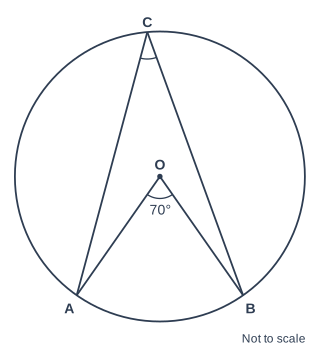
Geometry diagram, marked "Not to scale". A circle with centre O; A, B and C lie on it, in that order going anticlockwise. Line segments OA, OB, CA and CB are drawn. Angle AOB is marked 70°. Angle ACB is marked with a single arc.

Model answer

Ali has the theorem the wrong way round: the angle at the centre is twice the angle at the circumference, so the angle at the circumference is half the angle at the centre.
Angle ACB = 70° ÷ 2 = 35°

Explanation

Angles AOB and ACB stand on the same arc AB. The angle at the centre O is the larger angle: it is twice the angle at the circumference. So angle ACB is half of 70°, which is 35°. A sketch shows that 140° cannot be right, because angle ACB is clearly acute.

Mark scheme
  1. 1 mark

    B1 for explaining that the angle at the centre is twice the angle at the circumference (not the other way round) oe

    Accept e.g. 'he has the theorem the wrong way round', 'the angle at the centre is the bigger one, so he should halve 70', 'he should divide by 2, not multiply by 2'. Do not accept 'he used the wrong theorem' or 'he should have used 180' with no correct explanation.

  2. 1 mark

    B1 for 35

    Accept 35°. Independent of the explanation.
Question 2

3 marks

The diagram shows a circle, centre O.
A, B and C are points on the circumference.

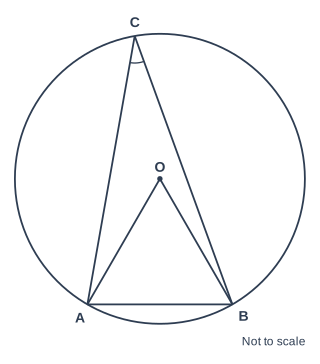
The chord AB is the same length as the radius of the circle.

Work out the size of angle ACB.
Give reasons for your answer.

Geometry diagram, marked "Not to scale". A circle with centre O; A, B and C lie on it, in that order going anticlockwise. Line segments OA, OB, AB, CA and CB are drawn. Angle ACB is marked with a single arc.

Model answer

OA and OB are radii and AB is the same length as the radius, so OA = OB = AB.
Triangle OAB is equilateral, so angle AOB = 60°.
The angle at the centre is twice the angle at the circumference, so
angle ACB = 60° ÷ 2 = 30°

Explanation

Join O to A and B: both are radii, and AB equals the radius, so triangle OAB is equilateral and angle AOB = 60°. Angle ACB stands on the same arc AB, so it is half of 60°. Many students do not spot the equilateral triangle because no angle is given in the question.

Mark scheme
  1. 1 mark

    M1 for angle AOB = 60 or triangle OAB is equilateral

    Implied by an answer of 30.

  2. 1 mark

    A1 for 30

    Accept 30°.

  3. 1 mark

    B1 for both reasons: OA = OB = AB (radii) so triangle OAB is equilateral, AND the angle at the centre is twice the angle at the circumference

    Both reasons are needed. Accept 'all angles in an equilateral triangle are 60°' with OA = OB = AB stated or clearly implied. Do not accept 'the angle at the circumference is half' without reference to the centre.

Question 3

4 marks

The diagram shows a circle, centre O.
A, B and C are points on the circumference.
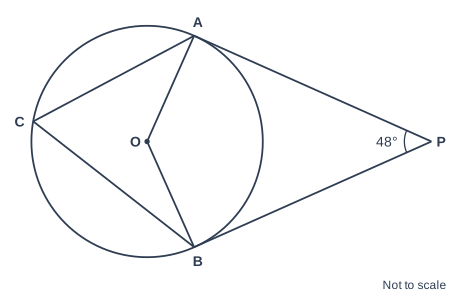
PA and PB are tangents to the circle at A and B.

Angle APB = 48°.

Work out the size of angle ACB.
Give reasons for your answer.

Geometry diagram, marked "Not to scale". A circle with centre O; A, C and B lie on it, in that order going anticlockwise. Line segments PA, PB, OA, OB, CA and CB are drawn. PA touches the circle at A (it is a tangent). PB touches the circle at B (it is a tangent). Angle APB is marked 48°.

Model answer

A tangent is perpendicular to the radius at the point of contact, so angle OAP = angle OBP = 90°.
Angles in a quadrilateral add up to 360°, so in OAPB:
angle AOB = 360° − 90° − 90° − 48° = 132°
The angle at the centre is twice the angle at the circumference, so
angle ACB = 132° ÷ 2 = 66°

Explanation

Join the radii OA and OB to make the quadrilateral OAPB, which has two right angles where the radii meet the tangents. Its angles add up to 360°, so angle AOB = 132°, and angle ACB is half of that. A quick check: angle AOB and angle APB always add up to 180° in this diagram.

Mark scheme
  1. 1 mark

    B1 for angle OAP = 90 or angle OBP = 90

    May be seen on the diagram.

  2. 1 mark

    M1 for angle AOB = 360 − 90 − 90 − 48 or 132

    Or 180 − 48. FT their 90s.

  3. 1 mark

    A1 for 66

    Accept 66°. Needs their 132 to be halved. 132 as the final answer scores B1 M1 A0. 24 (half of 48) scores 0.

  4. 1 mark

    B1 for all three reasons: a tangent is perpendicular to the radius (at the point of contact), angles in a quadrilateral add up to 360°, and the angle at the centre is twice the angle at the circumference

    Accept 'the angle between a tangent and a radius is 90°'; accept diameter for radius. All three reasons are needed for this mark.

Question 4

5 marks

The diagram shows a circle, centre O.
A, B and C are points on the circumference.
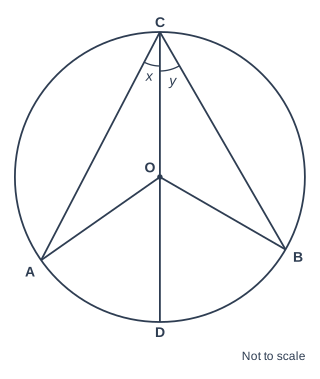
The straight line COD is a diameter of the circle.

Angle OCA = \(x\) and angle OCB = \(y\).

Prove that angle AOB = 2 × angle ACB.
Give a reason for each stage of your working.

Geometry diagram, marked "Not to scale". A circle with centre O; C, A, D and B lie on it, in that order going anticlockwise. Line segments CD, OA, OB, CA and CB are drawn. O lies on CD. Angle OCA is marked x. Angle OCB is marked y.

Model answer

OA = OC because they are radii, so triangle OAC is isosceles and angle OAC = \(x\).
The exterior angle of a triangle equals the sum of the two interior opposite angles, so angle AOD = \(x + x = 2x\).
OB = OC because they are radii, so triangle OBC is isosceles and angle OBC = \(y\).
Similarly, angle BOD is an exterior angle of triangle OBC, so angle BOD = \(2y\).
Angle AOB = angle AOD + angle BOD = \(2x + 2y = 2(x + y)\)
Angle ACB = \(x + y\), so angle AOB = 2 × angle ACB.

Explanation

This is the proof of the angle at the centre theorem. The diameter through C splits the diagram into two isosceles triangles, OAC and OBC, because OA, OB and OC are all radii. Each exterior angle at O is double the base angle, and adding them gives the result. You cannot use the theorem itself as a reason.

Mark scheme
  1. 1 mark

    B1 for angle OAC = \(x\) because OA = OC (radii) / triangle OAC is isosceles

    The reason is needed for this mark.

  2. 1 mark

    B1 for angle AOD = \(2x\), with reason

    Reason: the exterior angle of a triangle equals the sum of the two interior opposite angles; or angle AOC = \(180 - 2x\) (angles in a triangle) then angle AOD = \(2x\) (angles on a straight line).

  3. 1 mark

    B1 for angle OBC = \(y\) and angle BOD = \(2y\), with reasons

    Reasons as for triangle OAC; 'similarly' is acceptable if the reasons for triangle OAC have been given in full.

  4. 1 mark

    M1 for angle AOB = \(2x + 2y\)

    FT their angles AOD and BOD, provided they are in terms of x and y.

  5. 1 mark

    A1 for angle AOB = \(2(x + y)\) = 2 × angle ACB, since angle ACB = \(x + y\), completing a correct proof

    Needs all previous marks. Quoting 'the angle at the centre is twice the angle at the circumference' as a reason scores 0 for the whole proof: it is the result to be proved. Answer only scores 0.

Ready to try the rest? Every answer you write is marked against the mark scheme, so you can see exactly where the marks are.

Study Helper Hints first, answers after you try

Stuck on this one? Ask for a hint and I’ll point you in the right direction, without giving the answer away. Once you’ve checked your answer, I’ll show you how the marks are awarded.