Level:
Correct: 0
Incorrect: 0
Marks: 0/0
Exam Practice
Course:
Topics:
OCR GCSE Maths (Higher non-calculator) Smart practice A mixed round aimed at your weak spots
Unit 1
Number Operations and Integers
Unit 2
Fractions, Decimals and Percentages
Unit 3
Indices and Surds
Unit 4
Approximation and Estimation
Unit 5
Ratio, Proportion and Rates of Change
Unit 6
Algebra
Unit 7
Graphs of Equations and Functions
Unit 8
Basic Geometry
Unit 9
Congruence and Similarity
Unit 10
Mensuration
Unit 11
Probability
Unit 12
Statistics
Avg
score:
–
Topics
done:
0/121

Circle theorem: cyclic quadrilaterals

Practise 15 exam-style questions on Circle theorem: cyclic quadrilaterals for OCR GCSE Maths (Higher non-calculator). Write your answer as you would in the exam and get it marked in seconds against the mark scheme, point by point, with the Study Helper on hand if you get stuck.

  • 15 questions
  • 2–5 marks each
  • Instant marking
  • No sign-up needed
15 questions, marked as you go

Sample questions with model answers

Here are 4 of the questions in this topic, each with a model answer, an explanation of why it earns the marks and the mark scheme an examiner would use.

Question 1

2 marks

PQRS is a quadrilateral.

Angle P = 88°, angle Q = 95°, angle R = 94° and angle S = 83°.

Could the four vertices P, Q, R and S all lie on the circumference of a circle?
Give a reason for your answer.

Model answer

If PQRS were a cyclic quadrilateral, its opposite angles would add up to 180°.
Angle P + angle R = 88° + 94° = 182°
182° is not 180°, so PQRS cannot be a cyclic quadrilateral.
No, the four vertices cannot all lie on a circle.

Explanation

P and R are opposite vertices, as are Q and S. In a cyclic quadrilateral each pair of opposite angles adds up to 180°. Here 88° + 94° = 182°, so the quadrilateral is not cyclic. Check that you add opposite angles, not neighbouring ones.

Mark scheme
  1. 1 mark

    M1 for angle P + angle R = 182 or angle Q + angle S = 178

    Adding a pair of opposite angles.

  2. 1 mark

    A1 for No, because the opposite angles do not add up to 180° (but opposite angles of a cyclic quadrilateral must add up to 180°)

    The conclusion 'No' must be supported by a correct sum. Adding adjacent angles (e.g. P + Q = 183) scores M0 A0. 'Yes' scores M1 A0 at most.
Question 2

3 marks

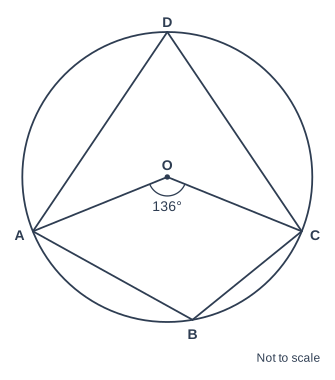
The diagram shows a circle, centre O.
A, B, C and D are points on the circumference.

Angle AOC = 136°.

Work out the size of angle ABC.
Give a reason for each stage of your working.

Geometry diagram, marked "Not to scale". A circle with centre O; A, B, C and D lie on it, in that order going anticlockwise. Quadrilateral ABCD. Line segments OA and OC are drawn. Angle AOC is marked 136°.

Model answer

Angle ADC and angle AOC both stand on the minor arc AC.
The angle at the centre is twice the angle at the circumference, so angle ADC = 136° ÷ 2 = 68°.
ABCD is a cyclic quadrilateral, and opposite angles of a cyclic quadrilateral add up to 180°, so
angle ABC = 180° − 68° = 112°

Explanation

B is on the minor arc, so angle ABC is obtuse: it is not half of 136°. Halving 136° gives the angle at D on the major arc, and the cyclic quadrilateral then gives angle ABC. Or halve the reflex angle AOC = 224° directly. The common error is to answer 68°.

Mark scheme
  1. 1 mark

    B1 for angle ADC = 68 because the angle at the centre is twice the angle at the circumference

    Value and reason needed.

  2. 1 mark

    M1 for 180 − their 68

    Opposite angles of a cyclic quadrilateral. Alternative: M1 for reflex angle AOC = 360 − 136 = 224, then 224 ÷ 2 (angle at the centre theorem).

  3. 1 mark

    A1 for 112 with the reason that opposite angles of a cyclic quadrilateral add up to 180°

    Accept 112°. For the alternative method the reasons are angles at a point and the angle at the centre theorem. 112 with no reasons scores B0 M1 A0; 68 as the final answer scores B1 M0 A0.

Question 3

4 marks

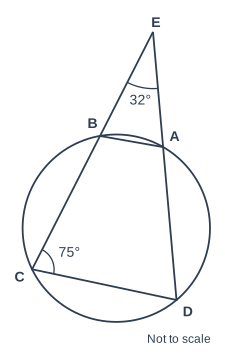
The diagram shows a circle.
A, B, C and D are points on the circumference.
The lines DA and CB are extended to meet at E.

Angle AEB = 32° and angle DCB = 75°.

Work out the size of angle ABE.
Give a reason for each stage of your working.

Geometry diagram, marked "Not to scale". A circle; A, B, C and D lie on it, in that order going anticlockwise. Quadrilateral ABCD. Line segments AE and BE are drawn. Angle AEB is marked 32°. Angle DCB is marked 75°.

Model answer

Opposite angles of a cyclic quadrilateral add up to 180°, so angle DAB = 180° − 75° = 105°.
EAD is a straight line, so angle EAB = 180° − 105° = 75° (angles on a straight line).
Angles in triangle EAB add up to 180°, so angle ABE = 180° − 32° − 75° = 73°.

Explanation

The exterior angle of the cyclic quadrilateral at A, angle EAB, equals the interior opposite angle, angle DCB = 75°. Then use the angle sum of triangle EAB. Another route: triangle EDC gives angle EDC = 73°, and the exterior angle at B, angle ABE, equals this interior opposite angle.

Mark scheme
  1. 1 mark

    B1 for angle DAB = 105 because opposite angles of a cyclic quadrilateral add up to 180°

    Value and reason needed. Alternative: B1 for angle EDC = 180 − 32 − 75 = 73 (angles in triangle EDC).

  2. 1 mark

    B1 for angle EAB = 75 because angles on a straight line add up to 180°

    FT 180 − their angle DAB. Alternative: B1 for angle ABC = 180 − 73 = 107 (cyclic quadrilateral).

  3. 1 mark

    M1 for 180 − 32 − their 75

    Angles in triangle EAB. Alternative: M1 for 180 − their 107 (angles on a straight line).

  4. 1 mark

    A1 for 73

    Accept 73°. 73 with values but no reasons scores M1 A1 only. 107 (angle ABC) scores B1 B1 M0 A0 at most.

Question 4

5 marks

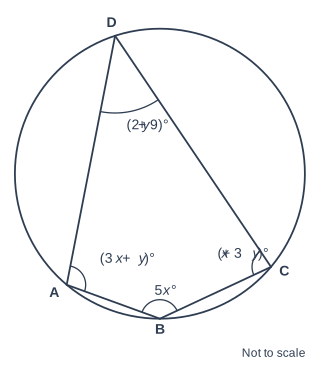
The diagram shows a circle.
A, B, C and D are points on the circumference.

Angle DAB = \((3x + y)^\circ\), angle ABC = \(5x^\circ\), angle BCD = \((x + 3y)^\circ\) and angle CDA = \((2y + 9)^\circ\).

Work out the values of \(x\) and \(y\).

Geometry diagram, marked "Not to scale". A circle; A, B, C and D lie on it, in that order going anticlockwise. Quadrilateral ABCD. Angle DAB is marked (3x + y)°. Angle ABC is marked 5x°. Angle BCD is marked (x + 3y)°. Angle CDA is marked (2y + 9)°.

Model answer

Opposite angles of a cyclic quadrilateral add up to 180°.
Angles DAB and BCD: \(3x + y + x + 3y = 180\), so \(4x + 4y = 180\) and \(x + y = 45\).
Angles ABC and CDA: \(5x + 2y + 9 = 180\), so \(5x + 2y = 171\).
From the first equation, \(y = 45 - x\).
\(5x + 2(45 - x) = 171\)
\(3x + 90 = 171\)
\(x = 27\), so \(y = 45 - 27 = 18\).
(Check: angles 99°, 135°, 81°, 45°; 99 + 81 = 180 and 135 + 45 = 180.)

Explanation

Each pair of opposite angles gives an equation, so you get two simultaneous equations in x and y. Simplify the first one (divide by 4) before substituting. Checking that all four angles are positive and add up to 360° confirms the answer.

Mark scheme
  1. 1 mark

    M1 for \(3x + y + x + 3y = 180\) oe

    Opposite angles DAB and BCD. Simplifies to \(4x + 4y = 180\) or \(x + y = 45\); correct answer with no working scores full marks

  2. 1 mark

    M1 for \(5x + 2y + 9 = 180\) oe

    Opposite angles ABC and CDA. Equations that add adjacent angles to 180 score M0.

  3. 1 mark

    M1 for a correct method to eliminate one variable from their two equations

    E.g. substituting \(y = 45 - x\) into \(5x + 2y = 171\), or multiplying to equate coefficients. Their equations must both be linear in x and y.

  4. 1 mark

    A1 for \(x = 27\)

  5. 1 mark

    A1 for \(y = 18\)

    A correct pair of answers with no working scores 5 marks. Check: the angles are 99°, 135°, 81° and 45°.

Ready to try the rest? Every answer you write is marked against the mark scheme, so you can see exactly where the marks are.

Study Helper Hints first, answers after you try

Stuck on this one? Ask for a hint and I’ll point you in the right direction, without giving the answer away. Once you’ve checked your answer, I’ll show you how the marks are awarded.