
Level:
Correct: 0
Incorrect: 0
Marks: 0/0
Exam Practice
Course:
Topics:
OCR GCSE Maths (Higher non-calculator) Smart practice A mixed round aimed at your weak spots
Unit 1
Number Operations and Integers
Unit 2
Fractions, Decimals and Percentages
Unit 3
Indices and Surds
Unit 4
Approximation and Estimation
Unit 5
Ratio, Proportion and Rates of Change
Unit 6
Algebra
Unit 7
Graphs of Equations and Functions
Unit 8
Basic Geometry
Unit 9
Congruence and Similarity
Unit 10
Mensuration
Unit 11
Probability
Unit 12
Statistics
Avg
score:
–
Topics
done:
0/121

Cosine rule

Practise 15 exam-style questions on Cosine rule for OCR GCSE Maths (Higher non-calculator). Write your answer as you would in the exam and get it marked in seconds against the mark scheme, point by point, with the Study Helper on hand if you get stuck.

  • 15 questions
  • 1–5 marks each
  • Instant marking
  • No sign-up needed
15 questions, marked as you go

Sample questions with model answers

Here are 4 of the questions in this topic, each with a model answer, an explanation of why it earns the marks and the mark scheme an examiner would use.

Question 1

3 marks

The diagram shows triangle ABC.

AB = 8 cm, AC = 5 cm and angle BAC = 60°.

Work out the value of \(x\).
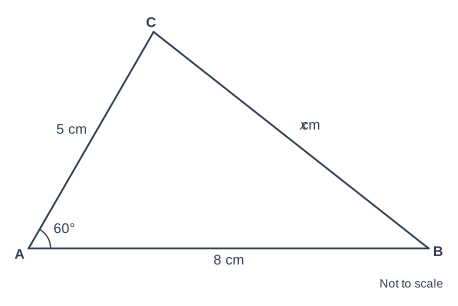
Geometry diagram, marked "Not to scale". Triangle ABC. Angle BAC is marked 60°. Side AB is labelled 8 cm. Side AC is labelled 5 cm. Side BC is labelled x cm.

Model answer

\(x\) is opposite the 60° angle, which is between the sides of 5 cm and 8 cm.
\(x^2 = 5^2 + 8^2 - 2 \times 5 \times 8 \times \cos 60^\circ\)
\(x^2 = 25 + 64 - 80 \times \dfrac{1}{2}\)
\(x^2 = 89 - 40 = 49\)
\(x = 7\)

Explanation

You know two sides and the angle between them, so use the cosine rule to find the third side. Work out 2 × 5 × 8 × cos 60° = 40 first, then subtract it from 25 + 64. Subtracting 80 from 89 before multiplying by cos 60° is a common order-of-operations error.

Mark scheme
  1. 1 mark

    M1 for \(x^2 = 5^2 + 8^2 - 2 \times 5 \times 8 \times \cos 60^\circ\) oe

    Correct substitution into the cosine rule; correct answer with no working scores full marks

  2. 1 mark

    M1 for \(25 + 64 - 40\) oe

    cos 60° = ½ used. 49 seen implies M1 M1.

  3. 1 mark

    A1 for 7

    Accept x = 7 or 7 cm. \(\sqrt{129}\) (adding instead of subtracting) scores M0 M0 A0. \((89 - 80) \times \dfrac{1}{2}\) giving \(\sqrt{4.5}\) scores M1 M0 A0. A correct answer with no working scores 3 marks.
Question 2

3 marks

A triangle has sides of length 6 cm, 7 cm and 10 cm.

Show that one of the angles of the triangle is obtuse.

Model answer

The largest angle, \(\theta\), is opposite the longest side, 10 cm.
\(\cos \theta = \dfrac{6^2 + 7^2 - 10^2}{2 \times 6 \times 7} = \dfrac{36 + 49 - 100}{84} = -\dfrac{15}{84}\)
The cosine of an angle between 90° and 180° is negative, so \(\theta\) is obtuse.

Explanation

Only the angle opposite the longest side can be obtuse. Its cosine has numerator 6² + 7² − 10², which is negative because 85 < 100, and cosines of angles between 90° and 180° are negative. This links to Pythagoras: if the longest side squared were exactly 85, the angle would be 90°.

Mark scheme
  1. 1 mark

    M1 for \(\cos \theta = \dfrac{6^2 + 7^2 - 10^2}{2 \times 6 \times 7}\) oe

    θ is the angle opposite the 10 cm side. Alternative method: M1 for \(6^2 + 7^2 = 85\) and \(10^2 = 100\).

  2. 1 mark

    A1 for \(\cos \theta = -\dfrac{15}{84}\) oe

    Accept \(-\dfrac{5}{28}\). Alternative method: A1 for 85 < 100 stated.

  3. 1 mark

    A1 for cos θ is negative, so θ is more than 90° (obtuse)

    Alternative method: A1 for 'the square of the longest side is more than the sum of the squares of the other two sides, so the angle opposite it is more than 90°' oe. This is a 'show that' question: a statement with no working scores 0.

Question 3

4 marks

A clock has an hour hand of length 7 cm and a minute hand of length 15 cm.
Both hands turn about the centre of the clock face.

Work out the distance between the tips of the two hands at exactly 2 o'clock.

Model answer

At 2 o'clock the minute hand points to 12 and the hour hand points to 2.
Angle between the hands = \(2 \times \dfrac{360^\circ}{12} = 60^\circ\)
\(d^2 = 7^2 + 15^2 - 2 \times 7 \times 15 \times \cos 60^\circ\)
\(d^2 = 49 + 225 - 210 \times \dfrac{1}{2} = 274 - 105 = 169\)
\(d = 13\) cm

Explanation

The two hands and the line joining their tips make a triangle. Each hour mark on a clock is 360° ÷ 12 = 30° apart, so the angle between the hands is 60°. Then the cosine rule gives the third side. Using 120° for the angle is a common error.

Mark scheme
  1. 1 mark

    B1 for angle between the hands = 60° soi

    From \(2 \times 30^\circ\) or \(\dfrac{2}{12} \times 360^\circ\); correct answer with no working scores full marks

  2. 1 mark

    M1 for \(7^2 + 15^2 - 2 \times 7 \times 15 \times \cos 60^\circ\) oe

    FT their angle.

  3. 1 mark

    M1 for \(49 + 225 - 105\) oe

    Exact value of cos 60° used. 169 seen implies M1 M1.

  4. 1 mark

    A1 for 13

    Accept 13 cm. A correct answer with no working scores 4 marks.

Question 4

5 marks

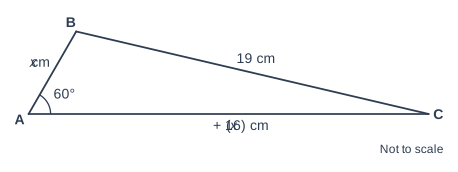
The diagram shows triangle ABC.

AB = \(x\) cm, AC = \((x + 16)\) cm, BC = 19 cm and angle BAC = 60°.

Work out the perimeter of triangle ABC.

Geometry diagram, marked "Not to scale". Triangle ABC. Angle CAB is marked 60°. Side AB is labelled x cm. Side AC is labelled (x + 16) cm. Side BC is labelled 19 cm.

Model answer

\(19^2 = x^2 + (x + 16)^2 - 2 \times x \times (x + 16) \times \cos 60^\circ\)
\(361 = x^2 + x^2 + 32x + 256 - x(x + 16)\)
\(361 = x^2 + 16x + 256\)
\(x^2 + 16x - 105 = 0\)
\((x + 21)(x - 5) = 0\)
\(x = 5\) (a length cannot be negative, so \(x\) is not −21)
The sides are 5 cm, 21 cm and 19 cm.
Perimeter = 5 + 21 + 19 = 45 cm

Explanation

Substitute the algebraic sides into the cosine rule; since cos 60° = ½, the last term is just x(x + 16). Expand and collect terms to get a quadratic, factorise it and reject the negative root. Remember the question asks for the perimeter, not x.

Mark scheme
  1. 1 mark

    M1 for \(19^2 = x^2 + (x + 16)^2 - 2x(x + 16)\cos 60^\circ\) oe

    Correct substitution into the cosine rule; correct answer with no working scores full marks

  2. 1 mark

    M1 for \(361 = x^2 + x^2 + 32x + 256 - x^2 - 16x\) oe

    cos 60° = ½ used and brackets expanded, with at least 3 of the 5 terms correct.

  3. 1 mark

    A1 for \(x^2 + 16x - 105 = 0\) oe

    A correct 3-term quadratic equal to zero.

  4. 1 mark

    M1 for \((x + 21)(x - 5) = 0\) oe

    Or a correct method to solve their 3-term quadratic (formula or completing the square). x = 5 from correct working implies M1.

  5. 1 mark

    A1 for 45

    Accept 45 cm. x = −21 must be rejected (a length cannot be negative). x = 5 given as the answer scores M1 M1 A1 M1 A0. A correct answer not from wrong working scores 5 marks.

Ready to try the rest? Every answer you write is marked against the mark scheme, so you can see exactly where the marks are.

Study Helper Hints first, answers after you try

Stuck on this one? Ask for a hint and I’ll point you in the right direction, without giving the answer away. Once you’ve checked your answer, I’ll show you how the marks are awarded.