
Level:
Correct: 0
Incorrect: 0
Marks: 0/0
Exam Practice
Course:
Topics:
OCR GCSE Maths (Higher non-calculator) Smart practice A mixed round aimed at your weak spots
Unit 1
Number Operations and Integers
Unit 2
Fractions, Decimals and Percentages
Unit 3
Indices and Surds
Unit 4
Approximation and Estimation
Unit 5
Ratio, Proportion and Rates of Change
Unit 6
Algebra
Unit 7
Graphs of Equations and Functions
Unit 8
Basic Geometry
Unit 9
Congruence and Similarity
Unit 10
Mensuration
Unit 11
Probability
Unit 12
Statistics
Avg
score:
–
Topics
done:
0/121

Sample spaces

Practise 17 exam-style questions on Sample spaces for OCR GCSE Maths (Higher non-calculator). Write your answer as you would in the exam and get it marked in seconds against the mark scheme, point by point, with the Study Helper on hand if you get stuck.

  • 17 questions
  • 2–4 marks each
  • Instant marking
  • No sign-up needed
17 questions, marked as you go

Sample questions with model answers

Here are 4 of the questions in this topic, each with a model answer, an explanation of why it earns the marks and the mark scheme an examiner would use.

Question 1

2 marks

Spinner A has four equal sections numbered 1, 2, 3 and 4.
Spinner B has three equal sections numbered 1, 3 and 5.
Both spinners are spun and the two scores are multiplied.

The table shows some of the possible products. The scores on spinner A are across the top and the scores on spinner B are down the side.

Work out the probability that the product is greater than 6.
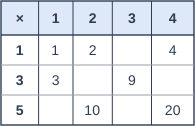
Table with columns "×", "1", "2", "3", "4". ×: 1; 1: 1; 2: 2; 3: (blank); 4: 4 | ×: 3; 1: 3; 2: (blank); 3: 9; 4: (blank) | ×: 5; 1: (blank); 2: 10; 3: (blank); 4: 20.

Model answer

Completed products:
B = 1: 1, 2, 3, 4
B = 3: 3, 6, 9, 12
B = 5: 5, 10, 15, 20
There are 12 equally likely outcomes. Products greater than 6: 9, 10, 12, 15, 20 (5 outcomes).
P(product greater than 6) = \(\dfrac{5}{12}\)

Explanation

Complete the sample space by multiplying each row heading by each column heading. Every cell is equally likely, so the probability is the number of cells greater than 6 divided by 12. Note that 6 itself is not greater than 6.

Mark scheme
  1. 1 mark

    M1 for all 12 products found, or for the five products greater than 6 identified (9, 10, 12, 15, 20)

    The missing products are 3, 6, 12, 5 and 15. Also implied by a fraction with denominator 12 and a numerator from 4 to 6.

  2. 1 mark

    A1 for \(\dfrac{5}{12}\) oe

    Accept 0.416... or 0.42 if from 5/12. Answer only scores 2 marks. 6/12 (including 6 itself) scores M1 A0. Do not accept a ratio or words.

Question 2

2 marks

Two fair six-sided dice are rolled.
The total of the two scores is 8.

Work out the probability that one of the dice shows a 3.

Model answer

We know the total is 8, so only these equally likely outcomes are possible:
(2, 6), (3, 5), (4, 4), (5, 3), (6, 2) - 5 outcomes
One dice shows a 3 in (3, 5) and (5, 3) - 2 outcomes
P = \(\dfrac{2}{5}\)

Explanation

Because the total is known to be 8, the sample space shrinks to the 5 outcomes on the 'total 8' diagonal. Two of these contain a 3. Dividing by 36 is wrong because the outcomes with other totals can no longer happen.

Mark scheme
  1. 1 mark

    M1 for the 5 outcomes with a total of 8 listed or identified: (2, 6), (3, 5), (4, 4), (5, 3), (6, 2)

    Implied by a denominator of 5.

  2. 1 mark

    A1 for \(\dfrac{2}{5}\) oe

    Accept 0.4. Answer only scores 2 marks. 2/36 or 1/18 (the probability of a total of 8 with a 3, out of all outcomes) scores 0. 1/3 (treating (2, 6), (3, 5), (4, 4) as the only outcomes) scores M0 A0.

Question 3

3 marks

Five cards are numbered 1, 2, 3, 4 and 6.

Maria takes two of the cards at random, without replacement.
She multiplies the numbers on the two cards.

Work out the probability that the answer is a multiple of 6.

Model answer

Possible pairs and products:
1 and 2: 2; 1 and 3: 3; 1 and 4: 4; 1 and 6: 6; 2 and 3: 6
2 and 4: 8; 2 and 6: 12; 3 and 4: 12; 3 and 6: 18; 4 and 6: 24
10 equally likely pairs; 6 of them give a multiple of 6.
P(multiple of 6) = \(\dfrac{6}{10} = \dfrac{3}{5}\)

Explanation

Because the cards are not replaced, Maria cannot take the same card twice, so list the 10 different pairs (or the 20 ordered outcomes in a table with the diagonal crossed out). A multiple of 6 needs factors 2 and 3 between the two cards. Using a full 5 by 5 table, which includes taking the same card twice, is the usual mistake.

Mark scheme
  1. 1 mark

    M1 for the 10 pairs of cards listed, or the 20 ordered outcomes, or 10 or 20 seen as the number of outcomes

    Pairs: 1 2, 1 3, 1 4, 1 6, 2 3, 2 4, 2 6, 3 4, 3 6, 4 6. A list including pairs of the same card (e.g. 3 3) scores M0 for this mark.

  2. 1 mark

    M1 for identifying the six pairs giving a multiple of 6: 1 and 6, 2 and 3, 2 and 6, 3 and 4, 3 and 6, 4 and 6

    Products 6, 6, 12, 12, 18, 24. Or 12 ordered outcomes out of 20.

  3. 1 mark

    A1 for \(\dfrac{6}{10}\) oe

    Accept 3/5, 12/20 or 0.6. Answer only scores 3 marks. Answers from a 25-outcome table (with replacement) score at most M0 M1 A0.

Question 4

3 marks

A fair six-sided dice is rolled and a fair spinner is spun.
The spinner has k equal sections numbered 1, 2, 3, ..., k, where k is a whole number from 2 to 6.
The two scores are added.

Show that the probability that the total is 7 is \(\dfrac{1}{6}\) for every possible value of k.

Model answer

The dice has 6 outcomes and the spinner has k, so there are 6k equally likely outcomes.
For any spinner score s (from 1 to k), the dice score needed for a total of 7 is 7 − s.
Since 1 ≤ s ≤ k ≤ 6, 7 − s is between 1 and 6, so it is always a possible dice score.
So each of the k spinner scores gives exactly one outcome with a total of 7: there are k such outcomes.
P(total is 7) = \(\dfrac{k}{6k} = \dfrac{1}{6}\), whatever the value of k.

Explanation

Think of the sample space as k rows (spinner) and 6 columns (dice). Every row contains exactly one cell with a total of 7, because 7 − s is always between 1 and 6, so there are k favourable cells out of 6k. A proof must work for every k: one or two examples are not enough, but checking all five possible values of k is a valid proof by exhaustion.

Mark scheme
  1. 1 mark

    B1 for 6k equally likely outcomes

    Accept 6 × k or a sample space with 6 columns and k rows described in general.

  2. 1 mark

    B1 for showing that each spinner score s gives exactly one dice score, 7 − s, that makes a total of 7, so there are k such outcomes

    Must explain why 7 − s is always a possible dice score (s is from 1 to 6, so 7 − s is from 1 to 6). Checking particular values of k only (e.g. k = 4: 4/24) scores 0 for this mark.

  3. 1 mark

    B1 for \(\dfrac{k}{6k} = \dfrac{1}{6}\) completing a correct general argument

    Needs the previous mark. Checking all five values k = 2, 3, 4, 5, 6 correctly (2/12, 3/18, 4/24, 5/30, 6/36) is a complete proof by exhaustion and scores 3 marks; checking some values only scores 0.

Ready to try the rest? Every answer you write is marked against the mark scheme, so you can see exactly where the marks are.

Study Helper Hints first, answers after you try

Stuck on this one? Ask for a hint and I’ll point you in the right direction, without giving the answer away. Once you’ve checked your answer, I’ll show you how the marks are awarded.