Level:
Correct: 0
Incorrect: 0
Marks: 0/0
Exam Practice
Subject:
Topics:
Edexcel GCSE Maths (Non-calculator) Smart practice A mixed round aimed at your weak spots
Unit 1
Number
Unit 2
Algebra
Unit 3
Ratio, proportion and rates of change
Unit 4
Geometry and measures
Unit 5
Probability
Unit 6
Statistics
Avg
score:
–
Topics
done:
0/97

Translations as vectors

Practise 19 exam-style questions on Translations as vectors for Edexcel GCSE Maths (Non-calculator). Write your answer as you would in the exam and get it marked in seconds against the mark scheme, point by point, with an AI tutor on hand if you get stuck.

  • 19 questions
  • 1–5 marks each
  • Instant marking
  • No sign-up needed
19 questions, marked as you go

Sample questions with model answers

Here are 4 of the questions in this topic, each with a model answer, an explanation of why it earns the marks and the mark scheme an examiner would use.

Question 1

1 mark

Shape A is mapped onto shape B by the translation \(\begin{pmatrix}2\\-5\end{pmatrix}\).

Write down the column vector of the translation that maps shape B onto shape A.

Model answer

\(\begin{pmatrix}-2\\5\end{pmatrix}\)

Explanation

The inverse of a translation moves the same distance in the opposite direction, so both components change sign.

Mark scheme
  1. 1 mark

    B1 for \(\begin{pmatrix}-2\\5\end{pmatrix}\)

    accept (−2, 5) typed as a vector
Question 2

2 marks

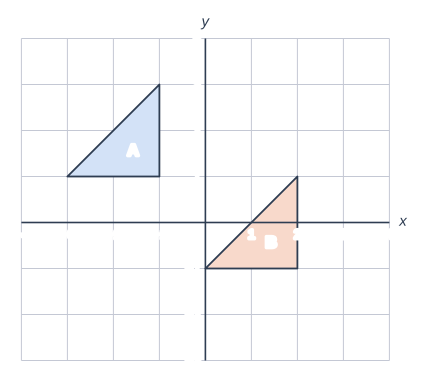
The grid shows triangle A and triangle B.

Kai says, "The translation that maps triangle A onto triangle B is \(\begin{pmatrix}-3\\2\end{pmatrix}\)."

Explain the mistake Kai has made and write down the correct vector.

A coordinate grid with x from −4 to 4 and y from −3 to 4; each grid square is 1 unit across, and the axes cross at the origin O. Shape A is a shaded triangle with vertices (−3, 1), (−1, 1) and (−1, 3). Shape B is a shaded triangle with vertices (0, −1), (2, −1) and (2, 1).

Model answer

Kai's vector maps B onto A, not A onto B: from A to B every vertex moves 3 right and 2 down, so both of his signs are wrong.
The correct vector is \(\begin{pmatrix}3\\-2\end{pmatrix}\).

Explanation

Always measure the movement from the object (A) to the image (B). Moving right is positive in the top number and moving down is negative in the bottom number.

Mark scheme
  1. 1 mark

    C1 for explaining that Kai has given the translation from B to A (the signs are the wrong way round / he has gone in the opposite direction)

    oe

  2. 1 mark

    B1 for \(\begin{pmatrix}3\\-2\end{pmatrix}\)

    accept (3, −2) typed as a vector

Question 3

3 marks

The translation \(\begin{pmatrix}a + 1\\2b\end{pmatrix}\) maps the point (3, 1) onto the point (−1, 7).

Work out the value of \(a\) and the value of \(b\).

Model answer

The vector from (3, 1) to (−1, 7) is \(\begin{pmatrix}-1 - 3\\7 - 1\end{pmatrix} = \begin{pmatrix}-4\\6\end{pmatrix}\)
\(a + 1 = -4\), so \(a = -5\)
\(2b = 6\), so \(b = 3\)

Explanation

Work out the actual translation vector from the two points, then set each component equal to the algebraic component and solve the two separate equations.

Mark scheme
  1. 1 mark

    M1 for the translation vector \(\begin{pmatrix}-4\\6\end{pmatrix}\)

    or \(3 + a + 1 = -1\) or \(1 + 2b = 7\); correct answer with no working scores full marks

  2. 1 mark

    A1 for \(a = -5\)

  3. 1 mark

    A1 for \(b = 3\)

Question 4

4 marks

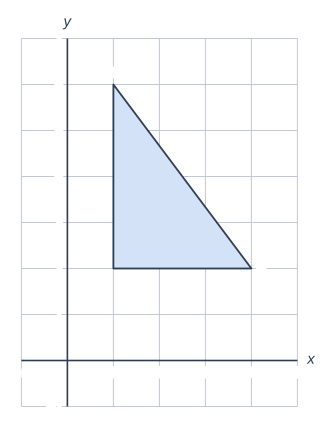
The grid shows triangle ABC.
Triangle ABC is translated by the vector \(\begin{pmatrix}p\\q\end{pmatrix}\) to give triangle A′B′C′.
C′ lies on the \(x\)-axis and A′ lies on the line \(y = x\).

Work out the value of \(p\) and the value of \(q\).

A coordinate grid with x from −1 to 5 and y from −1 to 7; each grid square is 1 unit across, and the axes cross at the origin O. Triangle ABC (shaded) is drawn with vertices A(1, 2), B(4, 2) and C(1, 6).

Model answer

From the grid: A(1, 2), B(4, 2), C(1, 6)
C′ = \((1 + p, 6 + q)\) lies on the \(x\)-axis, so \(6 + q = 0\) and \(q = -6\)
A′ = \((1 + p, 2 + q) = (1 + p, -4)\) lies on \(y = x\), so \(1 + p = -4\) and \(p = -5\)
\(p = -5\), \(q = -6\)

Explanation

Write the image of each vertex in terms of \(p\) and \(q\). A point on the \(x\)-axis has \(y\)-coordinate 0, and a point on \(y = x\) has equal coordinates. Check: A′ = (−4, −4), B′ = (−1, −4) and C′ = (−4, 0).

Mark scheme
  1. 1 mark

    P1 for C′ = \((1 + p, 6 + q)\) or A′ = \((1 + p, 2 + q)\)

    using A(1, 2) and C(1, 6) read from the grid; correct answer with no working scores full marks

  2. 1 mark

    P1 for \(6 + q = 0\), so \(q = -6\)

  3. 1 mark

    P1 for \(1 + p = 2 + q\)

    A′ on \(y = x\); ft their \(q\)

  4. 1 mark

    A1 for \(p = -5\) and \(q = -6\)

Ready to try the rest? Every answer you write is marked against the mark scheme, so you can see exactly where the marks are.

AI Tutor Hints first, answers after you try

Hi! Stuck? Ask me for a hint and I’ll help you work it out. Once you’ve checked your answer I can explain exactly where the marks are.