
Level:
Correct: 0
Incorrect: 0
Marks: 0/0
Exam Practice
Subject:
Topics:
Edexcel GCSE Maths (Non-calculator) Smart practice A mixed round aimed at your weak spots
Unit 1
Number
Unit 2
Algebra
Unit 3
Ratio, proportion and rates of change
Unit 4
Geometry and measures
Unit 5
Probability
Unit 6
Statistics
Avg
score:
–
Topics
done:
0/97

Constructions and loci

Practise 20 exam-style questions on Constructions and loci for Edexcel GCSE Maths (Non-calculator). Write your answer as you would in the exam and get it marked in seconds against the mark scheme, point by point, with an AI tutor on hand if you get stuck.

  • 20 questions
  • 1–5 marks each
  • Instant marking
  • No sign-up needed
20 questions, marked as you go

Sample questions with model answers

Here are 4 of the questions in this topic, each with a model answer, an explanation of why it earns the marks and the mark scheme an examiner would use.

Question 1

2 marks

The diagram is drawn accurately. It shows two points A and B that are 8 cm apart.
The dashed straight line crosses AB at its midpoint, at right angles to AB.
The dashed circle has centre B and radius 5 cm.

The region R, containing the letter R, is the part of the diagram that is inside the circle and on the same side of the dashed line as B.
Describe the region R in terms of distances from the points A and B.
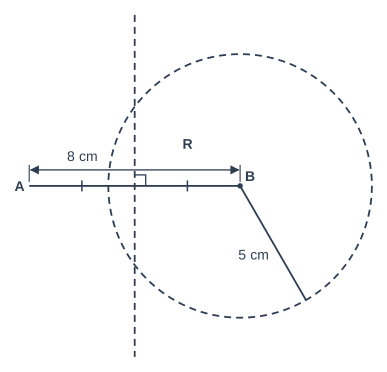
Geometry diagram, drawn accurately to scale. A dashed circle with centre B. Line segment AB is drawn. A dashed vertical straight line is drawn; it crosses AB at right angles at its midpoint. A line is drawn from B going down and to the right. A double-headed dimension arrow alongside AB (the distance from A to B) is labelled 8 cm. The line going down and to the right from B is labelled 5 cm. The angle at the midpoint of AB is marked as a right angle (90°). The text "R" is written inside the circle. The line from A to the midpoint of AB and the line from B to the midpoint of AB are each marked with one short dash (equal lengths).

Model answer

The dashed line is the perpendicular bisector of AB, so R is on the side of points closer to B than to A.
R is inside the circle, so its points are less than 5 cm from B.
R is the set of points that are closer to B than to A and less than 5 cm from B.

Explanation

The perpendicular bisector of AB is the locus of points equidistant from A and B, so it splits the plane into points closer to A and points closer to B. The inside of a circle centred at B is the set of points less than the radius from B. A region is described by giving every condition that defines it.

Mark scheme
  1. 1 mark

    B1 for points that are closer to B than to A

    oe, e.g. 'nearer to B than A'

  2. 1 mark

    B1 for points that are less than 5 cm from B

    oe, e.g. 'within 5 cm of B'; accept 'at most 5 cm'
Question 2

2 marks

To construct the perpendicular bisector of a line segment AB, arcs with the same radius are drawn from A and from B. The arcs cross at the points P and Q, and the line PQ is drawn.

Explain why the line PQ is perpendicular to AB and passes through the midpoint of AB.

Model answer

AP, BP, AQ and BQ are all equal to the radius of the arcs, so APBQ has four equal sides: it is a rhombus.
AB and PQ are the diagonals of the rhombus.
The diagonals of a rhombus bisect each other at right angles.
So PQ crosses AB at its midpoint and is perpendicular to it.

Explanation

Using the same radius from both ends makes all four sides of APBQ equal, and a property of a rhombus is that its diagonals cut each other in half at 90°. This is why the compasses must not be changed between A and B.

Mark scheme
  1. 1 mark

    C1 for AP = BP = AQ = BQ (all equal to the radius), so APBQ is a rhombus

    or a correct start using congruent triangles, e.g. triangles APQ and BPQ are congruent (SSS)

  2. 1 mark

    C1 for the diagonals of a rhombus bisect each other at right angles, so PQ is perpendicular to AB and passes through its midpoint

    or completing a congruence argument

Question 3

3 marks

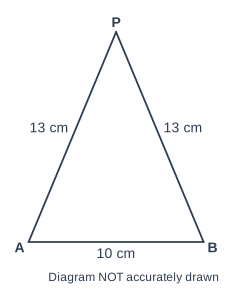
The diagram shows triangle PAB.
PA = PB = 13 cm and AB = 10 cm.

Work out the shortest distance from P to the line AB.

Geometry diagram, marked "Diagram NOT accurately drawn". Triangle PAB. Side AB is labelled 10 cm. Side PA is labelled 13 cm. Side PB is labelled 13 cm.

Model answer

The shortest distance from P to AB is the perpendicular distance.
P is equidistant from A and B, so P lies on the perpendicular bisector of AB: the perpendicular from P meets AB at its midpoint M, with AM = 5 cm.
\(PM^2 = 13^2 - 5^2 = 169 - 25 = 144\)
PM = 12 cm

Explanation

A point that is the same distance from A and B lies on the perpendicular bisector of AB, so the perpendicular from P hits AB exactly halfway along. That gives a right-angled triangle with hypotenuse 13 cm and base 5 cm. The slanted sides PA and PB are not the shortest distance.

Mark scheme
  1. 1 mark

    P1 for recognising that the perpendicular from P meets AB at its midpoint, so it splits AB into 5 cm and 5 cm

    may be shown on the diagram; correct answer with no working scores full marks

  2. 1 mark

    M1 for \(13^2 - 5^2\) (= 144)

  3. 1 mark

    A1 for 12 cm

    cao

Question 4

4 marks

P is the point (1, 7).
The line L has equation \(y = x + 2\).

Work out the shortest distance from P to the line L.
Give your answer in the form \(a\sqrt{2}\), where a is an integer.

Model answer

The shortest distance is along the perpendicular from P to L.
Gradient of L = 1, so the perpendicular has gradient −1.
Perpendicular through (1, 7): \(y = -x + 8\)
Meets L when \(x + 2 = -x + 8\), so \(x = 3\), \(y = 5\): the point (3, 5).
Distance \(= \sqrt{(3 - 1)^2 + (5 - 7)^2} = \sqrt{8} = 2\sqrt{2}\)

Explanation

The shortest distance from a point to a line is the perpendicular distance. Find the foot of the perpendicular by solving the two line equations simultaneously, then use Pythagoras. Simplify the surd: √8 = √4 × √2 = 2√2.

Mark scheme
  1. 1 mark

    P1 for the gradient of the perpendicular to L, −1

    correct answer with no working scores full marks

  2. 1 mark

    P1 for the equation of the perpendicular through P, \(y = -x + 8\)

    oe

  3. 1 mark

    P1 for the point where the perpendicular meets L, (3, 5)

  4. 1 mark

    A1 for \(2\sqrt{2}\)

    accept \(\sqrt{8}\) for P1 P1 P1 A0

Ready to try the rest? Every answer you write is marked against the mark scheme, so you can see exactly where the marks are.

AI Tutor Hints first, answers after you try

Hi! Stuck? Ask me for a hint and I’ll help you work it out. Once you’ve checked your answer I can explain exactly where the marks are.