Practise 28 exam-style questions on Ratio notation and simplifying ratios for Edexcel GCSE Maths (Non-calculator). Write your answer as you would in the exam and get it marked in seconds against the mark scheme, point by point, with an AI tutor on hand if you get stuck.
28 questions
1–5 marks each
Instant marking
No sign-up needed
20 questions, marked as you go
Sample questions with model answers
Here are 4 of the questions in this topic, each with a model answer, an explanation of why it earns the marks and the mark scheme an examiner would use.
Question 1
2 marks
Write the ratio 2.5 : 4 in its simplest form.
Model answer
Multiply both parts by 2: 2.5 : 4 = 5 : 8 5 and 8 have no common factor, so 5 : 8 is the simplest form.
Explanation
The simplest form of a ratio uses whole numbers with no common factor. Multiply both parts by the same number to remove the decimal, then check whether the result can be simplified further.
Mark scheme
1 mark
M1 for multiplying both parts to give whole numbers, e.g. 25 : 40 or 5 : 8
correct answer with no working scores full marks
1 mark
A1 for 5 : 8
cao
Question 2
2 marks
Write the ratio 0.4 : 1.25 : 2 in its simplest form.
Model answer
Multiply every part by 100: 40 : 125 : 200 Divide every part by 5: 8 : 25 : 40
Explanation
Multiply by a power of 10 that makes every part a whole number (100 here, because of 1.25), then divide by the highest common factor of all three parts.
Mark scheme
1 mark
M1 for multiplying all three parts to give whole numbers, e.g. 40 : 125 : 200
correct answer with no working scores full marks
1 mark
A1 for 8 : 25 : 40
cao
Question 3
3 marks
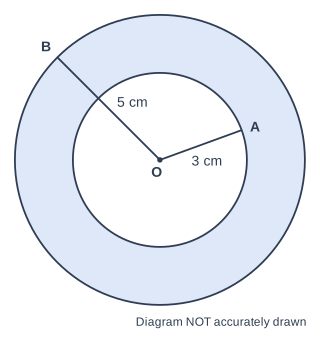
The diagram shows two circles with the same centre O. The small circle has radius 3 cm. The large circle has radius 5 cm. The region between the two circles is shaded.
Find the ratio area of the small circle : area of the shaded region. Give your answer in its simplest form.
Model answer
Area of small circle \(= \pi \times 3^2 = 9\pi\) cm² Area of large circle \(= \pi \times 5^2 = 25\pi\) cm² Shaded area \(= 25\pi - 9\pi = 16\pi\) cm² \(9\pi : 16\pi = 9 : 16\)
Explanation
Leave the areas in terms of \(\pi\): it is a common factor of both parts and cancels. The shaded region is the large circle minus the small circle. A common mistake is to compare the radii, 3 : 2, instead of the areas.
Mark scheme
1 mark
M1 for the areas of the circles, \(9\pi\) and \(25\pi\)
correct answer with no working scores full marks
1 mark
M1 for the shaded area, \(25\pi - 9\pi = 16\pi\)
1 mark
A1 for 9 : 16
cao
Question 4
4 marks
The lengths of the sides of a triangle are in the ratio 3 : 4 : 5. The perimeter of the triangle is 36 cm. A square has the same perimeter as the triangle.
Find the ratio area of the triangle : area of the square. Give your answer in its simplest form.
Model answer
One part = 36 ÷ 12 = 3 cm Sides: 9 cm, 12 cm, 15 cm \(9^2 + 12^2 = 81 + 144 = 225 = 15^2\), so the triangle is right-angled. Area of triangle \(= \dfrac{1}{2} \times 9 \times 12 = 54\) cm² Side of square = 36 ÷ 4 = 9 cm; area = 81 cm² 54 : 81 = 2 : 3
Explanation
Share the perimeter in the ratio 3 : 4 : 5 to find the sides. A 3 : 4 : 5 triangle is right-angled (by Pythagoras), so the two shorter sides are the base and height. Simplify 54 : 81 by dividing by 27.
Mark scheme
1 mark
P1 for the sides of the triangle, 9 cm, 12 cm and 15 cm
1 mark
P1 for the area of the triangle, \(\dfrac{1}{2} \times 9 \times 12 = 54\) cm², using the right angle between the 9 cm and 12 cm sides
the right angle may be implied by using 9 and 12 as base and height
1 mark
P1 for the area of the square, \(9^2 = 81\) cm²
1 mark
A1 for 2 : 3
cao
Ready to try the rest? Every answer you write is marked against the mark scheme, so you can see exactly where the marks are.
Ctrl + Enter to check
AI TutorHints first, answers after you try
Hi! Stuck? Ask me for a hint and I’ll help you work it out. Once you’ve checked your answer I can explain exactly where the marks are.