Level:
Correct: 0
Incorrect: 0
Marks: 0/0
Exam Practice
Subject:
Topics:
Edexcel GCSE Maths (Non-calculator) Smart practice A mixed round aimed at your weak spots
Unit 1
Number
Unit 2
Algebra
Unit 3
Ratio, proportion and rates of change
Unit 4
Geometry and measures
Unit 5
Probability
Unit 6
Statistics
Avg
score:
–
Topics
done:
0/97

Geometric reasoning and proof

Practise 28 exam-style questions on Geometric reasoning and proof for Edexcel GCSE Maths (Non-calculator). Write your answer as you would in the exam and get it marked in seconds against the mark scheme, point by point, with an AI tutor on hand if you get stuck.

  • 28 questions
  • 1–5 marks each
  • Instant marking
  • No sign-up needed
20 questions, marked as you go

Sample questions with model answers

Here are 4 of the questions in this topic, each with a model answer, an explanation of why it earns the marks and the mark scheme an examiner would use.

Question 1

2 marks

A triangle has sides of length 6 cm, 9 cm and 11 cm.

Is the triangle right-angled? You must show how you get your answer.

Model answer

\(6^2 + 9^2 = 36 + 81 = 117\)
\(11^2 = 121\)
117 ≠ 121, so the sides do not satisfy Pythagoras' theorem.
No, the triangle is not right-angled.

Explanation

Test the longest side against the other two. Only a right-angled triangle has (longest side)² equal to the sum of the squares of the other sides. Here 121 is bigger than 117, so the largest angle is slightly more than 90°.

Mark scheme
  1. 1 mark

    M1 for \(6^2 + 9^2\) (= 117) and \(11^2\) (= 121)

  2. 1 mark

    C1 for No, because 117 ≠ 121

Question 2

3 marks

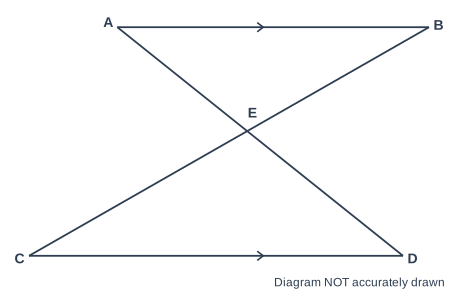
In the diagram, AB is parallel to CD.
The straight lines AD and BC cross at E.

Prove that triangles ABE and DCE are similar.

Geometry diagram, marked "Diagram NOT accurately drawn". Line segments AB, AD, BC and CD are drawn. E lies on AD and BC. AB and CD are each marked with an arrowhead (parallel lines).

Model answer

Angle BAE = angle CDE (alternate angles are equal, since AB is parallel to CD)
Angle ABE = angle DCE (alternate angles are equal)
Angle AEB = angle DEC (vertically opposite angles are equal)
The three angles of triangle ABE are equal to the three angles of triangle DCE, so the triangles are similar.

Explanation

Triangles are similar if their angles are equal (two pairs are enough, because the third pair then follows). The parallel lines give alternate angles and the crossing lines give vertically opposite angles. Note the correspondence: A matches D and B matches C.

Mark scheme
  1. 1 mark

    M1 for angle BAE = angle CDE (alternate angles are equal)

  2. 1 mark

    M1 for angle ABE = angle DCE (alternate angles are equal) or angle AEB = angle DEC (vertically opposite angles are equal)

  3. 1 mark

    C1 for all three angles are equal (the third pair also equal), so the triangles are similar

    reasons must be given

Question 3

3 marks

A is the point (1, 1), B is the point (5, 3) and C is the point (3, 7).

Prove that triangle ABC is a right-angled isosceles triangle.

Model answer

\(AB^2 = (5 - 1)^2 + (3 - 1)^2 = 16 + 4 = 20\)
\(BC^2 = (3 - 5)^2 + (7 - 3)^2 = 4 + 16 = 20\)
\(AC^2 = (3 - 1)^2 + (7 - 1)^2 = 4 + 36 = 40\)
AB = BC, so triangle ABC is isosceles.
\(AB^2 + BC^2 = 40 = AC^2\), so by the converse of Pythagoras' theorem angle ABC = 90°.
Triangle ABC is right-angled and isosceles.

Explanation

Work with squared lengths to avoid surds. Two equal sides show it is isosceles, and the squares satisfying Pythagoras' theorem show there is a right angle, opposite the longest side AC.

Mark scheme
  1. 1 mark

    M1 for finding the squares of the lengths, \(AB^2 = 20\), \(BC^2 = 20\), \(AC^2 = 40\)

    or gradients of AB and BC, \(\frac{1}{2}\) and −2

  2. 1 mark

    C1 for AB = BC, so the triangle is isosceles

  3. 1 mark

    C1 for \(AB^2 + BC^2 = 20 + 20 = 40 = AC^2\), so angle ABC = 90° (converse of Pythagoras)

    or the gradients multiply to −1, so AB is perpendicular to BC

Question 4

4 marks

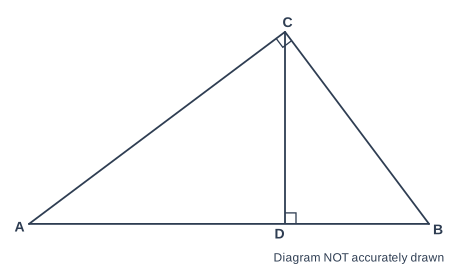
The diagram shows a right-angled triangle ABC with the right angle at C.
D is the point on AB such that CD is perpendicular to AB.

Prove that triangles ADC and ACB are similar.
Hence prove that \(AC^2 = AD \times AB\).

Geometry diagram, marked "Diagram NOT accurately drawn". Triangle ABC. Line segment CD is drawn. D lies on side AB. Angle ACB is marked as a right angle (90°). Angle CDB is marked as a right angle (90°).

Model answer

In triangles ADC and ACB:
angle DAC = angle CAB (common angle at A)
angle ADC = angle ACB = 90°
So the third angles ACD and ABC are also equal, and the triangles are similar.
Corresponding sides: AD in ADC matches AC in ACB, and AC in ADC matches AB in ACB.
\(\dfrac{AD}{AC} = \dfrac{AC}{AB}\)
\(AC^2 = AD \times AB\)

Explanation

Both triangles contain angle A and a right angle, so they are similar. Write the vertices in matching order (A to A, D to C, C to B) so the ratios pair the right sides. Adding the matching result for BC² gives AC² + BC² = AB², another proof of Pythagoras' theorem.

Mark scheme
  1. 1 mark

    M1 for angle DAC = angle CAB (common angle)

  2. 1 mark

    M1 for angle ADC = angle ACB = 90°

  3. 1 mark

    C1 for triangles ADC and ACB are similar (the third angles are also equal)

  4. 1 mark

    C1 for \(\dfrac{AD}{AC} = \dfrac{AC}{AB}\), so \(AC^2 = AD \times AB\)

    correct corresponding sides needed

Ready to try the rest? Every answer you write is marked against the mark scheme, so you can see exactly where the marks are.

AI Tutor Hints first, answers after you try

Hi! Stuck? Ask me for a hint and I’ll help you work it out. Once you’ve checked your answer I can explain exactly where the marks are.