Practise 38 exam-style questions on Angles, parallel lines and polygons for Edexcel GCSE Maths (Non-calculator). Write your answer as you would in the exam and get it marked in seconds against the mark scheme, point by point, with an AI tutor on hand if you get stuck.
38 questions
1–5 marks each
Instant marking
No sign-up needed
20 questions, marked as you go
Sample questions with model answers
Here are 4 of the questions in this topic, each with a model answer, an explanation of why it earns the marks and the mark scheme an examiner would use.
Question 1
2 marks
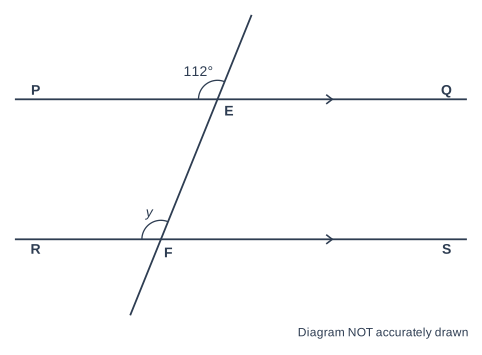
The diagram shows two parallel lines, PQ and RS, crossed by a straight line at E and F.
Write down the size of the angle marked y. Give a reason for your answer.
Model answer
y = 112° Corresponding angles are equal.
Explanation
The angle at E and angle y are in the same position at each crossing point (above the parallel line and to the left of the crossing line), so they are corresponding angles, which are equal.
Mark scheme
1 mark
B1 for 112°
1 mark
C1 for corresponding angles are equal
must use the word 'corresponding'; do not accept 'F angles'
Question 2
2 marks
Explain why the exterior angles of any convex polygon with n sides add up to 360°. You may use the fact that the interior angles add up to \(180(n - 2)\) degrees.
Model answer
At each vertex the interior and exterior angles lie on a straight line, so they add up to 180°. There are n vertices, so all the interior and exterior angles add up to 180n degrees. Sum of exterior angles = \(180n - 180(n - 2) = 180n - 180n + 360 = 360^\circ\)
Explanation
Combine the straight-line fact at each vertex with the interior angle sum. The n terms cancel, which shows the answer does not depend on the number of sides. Another way to see it: walking once round the polygon, you turn through the exterior angles and end up facing the way you started, one full turn of 360°.
Mark scheme
1 mark
C1 for at each vertex interior angle + exterior angle = 180°, so all interior and exterior angles together add up to 180n
accept a correct explanation about turning through one full turn when walking round the polygon
Question 3
3 marks
An isosceles triangle has one angle of 40°.
Work out the two possible pairs of sizes for the other two angles.
Model answer
Case 1: 40° is the angle between the equal sides. Other two angles = (180 − 40) ÷ 2 = 70° and 70° Case 2: 40° is one of the two equal base angles. Other two angles = 40° and 180 − 40 − 40 = 100°
Explanation
An isosceles triangle has two equal angles, but the 40° could be either the odd angle or one of the equal pair. Considering both cases gives two different triangles. Many students find only one case.
Mark scheme
1 mark
M1 for a correct method for one case, e.g. (180 − 40) ÷ 2 or 180 − 40 − 40
correct answer with no working scores full marks
1 mark
A1 for 70° and 70°
1 mark
A1 for 40° and 100°
Question 4
4 marks
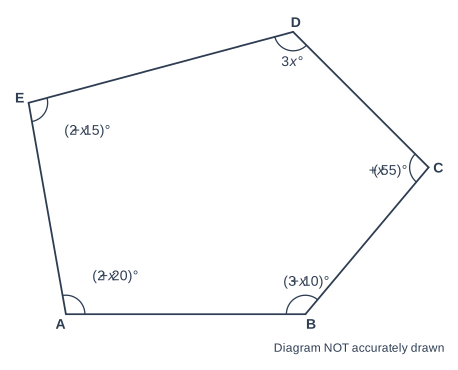
The diagram shows a pentagon ABCDE. The sizes of its angles are given in terms of x.
Work out the size of the largest angle of the pentagon.
Form an equation using the angle sum of a pentagon, 540°, and solve for x. The question asks for the largest angle, so substitute x = 40 into every expression and compare; finding x alone does not answer the question. Check that the five angles add up to 540°.
Mark scheme
1 mark
M1 for the sum of the interior angles of a pentagon, (5 − 2) × 180 = 540
correct answer with no working scores full marks
1 mark
M1 for \(11x + 100 = 540\)
oe, ft their angle sum
1 mark
A1 for \(x = 40\)
1 mark
A1 for 130°
cao
Ready to try the rest? Every answer you write is marked against the mark scheme, so you can see exactly where the marks are.
Ctrl + Enter to check
AI TutorHints first, answers after you try
Hi! Stuck? Ask me for a hint and I’ll help you work it out. Once you’ve checked your answer I can explain exactly where the marks are.