Practise 28 exam-style questions on Transformations for Edexcel GCSE Maths (Non-calculator). Write your answer as you would in the exam and get it marked in seconds against the mark scheme, point by point, with an AI tutor on hand if you get stuck.
28 questions
1–5 marks each
Instant marking
No sign-up needed
20 questions, marked as you go
Sample questions with model answers
Here are 4 of the questions in this topic, each with a model answer, an explanation of why it earns the marks and the mark scheme an examiner would use.
Question 1
2 marks
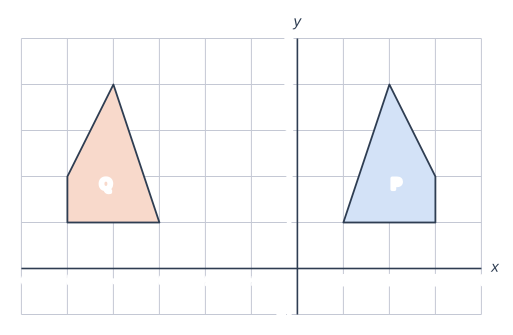
The grid below shows shape P and shape Q.
Describe fully the single transformation that maps shape P onto shape Q.
Model answer
Reflection in the line \(x = -1\)
Explanation
Q is a mirror image of P, so the transformation is a reflection. Corresponding points such as (1, 1) and (−3, 1) are the same distance either side of the mirror line, so it lies halfway between them, at x = −1. A full description must give the equation of the mirror line.
Mark scheme
1 mark
B1 for reflection
1 mark
B1 for in the line \(x = -1\)
B0 for any second transformation
Question 2
2 marks
A shape is rotated through 180°. The point (1, 2) on the shape maps to the point (5, 6).
Find the coordinates of the centre of rotation.
Model answer
For a half turn, the centre is the midpoint of each point and its image. Centre = \(\left(\dfrac{1 + 5}{2}, \dfrac{2 + 6}{2}\right) = (3, 4)\)
Explanation
A rotation of 180° sends each point straight through the centre to the same distance on the other side. So the centre is exactly halfway between a point and its image.
Mark scheme
1 mark
M1 for finding the midpoint of (1, 2) and (5, 6)
correct answer with no working scores full marks
1 mark
A1 for (3, 4)
cao
Question 3
3 marks
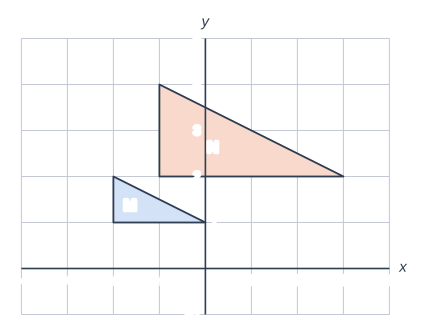
The diagram shows triangles M and N on a grid.
Describe fully the single transformation that maps triangle M onto triangle N.
Model answer
Enlargement, scale factor 2, centre (−3, 0)
Explanation
The sides of N are twice as long as those of M and face the same way, so it is an enlargement with scale factor 2. Draw lines through corresponding vertices, e.g. (0, 1) to (3, 2) and (−2, 1) to (−1, 2); they meet at the centre, (−3, 0).
Mark scheme
1 mark
B1 for enlargement
1 mark
B1 for scale factor 2
1 mark
B1 for centre (−3, 0)
B0 overall for any second transformation
Question 4
3 marks
A shape is enlarged by scale factor −2, with centre (2, 3). The image of the point P is the point (−4, 7).
Find the coordinates of P.
Model answer
From the centre (2, 3) to the image (−4, 7): \(\begin{pmatrix}-6\\4\end{pmatrix}\) This is −2 times the vector from the centre to P, so the vector to P is \(\begin{pmatrix}-6\\4\end{pmatrix} \div (-2) = \begin{pmatrix}3\\-2\end{pmatrix}\) P = (2 + 3, 3 − 2) = (5, 1)
Explanation
Work backwards: the image vector from the centre is the object vector multiplied by −2, so divide by −2 to undo it. Check: from (2, 3) to (5, 1) is (3, −2); times −2 gives (−6, 4), which reaches (−4, 7).
Mark scheme
1 mark
M1 for the vector from the centre to the image, \(\begin{pmatrix}-6\\4\end{pmatrix}\)
correct answer with no working scores full marks
1 mark
M1 for dividing by −2, giving \(\begin{pmatrix}3\\-2\end{pmatrix}\)
1 mark
A1 for (5, 1)
cao
Ready to try the rest? Every answer you write is marked against the mark scheme, so you can see exactly where the marks are.
Ctrl + Enter to check
AI TutorHints first, answers after you try
Hi! Stuck? Ask me for a hint and I’ll help you work it out. Once you’ve checked your answer I can explain exactly where the marks are.